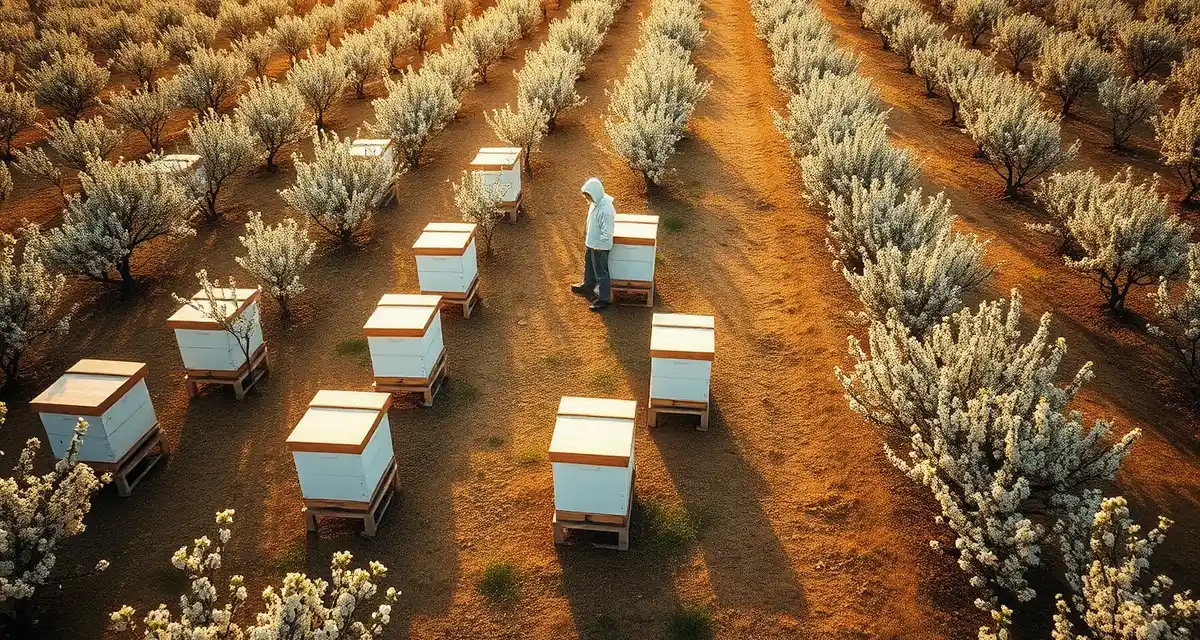
Almond Orchard Hive Placement: Best Practices for Maximum Pollination
Optimal hive placement increases almond nut set by 15 to 25% compared to suboptimal placement. That's not a marginal difference. It's the kind of improvement that changes a grower's season and determines whether they call you back next year.
The California Almond Board recommends every hive within 150 feet of the nearest almond row. Most beekeepers hit this metric at the edges of orchards. The difference between adequate placement and optimal placement comes down to understanding how bee foraging behavior interacts with orchard geometry, and documenting placement well enough that growers trust what you tell them.
No competitor integrates GPS placement coordinates with contract delivery records. This is a real documentation gap that creates both operational inefficiency and grower relationship risk.
TL;DR
- California almond pollination consumes roughly 80% of the US commercial hive population every February, making it the most supply-constrained pollination market in the country.
- Per-hive rates have held between $185 and $220 for 6-8 frame colonies over recent seasons.
- Contracts are typically signed October through November for the following February season; operators without agreements by December are working from a weak position.
- Hive strength minimums range from 6 to 8 frames of bees depending on the grower, with premium-strength colonies commanding $200-215/hive.
- varroa management, documentation, and logistics coordination in the 6-8 weeks before delivery determine whether almond season is profitable or a breakeven event.
Understanding Bee Foraging and Orchard Coverage
Before getting into specific placement protocols, it helps to understand why placement location matters.
Honey bees don't distribute evenly across an orchard. They concentrate near their hive cluster, with foraging activity dropping off with distance. The relationship isn't linear. Foraging density falls off more steeply beyond about 300 to 400 feet from the hive.
In a large almond orchard, hives placed exclusively on one side leave the far end of the orchard with much reduced pollination coverage. Uniform coverage (hives distributed throughout the orchard rather than concentrated at edges) delivers notably better nut set across the whole acreage.
What Placement Density Do Almond Growers Require?
The standard recommendation for California almond pollination is 2 to 3 hives per acre of almond acreage, with most commercial contracts specifying 2 hives per acre as the baseline.
Some growers with older, lower-density plantings or good natural habitat nearby use lower densities. Others with high-value, newer plantings or late bloom timing (higher cross-pollination dependency) use 3 hives per acre or more.
Know your specific contract requirements before placement. The per-acre density is often a negotiated contract term, not a universal standard.
How Should Hives Be Positioned in Almond Orchards?
The Almond Board's 150-foot recommendation is the starting point, not the finish line.
Distributing Hives Across the Orchard
Rather than placing all hives at orchard edges, distribute pallets throughout the orchard:
Edge placement alone: Hives on the orchard perimeter cover the outer rows well. Coverage falls off in the interior of a large orchard. For orchards under 20 acres, edge placement may provide adequate coverage. For larger orchards, interior distribution is needed.
Interior placement: Pallets placed at interior locations (typically accessible through orchard roads) extend effective coverage throughout the orchard. Foraging density is higher where bees can reach within their most active foraging range.
Cluster placement: Grouping hives in clusters of 4 to 8 per pallet location at multiple interior and edge locations provides better overall coverage than either all-edge or evenly distributed single-hive placement.
Practical Orchard Layout
Work with each grower to understand their orchard geometry and road access before delivery. Key questions:
- What's the orchard size (acres)?
- Are there interior roads or access lanes for placing hives in the middle of the orchard?
- Are there areas of poorer bloom history where extra coverage would help?
- What other orchards border theirs? (Adjacent orchards may share bee population and reduce your coverage obligation at shared borders)
Hive Orientation
Orient hive entrances:
- Facing south or southeast when possible (morning sun on the entrance stimulates early foraging)
- Away from prevailing winds (reduces draft stress on the colony)
- Not directly facing each other (reduces drift and fighting at entrances when multiple pallets are close)
This isn't about perfection. In a large yard with multiple pallets, you can't always orient every hive optimally. But the general principles apply where they're logistically achievable.
How Do You Document Hive Placement for Grower Records?
Documentation of hive placement serves two purposes: compliance record and dispute protection.
Why Documentation Matters
Growers increasingly want evidence that hives were placed where contracted. A grower who paid for 200 hives across a 100-acre orchard wants to know those hives were actually distributed across their property, not stacked at the gate.
In the rare case of a dispute about coverage quality or hive count, placement documentation is your evidence. A GPS record of where each pallet was placed on what date is objective, timestamped, and difficult to dispute.
GPS Placement Recording
The most defensible placement documentation is GPS coordinates for each pallet location, recorded at time of placement. This creates a verifiable record that shows:
- Where each pallet was placed
- When placement happened
- How many hives were at each location
Some operations use simple smartphone GPS apps to record each pallet location during delivery. The coordinates get logged into a field record that becomes part of the contract documentation file.
More sophisticated approaches integrate GPS placement coordinates directly with contract delivery records, so that when you generate your delivery confirmation for the grower, it includes a map showing pallet locations alongside the hive count and strength assessment.
Photographic Documentation
Photographs at each placement location add a visual layer to the GPS record. Photos should show:
- The pallet with hives in place
- The surrounding orchard context (so the location is visually identifiable)
- The date stamp (if your camera doesn't auto-embed this, write the date in the photo caption)
For large placements across multiple orchard locations, systematic photography takes 15 to 30 minutes but creates a record that prevents disputes.
Delivery Confirmation Documents
After placement, provide the grower with a placement summary document:
- Total hives delivered
- Number and location of each pallet group
- Strength assessment summary
- Date and time of placement
Growers who receive professional placement documentation are more likely to renew contracts. It demonstrates operational sophistication and gives them a filing record they can reference when evaluating their pollination program.
Colony Strength and Its Effect on Effective Coverage
A hive's foraging coverage area is directly related to its population. A strong colony with 8 to 10 frames of bees forages a much larger area and at higher density than a 4-frame colony. The same 200 hives at 8 frames of bees each covers more orchard area than 200 hives at 4 frames.
This is why growers specify minimum strength requirements. And it's why documentation of strength at delivery matters as much as hive count.
Strength Assessment at Delivery
For large placements, assessing every colony at delivery isn't practical. Standard commercial practice is to assess a representative sample (typically 10 to 20% of colonies) and document the sample assessment.
The sample should be random across your yard locations, not cherry-picked from your strongest pallets. The resulting strength documentation represents your delivered colony population.
For contracts with strict minimum strength requirements, a more systematic assessment may be warranted. If your contract specifies 8 frames minimum and you're delivering colonies that average 7.5 frames, you need to know that before delivery, not after a grower complaint.
Common Placement Mistakes
All-edge placement on large orchards. Colonies at the perimeter of a 200-acre orchard cannot cover the interior adequately. Interior placement access should be part of your pre-placement site assessment.
Placing hives in low spots. Cold air drainage settles in low areas in spring nights, which can chill clusters more than necessary. Avoid placing hives in obvious drainage basins when alternatives exist.
Ignoring windbreaks. Placing hives directly in wind corridors between windbreaks can stress colonies and reduce foraging on cold days. Position hives where natural windbreaks provide some protection.
Not communicating with the grower about access. Some internal orchard roads are too narrow for your truck, or are temporarily blocked by irrigation equipment. Verify access before arrival to avoid delivery delays.
Skipping documentation. This is the most common mistake. Everything else on this list costs you pollination efficiency. Missing documentation costs you grower relationships and exposes you to disputes.
FAQ
How should hives be positioned in almond orchards?
Distribute hives throughout the orchard rather than concentrating them at edges. The California Almond Board recommends every hive within 150 feet of the nearest almond row, which typically requires interior placement on orchards larger than 20 acres. Orient entrances south or southeast when possible, away from prevailing winds, and not directly facing adjacent hive clusters. Work with growers on specific placement logistics, including which internal roads can support your truck.
What placement density do almond growers require?
Most California almond pollination contracts specify 2 hives per acre as the standard density. Some growers with high-density plantings or specific cross-pollination requirements use 3 hives per acre. Lower-density contracts (1.5 hives per acre) occur with some older, lower-value orchards. Know your specific contract density requirements before delivery and confirm with the grower whether they want distribution throughout the orchard or have specific placement preferences for particular sections.
How do you document hive placement for grower records?
Record GPS coordinates for each pallet location at time of placement. Take photographs of each pallet in context showing the surrounding orchard. Assess a representative sample of colonies for strength at delivery. After placement, provide the grower with a placement summary showing total hives, pallet locations, strength assessment results, and delivery date and time. Connecting GPS placement coordinates directly with your delivery documentation creates a timestamped, objective record that protects both you and the grower and reduces the risk of post-delivery disputes.
How early should almond pollination contracts be negotiated?
Large almond growers and broker networks begin securing hive commitments in July and August for the following February season. Written contracts are typically signed October through November. Operators who do not have signed agreements by December are working from a weak position since most quality hive inventory is already committed. Start grower outreach in mid-summer and target signed agreements before Thanksgiving.
What documentation is required for hive delivery to California almonds?
California requires a Certificate of Health for out-of-state colonies, issued by the origin state's apiary inspection program within 30 days of entry. The certificate must certify freedom from American foulbrood, European foulbrood, and Varroa destructor below treatment threshold. Some states require small hive beetle freedom for California entry. In addition, many growers now expect documentation of pre-delivery mite counts confirming colonies are below threshold.
What happens to hives after almond season ends in late March?
Post-almond options include moving north for Pacific Northwest cherry or apple pollination in April-May, routing to Michigan or Maine blueberries in May-July, transitioning to summer honey yards in North Dakota or Montana, or staying in California for splits and rebuilding. The right choice depends on hive strength coming out of almonds and downstream contract commitments. Operators who plan their full-year circuit in advance can optimize both pollination revenue and honey production.
Try These Free Tools
Sources
- USDA Agricultural Research Service
- Bee Informed Partnership
- American Beekeeping Federation (ABF)
- Almond Board of California
- University of California Cooperative Extension
Get Started with PollenOps
Almond season is the revenue event that defines the commercial beekeeping year, and the details -- contract terms, delivery timing, hive strength documentation, and invoicing -- determine whether the season is profitable. PollenOps manages the full almond contract lifecycle from quote to final payment, with yard tracking, crew scheduling, and grower communication built in. See how it works for operations from 200 to 5,000 hives.