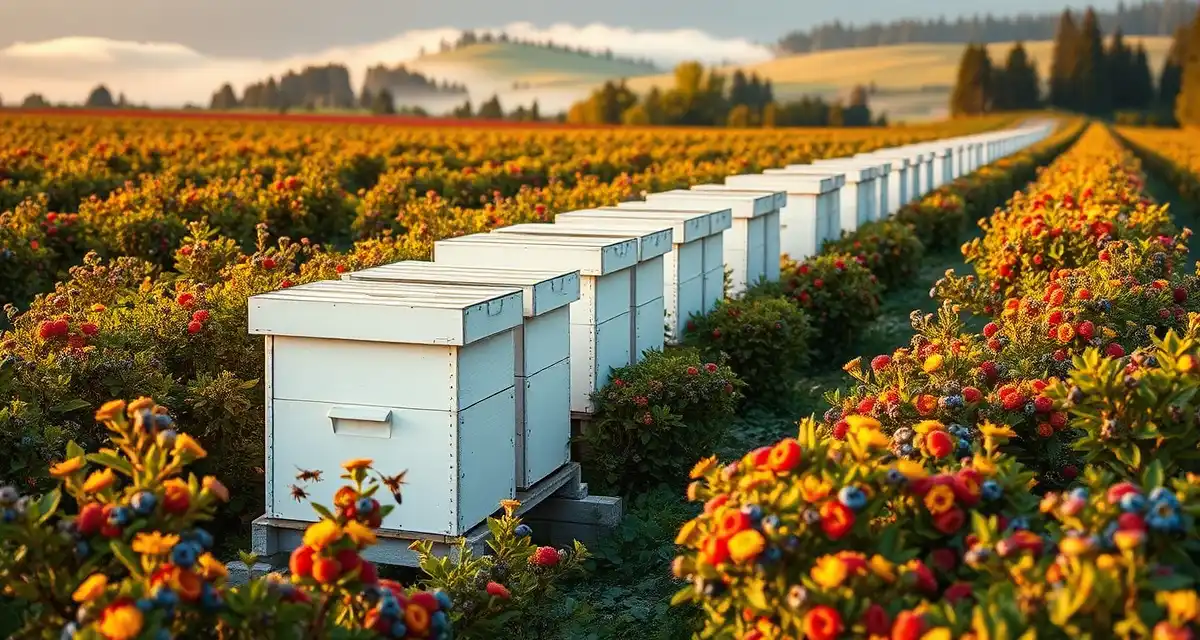
Berry Pollination Management in the Pacific Northwest
Pacific Northwest berry growers spend over $80 million annually on commercial pollination services. Oregon and Washington's berry industries, centered in the Willamette Valley and western Washington lowlands, represent a substantial pollination market that naturally follows cherry and apple season in the PNW pollination cascade.
Coastal vs valley microclimate adjustment improves bloom alert accuracy by an estimated 3-4 days in the PNW. For a crop with a bloom window as short as highbush blueberry, 3-4 days is the difference between placing bees at the right time and arriving after peak receptivity.
TL;DR
- Pacific Northwest berry crops (strawberries, raspberries, blackberries) create a summer pollination opportunity that follows tree fruit season.
- Berry pollination rates typically run $60-100 per hive depending on crop and location.
- Multiple berry crops can be sequenced across a Pacific Northwest summer circuit to maximize placement revenue.
- Hive strength requirements vary by crop: strawberries typically require 5-6 frames, caneberries 6-8 frames.
- Berry season's timing after tree fruit season makes it a natural continuation for migratory operators already positioned in the Pacific Northwest.
PNW Berry Crops and Their Pollination Needs
Highbush blueberries: The primary commercial berry pollination crop in both Oregon and Washington. Oregon's Willamette Valley blueberry industry is centered in Marion, Polk, Yamhill, and Benton counties. Washington's blueberry production is concentrated in the Skagit Valley and other western lowlands.
Strawberries: Oregon is one of the largest strawberry-producing states for the fresh market and processing. The Willamette Valley's strawberry industry benefits from commercial pollination for improved fruit size and uniformity. bloom timing runs late April through May.
Red raspberries: Oregon and Washington produce most of the US commercial red raspberry crop, primarily for the processing market (frozen and juiced). Raspberry is largely self-fertile but benefits from bee pollination for improved set. Bloom timing runs late May through June.
Marionberries: Oregon's iconic blackberry hybrid, the marionberry, is grown almost exclusively in the Willamette Valley. It blooms in late May through June and requires cross-pollination to set fruit effectively.
Boysenberries and loganberries: Similar to marionberry in bloom timing and pollination needs.
Cranberries: Oregon produces commercial cranberries primarily in Coos County on the south coast. Bloom timing runs July, later than most PNW berry crops.
When Does Blueberry Bloom in the Willamette Valley vs the Coast?
This is the microclimate question that drives PNW blueberry alert calibration.
Willamette Valley (Marion, Polk counties): Main season highbush blueberry bloom typically starts in late April and runs through May. The valley's protected climate warms faster in spring than coastal areas.
Oregon coast (Lincoln, Tillamook counties): Coastal marine influence delays bloom by 7-14 days compared to the Willamette Valley. Early varieties that bloom in late April in the valley may not bloom until mid-May on the coast.
Washington Skagit Valley: Similar to coastal Oregon, the Skagit Valley's proximity to Puget Sound creates a cooler spring that delays bloom compared to Oregon's Willamette Valley. Main season bloom in Skagit typically runs May into early June.
PollenOps provides separate bloom timing estimates for coastal vs valley sites, because applying a single "Willamette Valley" forecast to a coastal site would generate bloom alert timing that's 7-14 days off.
How Many Hives Per Acre Do Oregon Blueberry Growers Require?
Oregon highbush blueberry growers typically require:
- Standard commercial requirement: 2-3 hives per acre
- Large-scale commercial operations: 3 hives per acre as a default
- High-density plantings: Up to 4 hives per acre for premium fresh-market operations
Oregon blueberry contracts typically include hive strength minimums of 5-6 frames of bees, similar to Michigan requirements. Some premium fresh-market operations specify 7+ frames.
Oregon raspberry contracts, where they exist, typically require 1-2 hives per acre since raspberry is self-fertile and bees are supplemental.
How Do I Coordinate Berry Contracts Across Both Oregon and Washington?
The geographic reality of PNW berry work is that Oregon (Willamette Valley) and Washington (Skagit Valley) are separated by significant distance, approximately 250 miles by road via I-5. Managing contracts in both simultaneously requires planning for the truck move between states.
Timing consideration: Willamette Valley berry contracts tend to be earlier than Skagit Valley contracts because of the climate differential. This creates a natural cascade:
- Deliver to Willamette Valley blueberry contracts (late April to early May)
- Move trucks north to Skagit Valley as Willamette Valley bloom winds down (late May)
- Service Skagit Valley blueberry contracts (May through early June)
Fleet planning: If you have simultaneous contracts in both areas, you need enough truck capacity to serve both without one state's deliveries delaying another. Calculate your delivery timing before committing to simultaneous multi-state coverage.
Contract calendar visibility: PollenOps seasonal contract calendar shows your Oregon and Washington berry contracts alongside district-specific bloom timing data so you can see where you have overlaps and plan your truck allocation accordingly.
Post-Cherry Transition to Berry Work
Many PNW berry beekeepers are also running Washington cherry contracts in April. The transition from cherry to berry typically looks like:
- Late April: Lower elevation Washington cherry wraps up; Willamette Valley blueberry bloom alerts start firing
- May: Main transition window; move hives from Washington cherry sites to Oregon and Washington berry sites
- May through June: Berry season active across both states
This transition typically involves significant truck movement across the Cascades. Planning the route (US-97 south through Bend, or over Snoqualmie/Stevens Pass) and confirming pass conditions in late April is part of the logistics.
Strawberry and Cane Fruit Pollination Specifics
Strawberry pollination contracts in the Willamette Valley are typically shorter in duration than blueberry contracts (strawberry bloom runs 3-4 weeks) and at lower per-hive rates because strawberry is less dependent on commercial bees than blueberry.
Marionberry and raspberry pollination contracts, where they exist, are often structured as short-placement agreements tied to the first days of bloom. Cane fruit operations that use commercial bees typically want them in place for the first week of bloom and remove them promptly afterward.
Frequently Asked Questions
When does blueberry bloom in the Willamette Valley vs the coast?
Willamette Valley inland sites (Marion, Polk counties) typically see main season highbush blueberry bloom start in late April to early May. Oregon coastal sites experience bloom 7-14 days later due to marine air cooling. Washington Skagit Valley bloom runs late April through June. PollenOps provides coastal vs valley microclimate-adjusted bloom estimates for PNW berry sites, not a single regional average.
How many hives per acre do Oregon blueberry growers require?
Oregon highbush blueberry growers typically require 2-3 hives per acre, with 3 hives per acre being the most common commercial requirement for large-scale operations. High-density fresh-market plantings may request up to 4 hives per acre. Hive strength minimums of 5-6 frames of bees are standard, with some premium operations specifying 7+ frames.
How do I coordinate berry contracts across both Oregon and Washington?
The natural cascade flows from Willamette Valley (earlier bloom) to Skagit Valley (later bloom) over a 4-6 week window. Plan your truck allocation before the season to avoid simultaneous same-week delivery requirements in both states. PollenOps shows bloom timing separately for each PNW district alongside your contract delivery deadlines, making the scheduling sequence visible weeks in advance so you can plan your fleet movements accordingly.
What is the difference between commercial and hobby beekeeping?
Commercial beekeeping is distinguished by scale (typically 100+ hives, often 500-5,000+), revenue source (pollination contracts and bulk honey sales rather than local honey retail), and management approach (systematic protocols applied across yards rather than individual colony attention). Commercial operators manage bees as an agricultural enterprise, with the administrative, regulatory, and logistical complexity that entails. Most commercial operators derive the majority of their income from pollination services; honey production is a supplementary revenue stream.
How many hives are needed to make commercial beekeeping a full-time income?
Most beekeeping economists put the full-time commercial threshold at 500-800 hives, assuming efficient operations management and a combination of pollination and honey revenue. At 500 hives and $200/hive for almond pollination, almond season alone generates $100,000 in gross revenue before expenses. Net margins depend on operational efficiency, but well-run operations can achieve 30-50% net margins on pollination revenue. Additional crops and honey production improve per-hive economics but require additional management capacity.
What is the annual revenue potential for a 1,000-hive commercial operation?
A 1,000-hive operation running an almond season ($200/hive) plus blueberry or apple contracts ($80-100/hive) plus summer honey production ($25-40/hive after extraction costs) can generate $300,000-360,000 in annual gross revenue. Net margins after transport, crew, equipment, and hive replacement costs typically run 25-40% for well-managed operations, putting net income at $75,000-145,000 annually. The specific number depends heavily on circuit efficiency, loss rates, and contract quality.
Try These Free Tools
Sources
- USDA Agricultural Research Service
- Bee Informed Partnership
- American Beekeeping Federation (ABF)
- Oregon State University Extension
- Washington State University Extension
Get Started with PollenOps
Pacific Northwest berry season is a productive continuation of tree fruit season for operators already positioned in the region. PollenOps coordinates your berry contracts alongside apple and cherry commitments so your circuit runs continuously without administrative gaps.