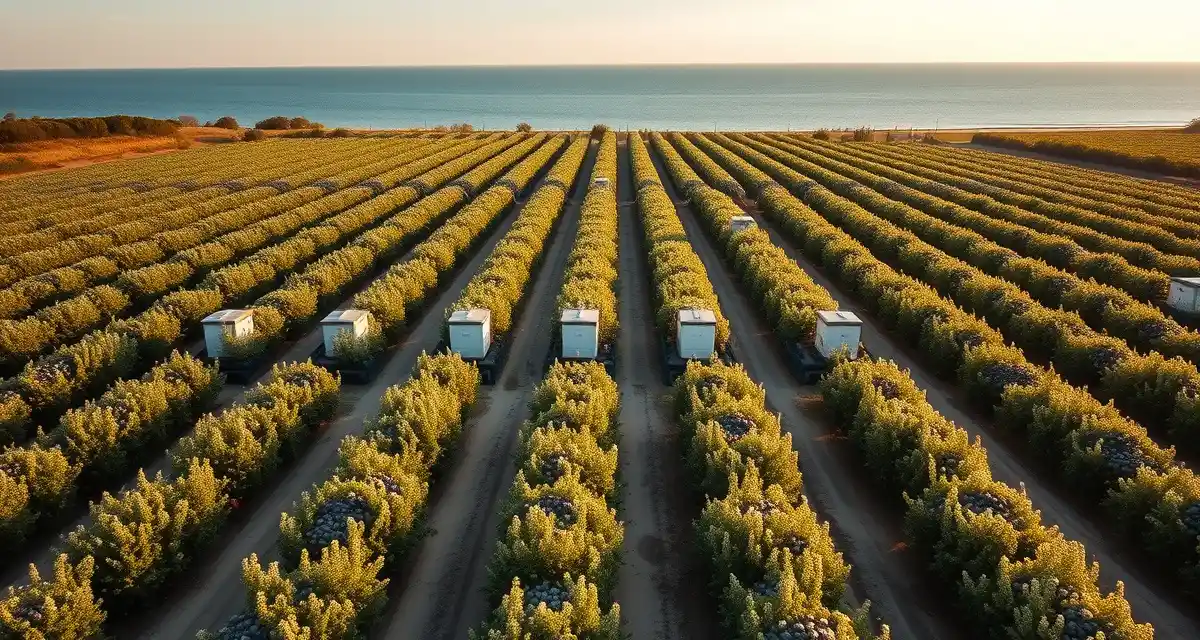
Blueberry Pollination Software for Michigan Beekeepers
Michigan produces 25 percent of all US blueberries, with the highest concentration in the southwestern lakeshore counties. Van Buren County alerts fire 3 to 5 days earlier than northern Michigan counties due to the warmer Lake Michigan influence, which means a single Michigan blueberry season is actually a sequence of county-by-county bloom progressions that a single regional timing estimate misses.
PollenOps Michigan blueberry software provides county-specific bloom timing calibration that accounts for the Lake Michigan thermal gradient running along Michigan's southwestern shore. This calibration is the difference between arriving at a Van Buren County orchard before bloom and arriving during it because you applied a Muskegon or Kalamazoo County timing to a warmer southwestern microclimate.
TL;DR
- Commercial blueberry pollination requires 2-4 hives per acre depending on variety and field density.
- Blueberry bloom windows are narrow (7-14 days) and vary by region from late February in Alabama to July in Maine.
- Lowbush blueberry in Maine operates under a different management model than highbush operations in Michigan, New Jersey, and the Pacific Northwest.
- Hive strength requirements for blueberry contracts typically range from 5-7 frames of bees depending on the grower.
- Coordinating delivery timing across multiple growers within a compressed bloom window is the primary logistics challenge in blueberry season.
Michigan Blueberry Geography
Michigan's southwestern blueberry belt runs along the Lake Michigan shoreline from Berrien County in the south to Mason County in the north, with production continuing inland:
Berrien County (southernmost): The warmest Michigan blueberry county due to Lake Michigan's moderating effect. Bloom typically starts in late May. Home to significant commercial acreage.
Van Buren County: Michigan's largest blueberry-producing county and the heart of the commercial market. Hartford, Bangor, and South Haven areas. Blooms slightly after Berrien but before inland counties.
Allegan County: Inland from the Lake Michigan shore. Typically blooms 2 to 3 days after Van Buren County due to slightly cooler conditions away from the lake.
Ottawa and Muskegon counties: Further north along the shore. Bloom runs 3 to 5 days later than Van Buren County.
Mason and Oceana counties: Northern reach of significant Michigan blueberry production. Latest-blooming counties in the southwestern belt.
County-Level Bloom Alert Calibration
PollenOps Michigan blueberry bloom alerts are calibrated at the county level using local weather station data and the Lake Michigan thermal gradient that drives the county-by-county bloom progression. When you enter a Van Buren County contract, the alert uses Van Buren's local conditions. An Allegan County contract uses Allegan's conditions. The alerts fire in sequence as bloom progresses northward from the warmest southern counties.
For operators managing contracts across multiple Michigan counties, this sequential alert system provides a delivery schedule that follows the biological reality of Michigan's bloom progression. Van Buren contracts fire their alerts first, then Allegan, then Ottawa and Muskegon, then northern counties. Your delivery sequence tracks the bloom progression naturally rather than requiring you to manually estimate each county's timing.
Michigan Blueberry Variety Timing
Michigan highbush blueberry varieties have staggered ripening dates that correspond roughly to staggered bloom dates:
Duke and Weymouth (early): May bloom, June harvest. These early varieties are planted alongside mid-season varieties in many operations.
Bluecrop and Blueray (mid-season): Late May to early June bloom, July harvest. The dominant mid-season commercial varieties.
Elliott and Jersey (late): June bloom, August harvest. Late-season varieties extend the Michigan blueberry harvest window.
Most commercial Michigan blueberry operations have mixed variety plantings to spread harvest workload and market timing. For pollination purposes, mixed-variety orchards need bloom alert triggers that cover the full bloom range of their variety mix rather than a single average.
Hive Density Requirements
Michigan highbush blueberry requires 4 to 6 hives per acre for commercial pollination. This high density requirement reflects blueberry's pollination biology: each berry requires multiple bee visits, and the dense planting configurations of commercial highbush operations create significant per-acre pollination demand.
At 4 hives per acre, a 50-acre Michigan blueberry operation requires 200 hives, generating $18,000 to $26,000 in contract revenue at current rates. At 6 hives per acre, the same acreage requires 300 hives and generates $27,000 to $39,000. The high density requirement makes Michigan blueberry one of the most hive-intensive markets in the country per acre.
Confirm density requirements in each contract explicitly. Some growers have moved to higher density than the industry standard based on their own production experience; others are comfortable with 4 hives per acre for established orchards with good native pollinator habitat. Don't assume a single density applies to all Michigan blueberry contracts.
Per-Hive Rates in Michigan
Michigan highbush blueberry rates in 2026 run $90 to $130 per hive, with Van Buren County operations sometimes commanding the higher end of the range due to the county's agricultural sophistication and the high commercial value of the Lake Michigan shore blueberry brand.
Rates in Michigan have edged upward in recent years as demand for managed pollination has grown faster than beekeeper supply in the region. Operators who can demonstrate documented delivery compliance and professional grower reporting consistently negotiate at or above the midpoint of the range.
Michigan Blueberry Season Integration
Michigan blueberry fits naturally into a Great Lakes circuit. Tart cherry in northwestern Michigan's Leelanau and Antrim counties blooms in late May, approximately 2 to 3 weeks before Van Buren County blueberry. Operators running cherry in the Traverse City area can transition south to the southwestern blueberry belt after cherry removal with reasonable positioning efficiency.
After Michigan blueberry, the summer circuit can extend to Midwest cucurbit pollination in Indiana and Ohio (July), Minnesota or Wisconsin canola (July), or North Dakota honey production positioning (June through August).
The blueberry pollination schedule regional overview and the Michigan commercial pollination service guide provide additional context for building a Michigan-anchored summer circuit.
Frequently Asked Questions
When does highbush blueberry bloom in Van Buren County compared to Muskegon County?
Van Buren County typically blooms 3 to 5 days earlier than Muskegon County due to the stronger Lake Michigan thermal influence in the southernmost counties. The lake moderates winter temperatures and accelerates spring warming along the immediate shoreline and nearby inland areas. Berrien County, the southernmost blueberry county, blooms first, followed by Van Buren, then Allegan, Ottawa, Muskegon, and northern counties in sequence. PollenOps Michigan blueberry alerts account for this county-by-county progression using local weather station calibration.
How many hives per acre do Michigan blueberry growers require?
Michigan highbush blueberry typically requires 4 to 6 hives per acre for commercial production. The high density reflects blueberry's intensive pollination biology and the dense plantings of commercial highbush operations. Some growers specify 4 hives per acre for established orchards with supplemental native pollinator habitat; others specify 5 to 6 hives per acre for maximum yield insurance on high-value operations. Confirm the density requirement in each contract rather than applying a single county average.
What per-hive rate can I expect for Michigan blueberry pollination?
Michigan highbush blueberry rates in 2026 run $90 to $130 per hive, with Van Buren County operations sometimes reaching the top of the range due to the market's agricultural sophistication. Rates have trended upward as demand growth has outpaced regional beekeeper supply. Operators with PollenOps delivery records showing consistent county-specific compliance and professional grower documentation negotiate at or above the midpoint range. First-season operators without a Michigan track record typically start at the lower end and build toward premium rates as their history develops.
What is the difference between lowbush and highbush blueberry pollination requirements?
Lowbush blueberry (Vaccinium angustifolium), grown primarily in Maine and eastern Canada, is managed as a wild crop in natural fields and requires 2-4 hives per acre. Highbush blueberry, grown commercially in Michigan, New Jersey, Oregon, and Washington, is a cultivated crop with different density requirements (typically 2-3 hives per acre). Lowbush bloom happens in late June to early July in Maine, while highbush bloom varies from May in the Mid-Atlantic to July in northern Michigan.
How long is the blueberry pollination placement period?
Blueberry pollination placements typically run 2-4 weeks, covering the full bloom window plus a few days before and after. Hives should be in position 1-2 days before peak bloom to allow forager orientation. Removal timing is typically negotiated in the contract and often coincides with petal fall or a set number of days after delivery. Most blueberry contracts specify 3-4 weeks of placement.
Can blueberry pollination contracts be combined with other crops in the same region?
Yes, and this is how experienced operators build efficient circuits. In the Pacific Northwest, blueberry season in June-July follows apple and cherry pollination in April-May. In New England, blueberry contracts in Maine (July) can follow apple pollination in Massachusetts and New York (May). Michigan blueberry in May-June can precede summer honey flows in the northern Midwest. Sequencing crops within a region reduces transport costs and maximizes revenue per hive per season.
Try These Free Tools
Sources
- USDA Agricultural Research Service
- Bee Informed Partnership
- American Beekeeping Federation (ABF)
- University of Maine Cooperative Extension
- Michigan State University Extension Apiculture Program
Get Started with PollenOps
Blueberry pollination across multiple growers and states requires tight coordination between delivery timing, hive inventory, and contract documentation. PollenOps tracks each grower's contract terms alongside your hive assignments and yard locations so your team executes on the schedule you planned, not the schedule you remember.