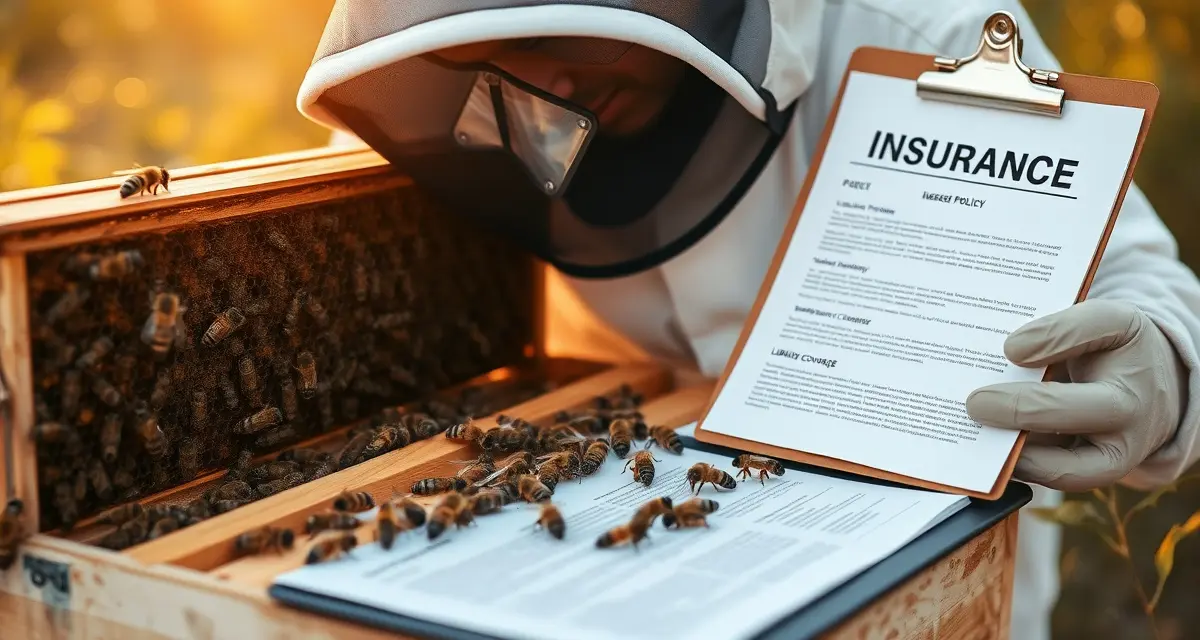
Business Insurance for Commercial Beekeeping Operations
Insurance in commercial beekeeping isn't optional, it's a basic requirement for operating professionally. Hive stings causing public liability claims can reach $100,000 or more without proper commercial coverage. Commercial vehicle insurance for hive-hauling trucks requires specialized agricultural endorsements that standard auto policies don't provide. Getting the wrong insurance, or not enough of it, creates exposure that can end a business.
Most commercial beekeepers who've been in the industry long enough can tell you a story about someone who got into serious financial trouble because their coverage didn't match what they actually did. The conversation with an insurance broker that takes 2 hours is worth it.
TL;DR
- Commercial beekeeping operations typically need general liability insurance, property coverage for hives and equipment, and commercial vehicle insurance.
- Many grower contracts require proof of liability coverage with minimum limits of $1 million per occurrence before hives can be placed.
- USDA's Noninsured Crop Disaster Assistance Program (NAP) provides some coverage for honey bees under disaster conditions.
- Dispute resolution provisions in pollination contracts should specify the jurisdiction and method (mediation, arbitration, or litigation) before a dispute arises.
- Pesticide kill documentation -- timestamped photos, dead bee samples, communication records -- is the foundation of any liability claim.
General Liability Insurance
Every commercial beekeeping operation needs general liability insurance. This covers bodily injury and property damage claims arising from your business activities, including bee stings to third parties, damage to growers' orchards or property during hive placement, and incidents at your yard locations.
Standard agricultural general liability policies for beekeeping typically run $1 million per occurrence with $2 million aggregate. Larger operations should evaluate whether $2 million per occurrence limits are appropriate given their scale and the number of contracts they hold.
Important coverage details to review:
Pollination service coverage: Some general liability policies exclude or limit coverage for pollination service activities. Verify that your policy explicitly covers you while performing pollination contract work, since this is your primary business activity.
Yard location coverage: Confirm that all yard locations are covered, including out-of-state locations if you're a migratory operator. Some policies have geographic limitations.
Grower indemnification requirements: Your grower contracts may require you to name the grower as an additional insured on your liability policy. This is a standard request from sophisticated agricultural growers. Know how to add additional insureds and what your policy allows.
Commercial Vehicle Insurance
Trucks hauling live bee colonies are specialized vehicles doing specialized work. Standard commercial auto insurance doesn't always cover the unique risks of hive transport. Commercial vehicle insurance for hive-hauling trucks requires specialized agricultural endorsements that acknowledge:
- The cargo (live bee colonies) has unique handling requirements
- Night driving for moves is standard practice in the industry
- Routes include agricultural roads and access paths that differ from commercial freight routes
- The value of the cargo can be substantial ($500 to $1,500 per hive × 200 to 400 hives per load)
Work with an insurer familiar with agricultural trucking. Standard commercial auto carriers may not fully understand the risk profile or may price it incorrectly. An agricultural specialist insurer is worth the search effort.
Confirm that your vehicle coverage includes the cargo value or that you have a separate inland marine or cargo policy that covers hive losses resulting from vehicle accidents.
Property and Equipment Insurance
Your beekeeping equipment, extraction facility, and yard infrastructure represent substantial capital. A commercial property policy covers:
- Extraction equipment (often $15,000 to $100,000 for commercial setups)
- Hive equipment inventory at your home base
- Outbuildings and storage facilities
- Tools and small equipment
For migratory operations, inland marine insurance (also called "equipment floater") covers property that moves from location to location. This is the correct coverage for hive equipment and tools that aren't at a fixed location.
Workers Compensation
Any commercial beekeeping operation with employees needs workers compensation insurance. This is legally required in virtually every state the moment you hire. Workers comp for beekeeping classifications carries high premiums due to the genuine injury risks involved.
For complete guidance on workers comp rates and payroll compliance, see the payroll and HR management guide.
Hive Loss and Crop Insurance
The USDA's Noninsured Crop Disaster Assistance Program (NAP) and the Whole-Farm Revenue Protection (WFRP) policies are available for beekeeping operations. These provide some protection against catastrophic hive losses from weather, disease, or other covered causes.
Colony loss coverage has limitations and deductibles that mean it doesn't replace the detailed colony health management you need anyway. But it can provide meaningful financial protection against catastrophic events like a harsh winter, major pesticide kill, or natural disaster affecting multiple yards simultaneously.
Documenting Colony Losses for Insurance Claims
Successful insurance claims for colony losses require documentation that most operators don't maintain proactively. When losses occur, you need:
- Contemporaneous records of colony counts at affected yards
- Photographs of dead colonies with visible hive identification markings
- A police report if theft is involved
- Diagnostic records from your state department of agriculture if disease is the cause
- Veterinarian or apiary inspector documentation for significant loss events
For insurance-related documentation through your commercial beekeeping operations management system, maintaining ongoing colony records that can support an insurance claim is more valuable than scrambling to reconstruct documentation after a loss event.
Frequently Asked Questions
What liability insurance does a commercial beekeeping operation need?
At minimum, you need commercial general liability insurance with at least $1 million per occurrence coverage, explicitly covering pollination service activities and all operating locations including out-of-state yards. Most commercial contracts with growers, landowners, and processors will require proof of insurance. Larger operations should consider $2 million per occurrence limits. Review your policy to confirm pollination service is not excluded, that geographic coverage matches where you operate, and that the policy allows you to add growers as additional insureds. An agricultural insurance specialist can help you find coverage that matches commercial beekeeping's specific risk profile.
What commercial vehicle insurance covers hive hauling trucks?
Hive-hauling trucks require commercial auto insurance with agricultural endorsements that account for live animal cargo, night movement practices, and agricultural road use. Standard commercial auto policies may not fully cover the unique aspects of bee transport. Work with an insurer experienced in agricultural trucking, and confirm that your policy covers the cargo value (hives and colonies) or that you have a separate inland marine or cargo policy for the hive inventory value. Also verify that your coverage applies during night moves, since some commercial auto policies have restrictions around driving hours or practices.
How do you document colony losses for insurance claims?
Document colony losses as they happen rather than after the fact. Maintain current colony count records at each yard with dated entries. Photograph dead colonies showing hive identification markings whenever significant losses occur. If disease is a factor, request written documentation from your state apiary inspector or a diagnostic lab. For theft losses, file a police report immediately. For weather-related losses, keep weather records and document yard conditions. Insurance claims require that you demonstrate the colonies existed, that they were lost, and that the cause was a covered event. Retroactive documentation is less compelling than contemporaneous records.
What is the difference between commercial and hobby beekeeping?
Commercial beekeeping is distinguished by scale (typically 100+ hives, often 500-5,000+), revenue source (pollination contracts and bulk honey sales rather than local honey retail), and management approach (systematic protocols applied across yards rather than individual colony attention). Commercial operators manage bees as an agricultural enterprise, with the administrative, regulatory, and logistical complexity that entails. Most commercial operators derive the majority of their income from pollination services; honey production is a supplementary revenue stream.
How many hives are needed to make commercial beekeeping a full-time income?
Most beekeeping economists put the full-time commercial threshold at 500-800 hives, assuming efficient operations management and a combination of pollination and honey revenue. At 500 hives and $200/hive for almond pollination, almond season alone generates $100,000 in gross revenue before expenses. Net margins depend on operational efficiency, but well-run operations can achieve 30-50% net margins on pollination revenue. Additional crops and honey production improve per-hive economics but require additional management capacity.
What is the annual revenue potential for a 1,000-hive commercial operation?
A 1,000-hive operation running an almond season ($200/hive) plus blueberry or apple contracts ($80-100/hive) plus summer honey production ($25-40/hive after extraction costs) can generate $300,000-360,000 in annual gross revenue. Net margins after transport, crew, equipment, and hive replacement costs typically run 25-40% for well-managed operations, putting net income at $75,000-145,000 annually. The specific number depends heavily on circuit efficiency, loss rates, and contract quality.
Try These Free Tools
Sources
- USDA Agricultural Research Service
- Bee Informed Partnership
- American Beekeeping Federation (ABF)
- USDA Farm Service Agency
Get Started with PollenOps
Commercial beekeeping insurance and legal compliance requirements have grown more complex as operations scale. PollenOps helps you maintain the documentation that supports coverage claims and contract enforcement when disputes arise.