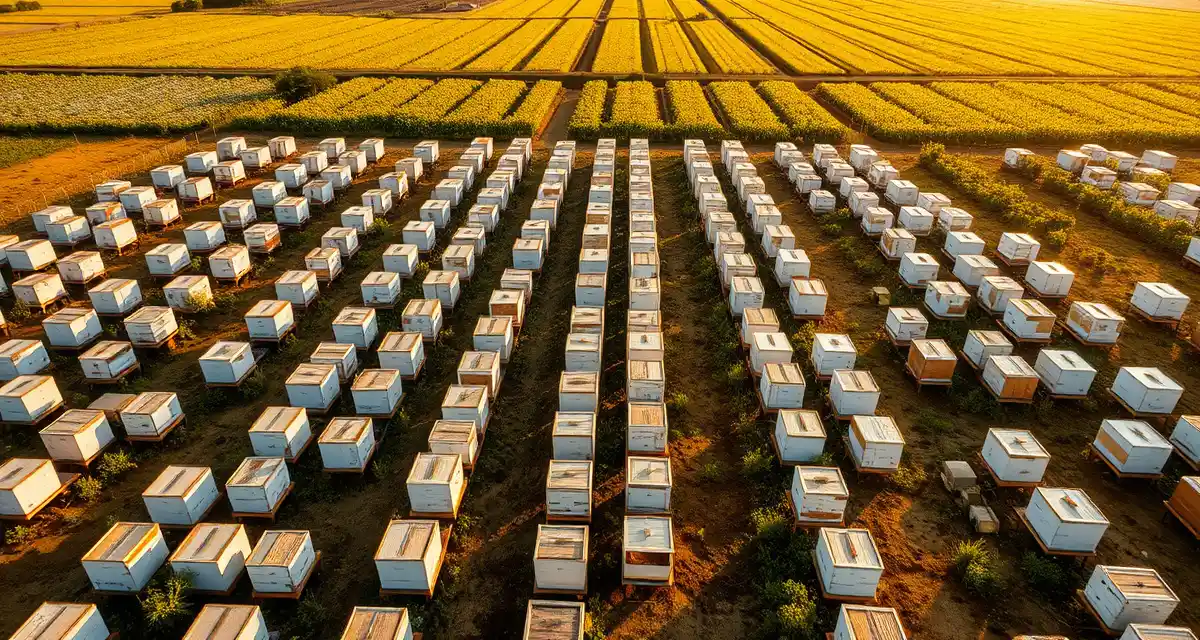
US Pollination Market Size, Trends, and Opportunities
The US pollination services market generates over $2 billion in direct fee income for commercial beekeepers annually, and that number understates the economic significance. When you include the value of crops that depend on bee pollination to produce at commercial yields, the figure exceeds $15 billion in agricultural value generated by managed pollination.
Almonds alone account for $1 billion or more in annual pollination fees paid to commercial beekeepers, roughly half the total market by fee value. Understanding where the money comes from, how it's growing, and where the commercial opportunity is expanding helps you position a migratory operation for the next decade, not just the next season.
TL;DR
- Commercial beekeeping operations face two primary management challenges: operational logistics (hive health, transport, placement) and administrative coordination (contracts, payments, documentation).
- Most disputes and revenue losses in commercial beekeeping are preventable with better documentation and clearer contract terms.
- The operations that run most profitably are those with disciplined systems for tracking hive health, contract status, and fleet logistics in one place.
- PollenOps is built specifically for the operational complexity of commercial-scale pollination services, not adapted from a hobbyist tool.
- The most important management decisions (treatment timing, contract renewal, hive allocation) require accurate current data to make well.
Market Size and Structure
The $2B+ pollination fee market is distributed across crops in rough proportion:
Almonds: ~$800M-1.1B annually in pollination fees. At 1.3 million hives placed at average $200-210/hive for the 2026 season, the math produces roughly $260M for the California almond season alone, though this is a significant undercount because it only includes the direct California almond fee, not the full value-chain impact.
Tree fruits (apples, cherries, pears, peaches): ~$300-450M. Scattered across major apple-growing regions (Washington, New York, Michigan, Pennsylvania), cherry-growing regions (Pacific Northwest, Michigan), and stone fruit areas.
Blueberries and cranberries: ~$150-250M. Michigan, New Jersey, Pacific Northwest (blueberries), Massachusetts and Wisconsin (cranberries). Contract rates run $75-110/hive.
Melons, cucumbers, squash: ~$100-175M. These crops require close pollination: bees placed directly in greenhouse operations or field-level contracts at $35-75/hive.
Alfalfa and seed crops: ~$100-150M. Clover seed, alfalfa seed, onion seed. Contract rates are modest per hive but volume is significant in major seed production areas (Idaho, Oregon, California, Wyoming).
Other crops (canola, sunflower, avocado, citrus): ~$150-250M. Canola pollination in North Dakota and Minnesota; sunflower seed in the Northern Plains; avocado in California coastal areas.
These figures are estimates based on industry reports and extension research. Exact market sizing is difficult because pollination contracts are private and not systematically tracked. The USDA NASS and academic researchers produce periodic estimates; the most recent systematic studies suggest $2-3B annually in total pollination service fees.
Why Almonds Dominate
California almonds require roughly 2 colonies per acre for adequate pollination. With 1.3 million acres in production, that's the demand for 2.6 million colony placements. The US has approximately 2.7-3.0 million managed commercial colonies total. Almond season consumes essentially all available commercial capacity for 6-8 weeks.
That supply constraint is structural. You can't quickly expand the commercial hive supply, building a colony takes 3+ months from a package install, and winter losses (averaging 30-40% nationally for commercial operations) constrain net growth. Almond acreage, meanwhile, has grown 50%+ over the past 20 years. The demand curve has outpaced the supply curve, which is why per-hive contract rates have risen from $100-130/hive in the early 2000s to $200-220/hive in 2026.
If almond acreage continues expanding (current projections suggest continued modest growth), and if colony loss rates remain high, per-hive rates will continue rising. Operations that can reliably deliver high-strength colonies at scale are in a structurally advantaged position.
Growth Drivers Beyond Almonds
Specialty fruit expansion: US consumers are buying more berries, tree fruits, and specialty produce. Blueberry consumption has roughly doubled over the past 15 years, driving expanded blueberry acreage and pollination demand in Michigan, Oregon, Washington, Georgia, North Carolina, and New Jersey. Organic fresh produce growth is pushing organic pollination demand, creating premium contract opportunities for certified organic-managed colonies.
Cannabis (hemp) pollination: Hemp flower production for CBD extraction does not require bee pollination. Hemp is wind-pollinated. But certified organic hemp seed production is an emerging niche that may create some pollination demand. This is not a significant market currently but worth watching.
Avocado acreage growth in California: California avocado growers have expanded production in response to rising domestic demand. Avocado is bee-pollinated; contract rates of $80-120/hive make it a secondary California circuit after almonds. The coastal terrain and spring timing create different logistics than almond placements.
Covered greenhouse and vertical farming: High-tunnel and greenhouse fruit and vegetable production is growing significantly in the Northeast and Midwest. These operations use managed pollinators (often bumble bees for tomatoes and peppers, honey bees for some crops). The commercial honey bee opportunity in controlled environment agriculture is still developing but represents a growing niche.
Colony Supply Constraints and Market Dynamics
The fundamental economics of the pollination market come down to this: colony supply is constrained by biology and mortality, while demand from agriculture continues growing. That structural imbalance supports contract prices.
Annual colony loss rates for commercial beekeepers have averaged 30-40% for over a decade. USDA tracking shows losses fluctuating between 28% and 45% depending on the year and region. These losses are replaced through package purchases, splits, and nucleus colony production, all of which have real costs. The cost of replacement affects the minimum viable contract rate.
At a 35% annual replacement rate for a 1,000-hive operation, you're replacing 350 colonies per year. At $175-220 per replacement nuc, that's $61,000-77,000 annually just in replacement colony costs. That replacement cost is embedded in the contract rates operators accept. Growers are, in effect, partially funding colony replacement through the pollination fees they pay.
When colony loss rates spike (as they did during the Colony Collapse Disorder years of 2006-2012) the supply constraint tightens and contract prices rise. When loss rates improve (as they have somewhat in recent years with better varroa management tools), supply recovers and contract price growth moderates. This is the price discovery mechanism in a market without a centralized exchange.
Regional Market Opportunities
For commercial operators planning circuit expansion, here are the underserved or growing segments:
Southeast and Gulf Coast early season: Florida early citrus and vegetable pollination is undersupplied relative to demand. The state relies heavily on colonies wintered there rather than operated there year-round. Georgia blueberry has seen rapid acreage expansion with pollination demand growing faster than local supply.
Pacific Northwest specialty fruit: The Pacific Northwest has a growing premium fruit sector (organic berries, wine grapes, stone fruits) where producers are willing to pay above-average rates for reliable, documented hive strength. This market rewards operators who can provide strength verification and professional contracts.
Midwest cucurbits and melons: Illinois, Indiana, and Ohio greenhouse and high-tunnel production for cucumbers and melons is growing year-round, creating demand for operators who can supply colonies multiple times per season with documented health status.
Northeast cranberries: Massachusetts, New Jersey, and Wisconsin cranberry production is a relatively stable market with consistent per-hive rates ($50-75/hive) and demand that's not being fully met by local supply. The logistics favor operations that winter in the South and move north in June.
What Market Growth Means for Your Operation
The long-term trend supports investment in commercial pollination capacity. A well-run 1,000-hive operation positioned on the California almond circuit with supplemental Pacific Northwest and Northern Plains stops generates $400-550 per hive annually. At 1,000 hives, that's $400,000-550,000 in gross revenue.
Scaling to 2,000 hives doesn't double administrative overhead. It increases it by perhaps 30-50% with the right operations management platform. The economics of scale favor operators who can manage the logistics of larger fleets without proportionally scaling their admin costs.
The operators who will capture the most value in a growing pollination market are those with: strong grower relationships that generate repeat contracts, reliable delivery of documented hive strength, and operational systems that let them manage fleet size increases without losing visibility into yard-level performance.
FAQ
What is the total size of the US pollination services market?
Current estimates place the US pollination services market at $2-3 billion annually in direct pollination fees paid to commercial beekeepers. Almonds account for roughly 40-50% of that total. When including the agricultural value of crops that depend on pollination to produce at commercial yields, the broader economic contribution of managed pollinators to US agriculture exceeds $15 billion annually.
Which crops drive the most pollination demand?
Almonds are by far the largest single driver. California's 1.3 million almond acres require 2.6 million colony placements at $200-220/hive in 2026, generating over $250 million in direct fee income. After almonds, the major demand drivers are tree fruits (apples, cherries, pears), blueberries and cranberries, melons and cucurbits, and alfalfa and seed crops. Each of these represents $100-450 million in annual pollination fees spread across different regions and timing windows.
How has the pollination market grown over the past decade?
Per-hive almond pollination rates have grown from approximately $130-150/hive in the early 2010s to $200-220/hive in 2026, driven by continued almond acreage expansion against constrained colony supply. Overall market growth has been driven by specialty fruit expansion, organic produce demand creating premium contract opportunities, and the persistent structural imbalance between growing pollination demand and relatively flat commercial colony supply. The trend supports continued per-hive rate growth for operators who can deliver reliable, documented colony strength.
What is the difference between commercial and hobby beekeeping?
Commercial beekeeping is distinguished by scale (typically 100+ hives, often 500-5,000+), revenue source (pollination contracts and bulk honey sales rather than local honey retail), and management approach (systematic protocols applied across yards rather than individual colony attention). Commercial operators manage bees as an agricultural enterprise, with the administrative, regulatory, and logistical complexity that entails. Most commercial operators derive the majority of their income from pollination services; honey production is a supplementary revenue stream.
How many hives are needed to make commercial beekeeping a full-time income?
Most beekeeping economists put the full-time commercial threshold at 500-800 hives, assuming efficient operations management and a combination of pollination and honey revenue. At 500 hives and $200/hive for almond pollination, almond season alone generates $100,000 in gross revenue before expenses. Net margins depend on operational efficiency, but well-run operations can achieve 30-50% net margins on pollination revenue. Additional crops and honey production improve per-hive economics but require additional management capacity.
What is the annual revenue potential for a 1,000-hive commercial operation?
A 1,000-hive operation running an almond season ($200/hive) plus blueberry or apple contracts ($80-100/hive) plus summer honey production ($25-40/hive after extraction costs) can generate $300,000-360,000 in annual gross revenue. Net margins after transport, crew, equipment, and hive replacement costs typically run 25-40% for well-managed operations, putting net income at $75,000-145,000 annually. The specific number depends heavily on circuit efficiency, loss rates, and contract quality.
Try These Free Tools
Sources
- USDA Agricultural Research Service
- Bee Informed Partnership
- American Beekeeping Federation (ABF)
- American Honey Producers Association
- Project Apis m.
Get Started with PollenOps
Managing a commercial beekeeping operation involves more data, more deadlines, and more moving parts than any general-purpose tool was designed to handle. PollenOps brings contracts, yard records, health documentation, and fleet logistics together in one platform built for the realities of commercial-scale beekeeping.