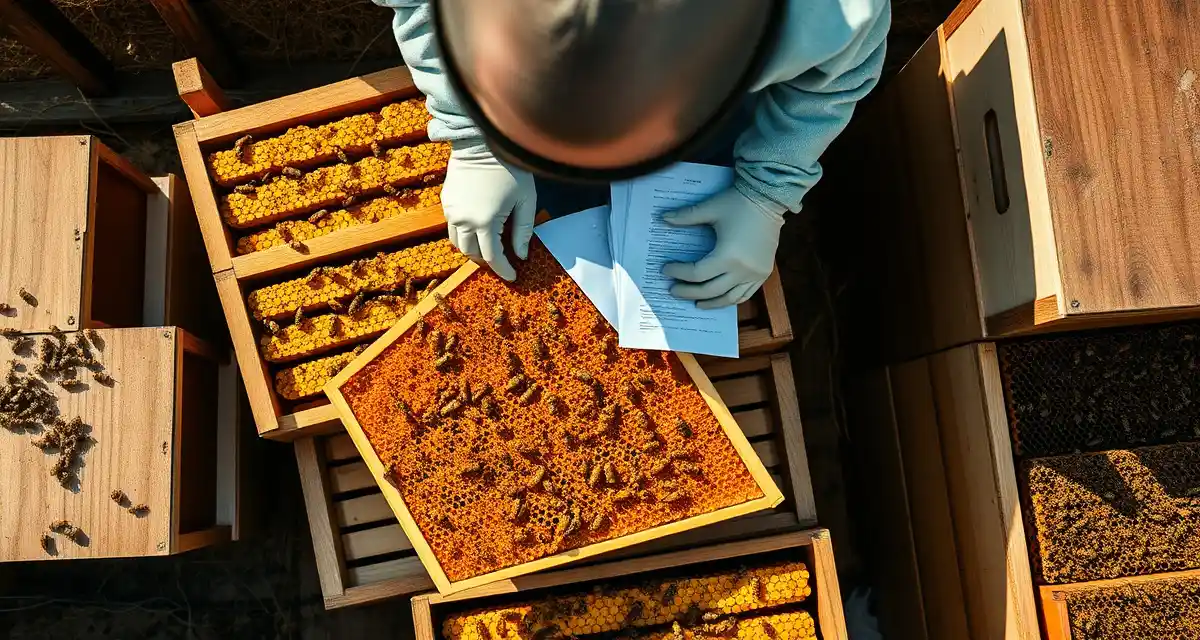
Commercial Beekeeping Profitability Analysis: Pollination vs Honey
Pollination at $200/hive generates $200,000 from almond alone on 1,000 hives in 6 weeks. Honey production adds $100-$200 per hive per year but requires more processing capital and labor. Most commercial operations find the optimal revenue mix is somewhere between pure pollination and pure honey, but the right balance depends on your specific operation, geography, and market access.
This analysis covers profit margins at 500, 1,000, and 2,000 hive scales across three scenarios: pollination-focused, honey-focused, and the hybrid model that most profitable operations use.
TL;DR
- Commercial beekeeping operations face two primary management challenges: operational logistics (hive health, transport, placement) and administrative coordination (contracts, payments, documentation).
- Most disputes and revenue losses in commercial beekeeping are preventable with better documentation and clearer contract terms.
- The operations that run most profitably are those with disciplined systems for tracking hive health, contract status, and fleet logistics in one place.
- PollenOps is built specifically for the operational complexity of commercial-scale pollination services, not adapted from a hobbyist tool.
- The most important management decisions (treatment timing, contract renewal, hive allocation) require accurate current data to make well.
Understanding the Revenue Model for Each Approach
Pollination Revenue Structure
pollination contracts generate revenue through per-hive fees paid by growers during bloom periods. The revenue characteristics:
High per-hive weekly revenue: At $200/hive for a 3-week almond contract, you're earning roughly $67/hive/week. Honey production at $150/hive/year earns about $3/hive/week. The per-week revenue from pollination is dramatically higher.
Capital-intensive during contract period: During active season, you're spending significantly on fuel, labor, and logistics.
Front-loaded cost structure: Pre-move assessments, health certificates, county registrations, and transport costs all occur before you collect the balance payment.
Revenue concentrated in weeks, not spread through the year: Almond season is 3 weeks. Cherry is 2-3 weeks. Your entire pollination income for that crop comes in a compressed window.
Honey Revenue Structure
Honey production generates revenue through honey sales, which may be wholesale, retail, or direct-to-consumer depending on your operation.
Lower weekly revenue per hive: But spread across more of the year.
Higher processing capital requirements: Extracting, filtering, bottling, and selling honey requires equipment investment that pollination doesn't.
Less dependence on regional markets: You can sell honey anywhere, whereas pollination requires being physically present in specific growing regions.
Variable by forage conditions: Honey yields vary dramatically by year, location, and timing. Pollination revenue is more predictable (contracted in advance).
Profit Analysis at 500 Hives
Scenario A: Pollination-Focused (500 hives)
Revenue:
- 500 hives at California almond ($200/hive): $100,000
- 250 hives at Pacific Northwest cherry ($110/hive): $27,500
- 500 hives at Michigan blueberry ($80/hive): $40,000
- Total pollination revenue: ~$167,500
Variable costs:
- Fuel for full season route: ~$25,000
- Driver wages (1 driver, seasonal): ~$18,000
- Health certificates and compliance: ~$2,500
- Pre-move assessment labor: ~$3,500
- Colony maintenance (varroa, feed, queens): ~$15,000
- Total variable costs: ~$64,000
Fixed costs:
- Truck depreciation and insurance: ~$12,000
- Liability insurance: ~$3,500
- Software (PollenOps): ~$1,100
- Other business overhead: ~$4,000
- Total fixed costs: ~$20,600
Net profit before owner compensation: ~$82,900
At 500 hives with a well-organized 3-crop pollination season, a solo operator can generate meaningful net profit. The owner's time is the key additional cost not fully captured here.
Scenario B: Honey-Focused (500 hives)
Revenue:
- 500 hives × $150 net per hive per year (after packing/processing): $75,000
Costs:
- Colony maintenance: ~$15,000
- Extraction and processing: ~$8,000
- Bottles, labels, packaging: ~$5,000
- Vehicle costs (local only): ~$6,000
- Overhead: ~$8,000
- Total costs: ~$42,000
Net profit before owner compensation: ~$33,000
The comparison is stark: pollination at 500 hives can generate 2.5x the net profit of honey production at the same scale, at the cost of significantly more travel, complexity, and seasonal intensity.
The Hybrid Model (500 hives)
Most 500-hive operations are some version of a hybrid:
- 300-400 hives on pollination contracts (highest priority, best revenue)
- 100-200 hives in honey production during and after pollination season
- Some hives moving between roles as schedule allows
This model typically generates $100,000-$130,000 in combined gross revenue with somewhat higher management complexity than either pure approach.
Profit Analysis at 1,000 Hives
Pollination at $200/hive generates $200,000 from almond alone on 1,000 hives. That single crop event in 6 weeks of committed time can represent a large portion of your annual revenue. Adding 2-3 additional crops turns that into a full-year income stream.
1,000-Hive Pollination-Focused Operation
Revenue (typical multi-crop season):
- 1,000 hives at almond ($200): $200,000
- 500 hives at cherry ($110): $55,000
- 1,000 hives at blueberry ($80): $80,000
- Total: ~$335,000
Costs:
- Fuel (full migratory season): ~$45,000
- Drivers (2-3 seasonal): ~$50,000
- Colony maintenance: ~$30,000
- Compliance and registrations: ~$5,000
- Equipment and insurance: ~$25,000
- Software and admin: ~$5,000
- Total costs: ~$160,000
Net profit before owner draw: ~$175,000
The 1,000-Hive Honey Addition
Adding honey production to a 1,000-hive pollination operation during off-contract periods (summer honey flow in the Northern Plains, for example) adds $50,000-$100,000 in gross revenue at relatively modest additional variable cost. The fixed costs of operating the fleet and maintaining colonies are already covered by pollination revenue.
Profit Analysis at 2,000 Hives
Operations above 2,000 hives generate an average of $800,000 to $4 million in annual pollination contract revenue. The wide range reflects the difference between a well-optimized 2,000-hive operation with 3-4 high-value crop contracts and an operation that has grown in hive count but not in contract quality or geographic reach.
At 2,000 hives, the economics of scale work in your favor:
- Fixed overhead spreads across more revenue
- Multiple trucks reduce per-hive transportation cost
- Multiple employees allow more efficient route execution
- Better grower relationships from volume delivery capability
The profit margin at 2,000 hives is often higher as a percentage than at 500 hives, assuming equivalent management quality, because the fixed cost base grows slower than revenue.
Which Generates More Profit Per Hive: Pollination or Honey?
Pollination wins on per-hive-week revenue in commercial markets. But the comparison isn't always simple because:
Pollination requires migratory capability: The most valuable pollination contracts (California almond, Pacific Northwest cherry) require being in the right place at the right time. Local beekeepers who can't or won't travel are excluded from these markets.
Honey is more geographically flexible: A beekeeper in Iowa who sells wholesale honey can operate profitably without leaving the state. A California almond contract requires being in the Central Valley in February.
Risk profiles differ: Pollination revenue is contracted in advance and largely predictable. Honey revenue depends on forage conditions, weather, and market prices that can vary significantly year to year.
Processing capital matters: A large honey operation requires significant investment in extraction equipment, storage, and sales infrastructure. A pollination operation's major capital requirements are truck fleet and hives.
How Do You Calculate Profit Margins for a 1,000-Hive Operation?
The basic formula:
Gross revenue: All pollination contract payments + all honey sales + any other income (nucs, queens, beeswax, etc.)
Variable costs: Costs that change directly with the scale of your operation: fuel, driver wages, colony treatments and feed, health certificates, temporary equipment
Contribution margin: Gross revenue minus variable costs = what's available to cover fixed costs and generate profit
Fixed costs: Costs that don't change significantly with production volume: truck depreciation, insurance, permanent staff wages, software, facilities
Net profit: Contribution margin minus fixed costs
A healthy 1,000-hive commercial pollination operation typically runs a contribution margin of 50-60% of gross pollination revenue, with net profit margin of 35-45% after fixed costs, before owner compensation.
Frequently Asked Questions
Which generates more profit per hive: pollination or honey?
Pollination generates 5-10x more revenue per hive per week during active contract periods than honey production. At $200/hive for a 3-week almond contract ($67/hive/week) vs. $150/hive/year for honey ($3/hive/week), the pollination revenue rate is dramatically higher. However, pollination requires migratory capability and regional market access that honey production doesn't. The optimal revenue mix depends on your geography, travel tolerance, and capital structure.
How do you calculate profit margins for a 1,000-hive operation?
Calculate gross revenue from all sources. Subtract variable costs (fuel, driver wages, treatments, compliance fees) to get contribution margin. Subtract fixed costs (truck depreciation, insurance, software, permanent staff) to get net profit before owner compensation. A healthy 1,000-hive commercial pollination operation typically runs 35-45% net profit margins, with the largest variable cost being fuel and driver wages for migratory moves.
What is the optimal revenue mix for commercial beekeeping?
Most profitable commercial operations combine pollination contracts (for peak revenue during bloom seasons) with honey production (during off-contract periods when hives are in honey production locations). The specific mix depends on your migratory capability, processing infrastructure, and market access. Operations with strong migratory capability and multiple crop contracts typically earn more from pollination; operations with strong direct-to-consumer honey markets may weight the mix toward honey.
What is the difference between commercial and hobby beekeeping?
Commercial beekeeping is distinguished by scale (typically 100+ hives, often 500-5,000+), revenue source (pollination contracts and bulk honey sales rather than local honey retail), and management approach (systematic protocols applied across yards rather than individual colony attention). Commercial operators manage bees as an agricultural enterprise, with the administrative, regulatory, and logistical complexity that entails. Most commercial operators derive the majority of their income from pollination services; honey production is a supplementary revenue stream.
How many hives are needed to make commercial beekeeping a full-time income?
Most beekeeping economists put the full-time commercial threshold at 500-800 hives, assuming efficient operations management and a combination of pollination and honey revenue. At 500 hives and $200/hive for almond pollination, almond season alone generates $100,000 in gross revenue before expenses. Net margins depend on operational efficiency, but well-run operations can achieve 30-50% net margins on pollination revenue. Additional crops and honey production improve per-hive economics but require additional management capacity.
What is the annual revenue potential for a 1,000-hive commercial operation?
A 1,000-hive operation running an almond season ($200/hive) plus blueberry or apple contracts ($80-100/hive) plus summer honey production ($25-40/hive after extraction costs) can generate $300,000-360,000 in annual gross revenue. Net margins after transport, crew, equipment, and hive replacement costs typically run 25-40% for well-managed operations, putting net income at $75,000-145,000 annually. The specific number depends heavily on circuit efficiency, loss rates, and contract quality.
Try These Free Tools
Sources
- USDA Agricultural Research Service
- Bee Informed Partnership
- American Beekeeping Federation (ABF)
- American Honey Producers Association
- Project Apis m.
Get Started with PollenOps
Managing a commercial beekeeping operation involves more data, more deadlines, and more moving parts than any general-purpose tool was designed to handle. PollenOps brings contracts, yard records, health documentation, and fleet logistics together in one platform built for the realities of commercial-scale beekeeping.