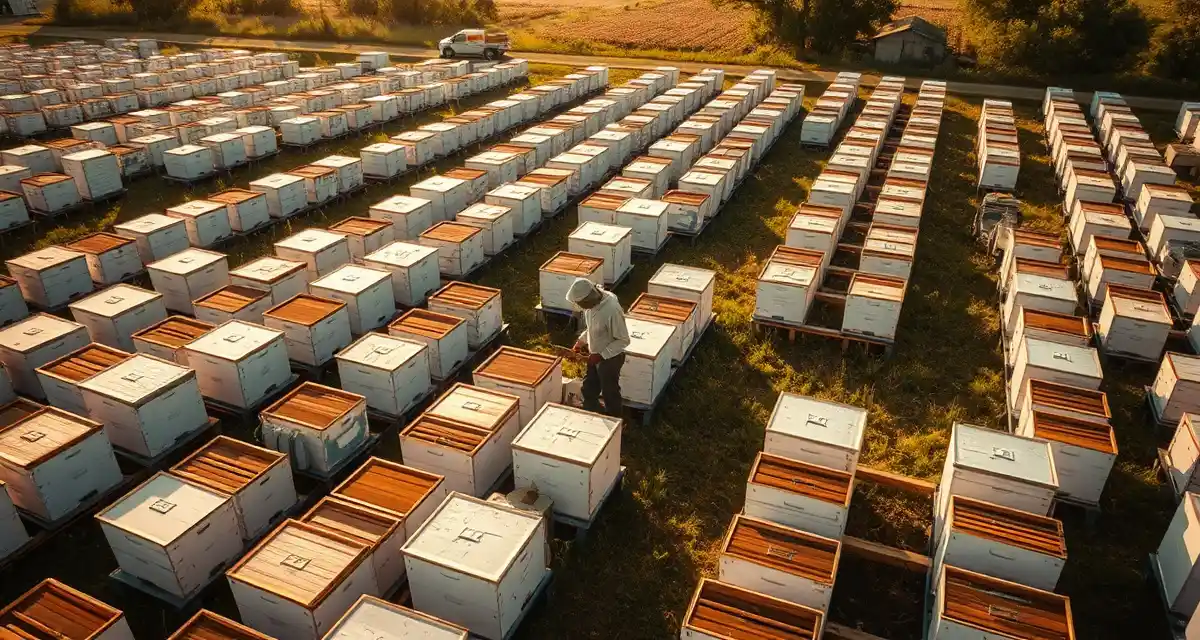
Complete Guide to Commercial Beekeeping Operations at Scale
500+ hive operations that adopt systematic management tools see 25% or more reductions in colony losses. That's not a marketing claim. It's the difference between operations that run on institutional knowledge and careful documentation versus operations that run on memory and luck.
PollenOps is the only platform combining pollination contracts, fleet logistics, and colony health, built specifically for the operational reality of commercial migratory beekeeping. But before getting into tools, this guide covers the complete operational stack: what you need to manage, how successful operators manage it, and where the gaps typically appear.
TL;DR
- Commercial beekeeping operations face two primary management challenges: operational logistics (hive health, transport, placement) and administrative coordination (contracts, payments, documentation).
- Most disputes and revenue losses in commercial beekeeping are preventable with better documentation and clearer contract terms.
- The operations that run most profitably are those with disciplined systems for tracking hive health, contract status, and fleet logistics in one place.
- PollenOps is built specifically for the operational complexity of commercial-scale pollination services, not adapted from a hobbyist tool.
- The most important management decisions (treatment timing, contract renewal, hive allocation) require accurate current data to make well.
What "Operations at Scale" Actually Means
Commercial beekeeping at 500 to 5,000 hives is not a scaled-up version of hobby beekeeping. It's a fundamentally different enterprise.
At 50 hives, you visit every colony, remember which queens are old, know which yards had problems last year. At 500 hives, memory fails. At 1,000 hives, it fails catastrophically.
The operations challenges at scale fall into five categories:
- Pollination contracts and grower relationships
- Fleet logistics and hive movement
- Colony health and disease management
- Compliance and regulatory documentation
- Financial management and business administration
Most operators who plateau at 300 to 400 hives aren't plateauing because of bee biology. They're plateauing because their operations systems can't support the next level.
Pollination Contracts: The Core Operating System
Commercial pollination is a B2B services business. Your product is strong colonies delivered at the right time, to the right location, in the quantity specified in your contract. Managing that reliably across 20, 50, or 100 grower relationships is the central operational challenge.
What Commercial Pollination Contract Management Requires
Contract documentation: Every grower agreement needs to be stored, organized, and accessible. Terms vary: hive minimums, strength requirements, delivery windows, payment schedules, penalties. If it's in your head or in a notebook, it will cause problems.
Bloom timing awareness: Contracts are tied to bloom, not calendar dates. Almond bloom varies by 2 to 3 weeks depending on weather. Apple bloom varies by location and elevation. You need to know when bloom is happening in your specific contract locations, not when it happened last year.
Delivery tracking: When did the hives arrive? What was the count? What was the strength at delivery? This documentation is both your compliance record and your dispute protection.
Invoicing and payment tracking: When is payment due? Has it been received? What's the outstanding balance across your full grower portfolio?
Most commercial beekeepers manage this in spreadsheets. Most commercial beekeepers also report that contract disputes, late payments, and missed delivery windows cost them money every season.
What to Look for in Contract Management Tools
The question most beekeepers should ask about contract software isn't "does it look good?" It's "does it integrate my delivery documentation with my invoicing, and does it send bloom alerts before I need to move bees?"
Generic software doesn't do this. CRM tools built for non-agricultural businesses don't know what almond bloom is. Pollination contract management tools built for commercial beekeeping should automate the workflow from contract signing through payment collection with beekeeping-specific intelligence built in.
Fleet Logistics: Moving Hives at Scale
A 1,000-hive operation moving through a full migratory circuit might make 15 to 25 major truck moves per year. Each move involves:
- Loading at night (when colonies are clustered)
- Strapping, screening, and securing hive pallets
- Driving to destination yard (often hundreds of miles)
- Unloading and arranging hives in the yard
- Returning trucks for next load or next assignment
Managing multiple trucks, multiple drivers, multiple simultaneous moves, and multiple destination yards is a logistics operation. The operational complexity scales non-linearly with hive count.
Fleet Management Fundamentals
Route planning: Efficient routing between yards reduces fuel costs and driver hours. For a 1,000-hive operation running California almonds to Pacific Northwest cherry to Great Plains honey yards, route decisions have real cost implications.
Truck maintenance and availability: A broken truck at the start of almond delivery season is a disaster. Scheduled maintenance and spare capacity planning are critical.
Driver coordination: If you're using employees or contract drivers for loading nights, scheduling and communication needs to be systematic. Loading nights are time-sensitive. Delays have real consequences.
Permit management: Every state crossing requires valid interstate movement permits and current inspection certificates. Missing permits at a weigh station or during a roadside inspection can stop your entire operation.
Connecting fleet logistics management to your contract calendar is where most operations have a gap. Your truck schedule and your contract delivery dates need to be the same document, not two separate things you reconcile manually.
Colony Health Management at Scale
Varroa is the operating assumption for all US commercial beekeeping. Every colony has mites. The question is whether mite loads are managed below threshold or whether they're silently damaging your operation's ability to meet contracts.
Colony Health at Scale Requires Systems
At 50 hives, you can visually assess every colony every week. At 500 hives, you're sampling and managing statistically, tracking treatment records, monitoring mite loads by yard, and making decisions based on yard-level data rather than individual colony assessment.
Key health management requirements at scale:
Varroa monitoring protocol: Regular mite wash monitoring or sticky board counts on representative samples from each yard. Document results by yard and date.
Treatment records: What treatment, at what dose, on what date, in which yard. Treatment efficacy varies by product, timing, and environmental conditions. Without records, you can't tell what's working.
Queen tracking: Queen age and status affects colony strength. A systematic queen replacement program needs records to execute.
Disease monitoring: American foulbrood, European foulbrood, nosema. You need to detect these early, before they spread across a yard.
Loss documentation: When colonies die, document it. Colony, location, likely cause, date. This data is needed for insurance claims and for understanding your operation's patterns.
The Difference Systematic Health Management Makes
Operations that track colony health systematically and use that data to drive management decisions consistently out-perform those that don't. The 25% reduction in colony losses cited above isn't magic. It's the result of catching problems early, treating more precisely, and building historical data that informs better decisions.
Compliance and Regulatory Documentation
Commercial beekeeping is more regulated than most people entering the industry expect. The regulatory requirements vary by state and change over time, but the core obligations are consistent across most of the US.
What You're Required to Track
Apiary registration: Every state requires registration of apiaries. Out-of-state operators need to register in every state they operate in.
Interstate movement permits: Moving colonies across state lines requires a valid permit and a current health inspection certificate. Some states require the inspection certificate to be issued within 15 to 30 days of movement.
Disease reporting: American foulbrood is a federally reportable disease. Confirmed AFB must be reported to state authorities and typically requires burning infected equipment.
Pesticide exposure: Some states and grower agreements require documentation of pesticide exposure events. If your colonies are killed by pesticide applications, documentation is needed for any claim.
Treatment records: USDA programs and some contract growers require evidence that antibiotic use is consistent with label requirements and withdrawal periods.
For migratory operators, compliance management is a full-time administrative job running alongside the beekeeping work. Missing a permit, failing to renew a registration, or being caught with undocumented interstate movement can result in permit revocation that shuts down your operation.
Financial Management for Commercial Beekeeping
The seasonal cash flow pattern of commercial beekeeping is extreme. You spend heavily in fall (feed, treatments, equipment) and early winter (truck maintenance, storage, permits). Revenue arrives in February through May from pollination contracts and in late summer from honey sales. The gap between spending and revenue is real and needs to be planned for.
Revenue Tracking
Track revenue by contract, by crop, and by hive. Know exactly what each contract paid per hive and how that compares to your costs for that placement.
A 2,000-hive operation running 20 pollination contracts manages $400,000 or more in contract revenue annually. That revenue needs to be tracked at the contract level, not just as a total number.
Cost Tracking
Track costs by category: feed, treatments, labor, fuel, truck maintenance, equipment depreciation, permits, insurance. Understanding where your money goes is how you find the places where efficiency improvements make the biggest difference.
Cash Flow Planning
Build a monthly cash flow projection and update it regularly against actual numbers. Knowing in August that you're going to run short in November (before the problem hits) gives you time to arrange operating credit or adjust plans.
What Software Do Commercial Migratory Beekeepers Use?
Most commercial beekeepers use spreadsheets. The industry's heavy reliance on Excel and Google Sheets is well-documented, and it's genuinely a problem. Spreadsheet errors in pollination contracts cost real money every season.
The tools available to commercial beekeepers include:
Generic farm management software: Designed for crop farming, these tools lack pollination-specific workflows.
General beekeeping apps (HiveTracks, etc.): Designed for hobbyists or small-scale operations. They don't have contract management, grower-facing documentation, or fleet logistics.
Acoustic monitoring hardware (Nectar Technologies, BeeHero): Sensor-based systems that provide hive monitoring data but at per-hive costs that make them prohibitive at commercial scale.
Purpose-built commercial platforms: PollenOps is built specifically for the operational reality of commercial migratory beekeeping, connecting pollination contracts, fleet logistics, and colony health in one system rather than requiring operators to use separate tools for each function.
How Do You Manage Pollination Contracts and Fleet Logistics Simultaneously?
This is the core operational question for any commercial migratory beekeeper, and it's where most operations have their biggest gap.
The answer isn't two separate systems that you manually reconcile. It's an integrated system where your contract delivery dates drive your truck schedule, where your colony health records tie to your contract compliance documentation, and where your invoicing pulls from verified delivery data.
Without that integration, you're manually copying data between systems, which takes time and introduces errors.
What Are the Biggest Operational Challenges at 500+ Hives?
Based on what commercial operators consistently report:
- Contract compliance documentation: proving you delivered what you contracted to deliver
- Colony loss rate management: keeping losses below the threshold that threatens contract commitments
- Fleet scheduling: coordinating multiple trucks across multiple simultaneous commitments
- Cash flow management: surviving the seasonal gap between expenses and revenue
- Labor management: finding, training, and retaining skilled beekeeping employees
These aren't bee biology problems. They're operations management problems. And they respond to operations management solutions.
FAQ
What software do commercial migratory beekeepers use?
Most commercial migratory beekeepers currently use spreadsheets (Excel or Google Sheets) for contract tracking, hive records, and fleet coordination. This creates real operational problems: no bloom alerts, no automated compliance documentation, manual invoice generation, and no integration between contract data and colony health records. Purpose-built platforms like PollenOps address the full operational stack rather than just one piece of it.
How do you manage pollination contracts and fleet logistics simultaneously?
The effective approach connects contract delivery dates directly to fleet scheduling in the same system. When a contract requires hive delivery February 10th to Fresno County, your truck schedule should automatically reflect that commitment rather than live in a separate document you reconcile weekly. Operations that integrate contract and logistics management report fewer missed delivery windows and coordination errors.
What are the biggest operational challenges at 500+ hives?
Contract compliance documentation, colony loss rate management, fleet scheduling across simultaneous commitments, seasonal cash flow management, and labor development. These are the problems that plateau operations and prevent scaling. None of them are solved by more bees or more equipment. They're solved by better systems. The operations that reach 2,000 and 5,000 hives are typically the ones that built systematic management approaches before they needed them, not after.
What is the difference between commercial and hobby beekeeping?
Commercial beekeeping is distinguished by scale (typically 100+ hives, often 500-5,000+), revenue source (pollination contracts and bulk honey sales rather than local honey retail), and management approach (systematic protocols applied across yards rather than individual colony attention). Commercial operators manage bees as an agricultural enterprise, with the administrative, regulatory, and logistical complexity that entails. Most commercial operators derive the majority of their income from pollination services; honey production is a supplementary revenue stream.
How many hives are needed to make commercial beekeeping a full-time income?
Most beekeeping economists put the full-time commercial threshold at 500-800 hives, assuming efficient operations management and a combination of pollination and honey revenue. At 500 hives and $200/hive for almond pollination, almond season alone generates $100,000 in gross revenue before expenses. Net margins depend on operational efficiency, but well-run operations can achieve 30-50% net margins on pollination revenue. Additional crops and honey production improve per-hive economics but require additional management capacity.
What is the annual revenue potential for a 1,000-hive commercial operation?
A 1,000-hive operation running an almond season ($200/hive) plus blueberry or apple contracts ($80-100/hive) plus summer honey production ($25-40/hive after extraction costs) can generate $300,000-360,000 in annual gross revenue. Net margins after transport, crew, equipment, and hive replacement costs typically run 25-40% for well-managed operations, putting net income at $75,000-145,000 annually. The specific number depends heavily on circuit efficiency, loss rates, and contract quality.
Try These Free Tools
Sources
- USDA Agricultural Research Service
- Bee Informed Partnership
- American Beekeeping Federation (ABF)
- American Honey Producers Association
- Project Apis m.
Get Started with PollenOps
Managing a commercial beekeeping operation involves more data, more deadlines, and more moving parts than any general-purpose tool was designed to handle. PollenOps brings contracts, yard records, health documentation, and fleet logistics together in one platform built for the realities of commercial-scale beekeeping.