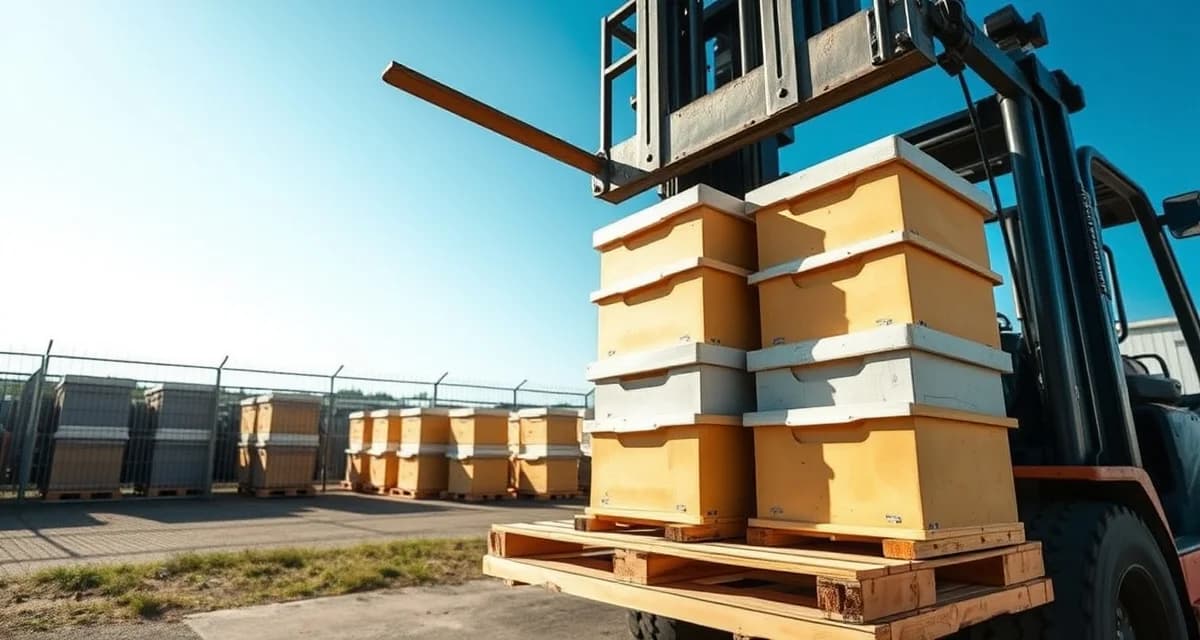
Forklift Operations for Commercial Beekeeping: Loading and Yard Management
Forklift operations are one of the most consequential productivity decisions in a commercial beekeeping operation. Forklift-compatible pallets allow loading 4 hives in 2 minutes versus 10 or more minutes for manual loading. On a 2,000-hive operation moving 500 hives, that means 125 pallet lifts. The difference between efficient and inefficient forklift work at that scale is hours per move, and moves happen dozens of times per season.
Getting forklift operations right involves the right equipment, trained operators, standardized pallet configurations, and yard access that accommodates your equipment. These aren't glamorous topics but they directly determine how many hives you can move per day, which constrains your contract capacity.
TL;DR
- Commercial beekeeping operations face two primary management challenges: operational logistics (hive health, transport, placement) and administrative coordination (contracts, payments, documentation).
- Most disputes and revenue losses in commercial beekeeping are preventable with better documentation and clearer contract terms.
- The operations that run most profitably are those with disciplined systems for tracking hive health, contract status, and fleet logistics in one place.
- PollenOps is built specifically for the operational complexity of commercial-scale pollination services, not adapted from a hobbyist tool.
- The most important management decisions (treatment timing, contract renewal, hive allocation) require accurate current data to make well.
Equipment Selection
Commercial beekeeping uses two main types of lifting equipment: traditional propane or electric forklifts and specialized telehandlers (telescoping handler machines). Each has trade-offs.
Traditional forklifts are lower cost and excellent for flat, firm ground like paved loading areas and established yards with compacted surfaces. They're less useful in soft or uneven terrain, which limits where you can place hives in agricultural settings.
Telehandlers offer reach and angle flexibility that forklifts can't match, including the ability to place pallets at height or reach over obstacles. They handle softer and more uneven ground better. The trade-off is higher cost and more complex operation.
For operations that are primarily loading and unloading on firm surfaces, a traditional forklift handles the job well. Operations that regularly work in soft orchard soils or varied terrain benefit from a telehandler's flexibility.
The connection between fleet logistics and forklift capability matters when you're planning what yard types you can service efficiently. Know your equipment's limits before you commit to yard locations that exceed them.
Pallet Configuration Standards
Standard commercial beekeeping pallets run 4-way entry on a 48x40 or 48x48 inch footprint, configured for 4 hives per pallet (2x2 arrangement) or 6 hives per pallet in some configurations. Four hives per pallet is the most common setup because it balances load weight against forklift capacity and truck bed capacity.
A fully loaded 4-hive pallet with two deep hive bodies per colony weighs roughly 400 to 600 pounds, depending on honey stores and population. Know the rated capacity of your forklift and don't exceed it. Overloaded pallets and overloaded forklifts are the leading cause of pallet drops and equipment failures during loading.
Keep pallets in good repair. Broken or rotting pallet boards cause drops and are a safety hazard for operators. Building pallet inspection into your yard setup and teardown routine prevents surprises during loading.
Loading Procedures
When loading hives onto a truck at night (the standard practice for moving active colonies), follow a consistent sequence that minimizes time with the truck loaded and reduces heat buildup:
Screen or close hive entrances before loading. Load pallets onto the truck starting from the cab end toward the rear to keep weight forward. Strap pallets to the truck bed anchors once all loading is complete. Work efficiently but don't rush, as rushed loading is when drops happen.
Driver and forklift operator should maintain clear communication during loading. The driver shouldn't be near the loading zone while the forklift is operating. Standardize hand signals or use radio communication if ambient noise is an issue.
Safe Forklift Practices at Yard Sites
Yard sites in agricultural settings often have challenges that loading docks don't: uneven ground, soft soil, irrigation ditches, low-hanging branches, and uncertain road access. Before operating a forklift at a new yard site, walk the entire area on foot to identify hazards.
Never operate a forklift on a slope that exceeds the manufacturer's rated maximum. When terrain is uncertain, use wheel chocks, move slowly, and avoid sudden turns with a load elevated.
For truck loading and transport operations at scale, training crew members on forklift safe practices and making it a required competency before they operate equipment independently reduces your incident rate.
Pallet and Truck Compatibility
Your forklifts and your trucks need to be compatible. Flatbed and lowboy trailers typically accommodate standard pallet configurations. Verify that your forklift's mast height clears your truck cab height when driving around a loaded truck. Know the weight rating of your truck bed and how many loaded pallet stacks it can safely carry.
Operators running a mixed fleet of truck types need to verify that each truck-forklift combination works before it's needed in the field. Finding out at 2 AM in an almond orchard that your forklift can't reach the back of the flatbed is a preventable problem.
Frequently Asked Questions
What type of forklift works best for commercial beekeeping operations?
For operations primarily loading on firm, flat surfaces, a standard propane or electric forklift with a rated capacity of 4,000 to 6,000 pounds handles the typical 4-hive pallet load comfortably with adequate margin. Operations that work frequently in orchards with soft or uneven ground benefit from an all-terrain telehandler. The best choice depends on your specific operation's terrain requirements. Many larger commercial operations run both, using a telehandler for yard work and a traditional forklift for loading dock work at a home base or staging facility.
How do you safely load hive pallets with a forklift?
Load at night when bees are in the hives, with entrances closed or screened to prevent flying. Position the forklift squarely behind the pallet before inserting forks, never approach at an angle. Lift smoothly and keep the load tilted back slightly when traveling to prevent forward tipping. Keep loads as low as practical while traveling. Position the truck on level ground and chock wheels before loading. The forklift operator should maintain clear sight lines and have a ground spotter for tight spaces. Never exceed the forklift's rated load capacity.
What pallet configurations are compatible with standard forklifts and trucks?
The most common commercial beekeeping pallet is a 48x48 inch 4-way entry wooden pallet configured for 4 hives arranged in a 2x2 pattern. This fits standard flatbed and lowboy trailer configurations and is compatible with most 4,000 to 6,000 pound capacity forklifts. Some operations use 6-hive pallets for higher density loading, which requires a forklift with adequate capacity to handle the heavier load. Verify that your specific pallet dimensions match your truck bed width and your forklift's fork spread range before standardizing on a configuration.
What is the difference between commercial and hobby beekeeping?
Commercial beekeeping is distinguished by scale (typically 100+ hives, often 500-5,000+), revenue source (pollination contracts and bulk honey sales rather than local honey retail), and management approach (systematic protocols applied across yards rather than individual colony attention). Commercial operators manage bees as an agricultural enterprise, with the administrative, regulatory, and logistical complexity that entails. Most commercial operators derive the majority of their income from pollination services; honey production is a supplementary revenue stream.
How many hives are needed to make commercial beekeeping a full-time income?
Most beekeeping economists put the full-time commercial threshold at 500-800 hives, assuming efficient operations management and a combination of pollination and honey revenue. At 500 hives and $200/hive for almond pollination, almond season alone generates $100,000 in gross revenue before expenses. Net margins depend on operational efficiency, but well-run operations can achieve 30-50% net margins on pollination revenue. Additional crops and honey production improve per-hive economics but require additional management capacity.
What is the annual revenue potential for a 1,000-hive commercial operation?
A 1,000-hive operation running an almond season ($200/hive) plus blueberry or apple contracts ($80-100/hive) plus summer honey production ($25-40/hive after extraction costs) can generate $300,000-360,000 in annual gross revenue. Net margins after transport, crew, equipment, and hive replacement costs typically run 25-40% for well-managed operations, putting net income at $75,000-145,000 annually. The specific number depends heavily on circuit efficiency, loss rates, and contract quality.
Try These Free Tools
Sources
- USDA Agricultural Research Service
- Bee Informed Partnership
- American Beekeeping Federation (ABF)
- American Honey Producers Association
- Project Apis m.
Get Started with PollenOps
Managing a commercial beekeeping operation involves more data, more deadlines, and more moving parts than any general-purpose tool was designed to handle. PollenOps brings contracts, yard records, health documentation, and fleet logistics together in one platform built for the realities of commercial-scale beekeeping.