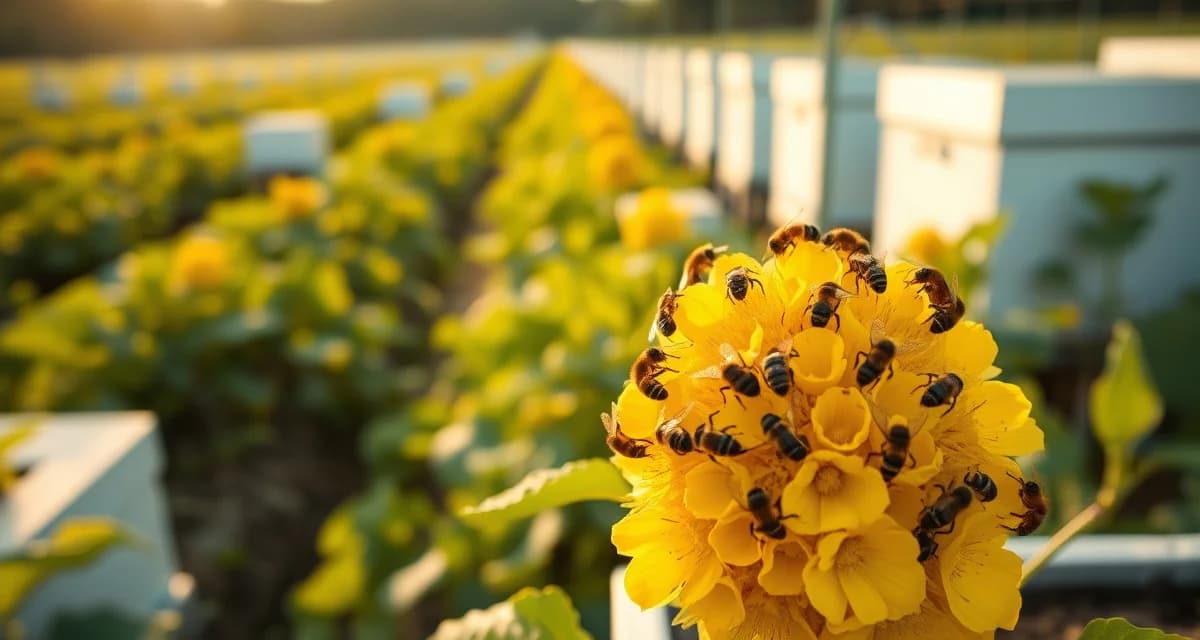
Cucumber and Squash Pollination Contracts for Commercial Beekeepers
Cucumbers and squash don't get the press that almonds and blueberries do, but they're consistent summer income for operators who understand the market. Both crops are entirely dependent on bee pollination, field production is widespread, and summer timing fits perfectly between spring tree fruit and fall operations.
TL;DR
- Cucurbits (melons, cucumbers, squash, pumpkins) require bee pollination for fruit set and are grown commercially in multiple states with overlapping seasons.
- Watermelon and cantaloupe are the highest-value commercial cucurbit crops for pollination contracts, with demand concentrated in the Southeast and Southwest.
- Pollination rates for cucurbit crops typically run $50-90 per hive, lower than tree fruit but with shorter placement periods.
- Cucurbit crops are highly sensitive to pesticide exposure, requiring clear communication with growers about spray schedules.
- Bee placement timing is critical: hives should enter the field when 10-20% of female flowers are open.
The Cucurbit Pollination Opportunity
Like watermelons, cucumbers and squash produce separate male and female flowers on the same plant. Bees transfer pollen from male to female flowers. Without that transfer, there's no fruit set. Commercial pickle cucumber and fresh market cucumber growers who've had inadequate bee coverage in previous seasons are motivated buyers of pollination services.
Major production states for commercial cucumber pollination:
- Michigan: Major pickle cucumber production in the western Lower Peninsula. Season runs late June–August.
- Ohio: Significant pickle cucumber acreage.
- Georgia and Carolinas: Fresh market cucumber and squash, April–June.
- California: Year-round production in some areas, main season April–August.
- Florida: Winter and spring cucumber and squash production.
Summer squash (zucchini, yellow squash), winter squash, and pumpkin share similar pollination requirements and timing.
Hive Density and Strength
Commercial cucumber contracts typically specify 1–2 hives per acre, with fresh market cucumber at the higher end. Pickle cucumber at 1 hive/acre is the standard for most contract operations.
Pumpkin and winter squash: 1–2 hives per acre, with the higher density for large plantings targeting reliable set.
Summer squash: 1 hive per acre is standard; growers with dense plantings or premium markets may specify 1.5/acre.
Colony strength: 4–5 frames is adequate for most cucurbit contracts. These crops have accessible flowers (short tube, abundant nectar) that are highly attractive to bees, so pollination efficiency per colony is good.
When Cucumber Pollination Generates Real Income
The economic logic for cucumber pollination isn't the per-hive rate in isolation. It's the utilization of hives that would otherwise be sitting idle between spring and fall. A Michigan operator who exits blueberries in mid-June and doesn't have North Dakota contracts until July might have 500 hives with nothing to do for 3–4 weeks. Cucumber pollination in Michigan ($65–80/hive × 500 hives = $32,500–40,000) is incremental revenue with minimal additional logistics.
The same logic applies in Ohio, Georgia, and other cucumber-producing states where your hives are already in the region.
Finding Contracts
Cucumber and squash pollination contracts are less formalized than almond or blueberry contracts. The market operates primarily through:
- Direct grower outreach in key production counties (Hillsdale, Gratiot, and Montcalm counties in Michigan pickle country)
- Agricultural processor relationships: companies like Vlasic and other pickle processors sometimes coordinate pollination services for their contract growers
- County extension offices in vegetable-producing counties can connect beekeepers with growers
Rates: $65–90/hive for cucumber, $60–80/hive for squash, varying by region and demand in a given year.
FAQ
How many hives per acre do cucumber growers require?
Commercial cucumber operations typically specify 1–2 hives per acre. Pickle cucumber at 1 hive per acre is standard, as the crop is planted densely and forager coverage is adequate at that density. Fresh market cucumber growers targeting premium quality and maximum set often specify 1.5–2 hives per acre. Pumpkin and winter squash run 1–2 hives per acre; zucchini and summer squash typically 1 hive per acre. Cucurbit flowers are highly attractive to honey bees (abundant accessible nectar), so colonies work effectively at these densities without the forager competition issues that arise in less-attractive crops.
When is cucumber pollination season?
Cucumber and squash pollination season varies significantly by region: Florida and southern states from March–May, Georgia and Carolinas from April–June, California Central Valley from April–August (multiple production cycles), and Michigan from late June–August for the primary pickle cucumber season. Ohio and Indiana run a similar schedule to Michigan. The multi-region timing creates opportunities for operators to run sequential cucumber contracts across multiple states, starting in the Southeast in spring and moving north through summer as the season progresses. Michigan late June–August is the highest-volume commercial pickle cucumber market.
How do you price cucumber pollination services?
Cucumber pollination pricing runs $65–90/hive in most markets, with regional variation. Michigan and California tend to be at the higher end of this range; southeastern states toward the lower end. Your pricing should reflect: hive transport cost to the specific location, colony strength (stronger colonies command premium rates), contract length and minimum hive count, and local market rates you can research through state beekeeping associations. Cucumber contracts are shorter-duration than almond (typically 2–4 weeks) so the annualized cost comparison to longer-duration tree fruit contracts underestimates their per-day value.
What is the difference between commercial and hobby beekeeping?
Commercial beekeeping is distinguished by scale (typically 100+ hives, often 500-5,000+), revenue source (pollination contracts and bulk honey sales rather than local honey retail), and management approach (systematic protocols applied across yards rather than individual colony attention). Commercial operators manage bees as an agricultural enterprise, with the administrative, regulatory, and logistical complexity that entails. Most commercial operators derive the majority of their income from pollination services; honey production is a supplementary revenue stream.
How many hives are needed to make commercial beekeeping a full-time income?
Most beekeeping economists put the full-time commercial threshold at 500-800 hives, assuming efficient operations management and a combination of pollination and honey revenue. At 500 hives and $200/hive for almond pollination, almond season alone generates $100,000 in gross revenue before expenses. Net margins depend on operational efficiency, but well-run operations can achieve 30-50% net margins on pollination revenue. Additional crops and honey production improve per-hive economics but require additional management capacity.
What is the annual revenue potential for a 1,000-hive commercial operation?
A 1,000-hive operation running an almond season ($200/hive) plus blueberry or apple contracts ($80-100/hive) plus summer honey production ($25-40/hive after extraction costs) can generate $300,000-360,000 in annual gross revenue. Net margins after transport, crew, equipment, and hive replacement costs typically run 25-40% for well-managed operations, putting net income at $75,000-145,000 annually. The specific number depends heavily on circuit efficiency, loss rates, and contract quality.
Try These Free Tools
Sources
- USDA Agricultural Research Service
- Bee Informed Partnership
- American Beekeeping Federation (ABF)
- USDA National Agricultural Statistics Service
- Project Apis m.
Get Started with PollenOps
Cucurbit pollination contracts cover a diverse range of crops, regions, and timing windows that require organized tracking to manage alongside your other seasonal commitments. PollenOps keeps all your contracts in one system regardless of crop type.