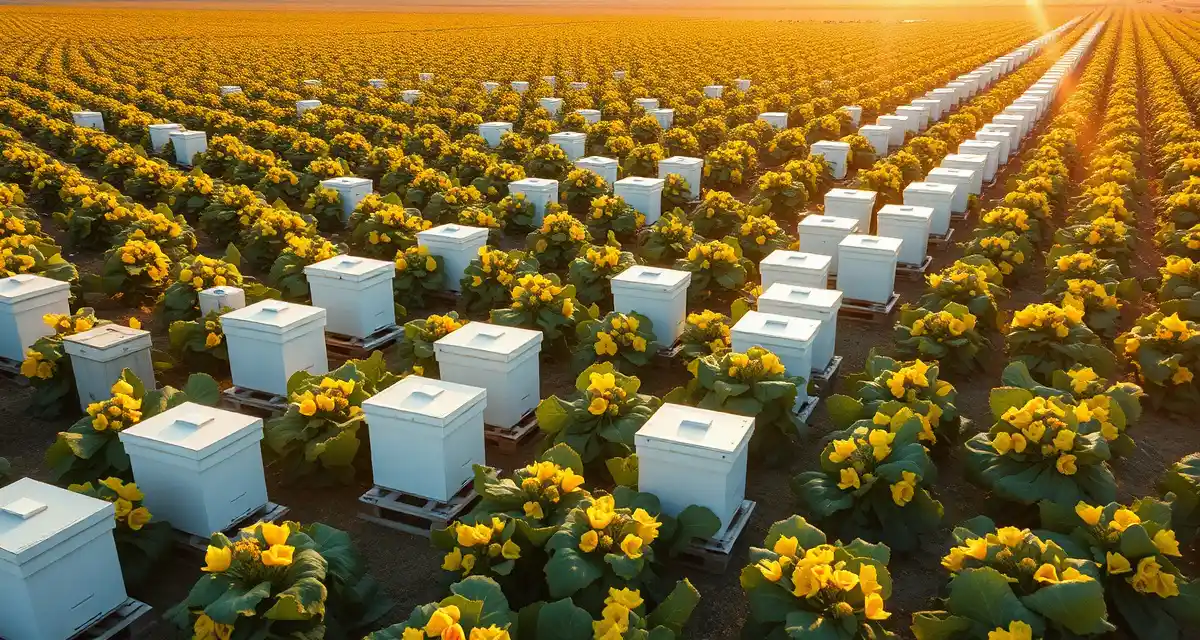
Melon Pollination Tracking and Contract Management
Arizona and California desert melon growers require up to 1.5 hives per acre for commercial production, and melon bloom alerts in PollenOps account for regional planting date variation from Florida in March to Arizona in May. The melon market spans the full southern tier of the US from winter Arizona placements to summer California Central Valley season, and managing contracts across these geographies requires tools calibrated for each region's specific growing calendar.
PollenOps melon pollination tracking handles watermelon, cantaloupe, and honeydew contracts with variety-specific placement timing, GPS hive management, and the documentation that protects you in the common scenario where grower expectations about pollination outcome don't match what you can contractually guarantee.
TL;DR
- Cucurbits (melons, cucumbers, squash, pumpkins) require bee pollination for fruit set and are grown commercially in multiple states with overlapping seasons.
- Watermelon and cantaloupe are the highest-value commercial cucurbit crops for pollination contracts, with demand concentrated in the Southeast and Southwest.
- Pollination rates for cucurbit crops typically run $50-90 per hive, lower than tree fruit but with shorter placement periods.
- Cucurbit crops are highly sensitive to pesticide exposure, requiring clear communication with growers about spray schedules.
- Bee placement timing is critical: hives should enter the field when 10-20% of female flowers are open.
Melon Pollination Biology
Watermelon, cantaloupe, and honeydew all require bee cross-pollination for fruit set. Each produces separate male and female flowers (monoecious), and bees must transfer pollen from male flowers to the short-lived female flowers for fruit development.
Watermelon: Female flowers are receptive for a single day and require multiple bee visits (typically 8 to 12) for full fruit development. Seedless triploid watermelon production plants triploid (seedless) varieties in rows with diploid pollenizer varieties, requiring active bee movement between pollenizer rows and the seedless crop rows.
Cantaloupe: Female flowers have a slightly longer receptivity window than watermelon but still require same-day pollination. Well-pollinated cantaloupes have more developed flesh, better symmetry, and improved Brix sugar content. Poorly pollinated cantaloupes produce smaller, less uniform fruit with reduced pack-out value.
Honeydew: Similar cross-pollination requirements to cantaloupe, with smooth-skinned female flowers that require bee visits for seed set and fruit development.
The commercial grower's primary pollination concern is fruit set consistency across the field. Patchy pollination produces irregular harvest dates and pack-out variability that costs growers more than the pollination service itself.
Bloom Alert Calibration by Region
Melon planting schedules vary dramatically by region, and bloom timing is driven by days-to-bloom from planting combined with cumulative heat unit accumulation. A Florida March-planted watermelon crop blooms very differently from an Arizona May-planted crop and a California June-planted crop.
PollenOps melon bloom alerts are configured with the grower's planting date at contract entry, then calculate expected first female flowering based on regional growing degree day accumulation. The system fires a delivery alert at the appropriate lead time before expected female flower opening.
For operators running the full melon season from Florida in March through California in August, maintaining separate contract records with region-specific bloom alert configurations for each grower prevents the calendar confusion of managing 8 simultaneous contracts across 4 states with different growing season timelines.
Seedless Watermelon Placement Strategy
Seedless watermelon production is the most placement-sensitive melon contract because of the pollenizer row ratio management. Standard seedless watermelon production plants pollenizer rows at a 1:2 or 1:3 ratio (one pollenizer row per 2 or 3 seedless rows). Bees must carry pollen from the pollenizer rows to the seedless rows in both directions to ensure adequate coverage across all seedless plants.
Hive clusters positioned adjacent to pollenizer rows ensure that foragers establish on those rows first and then distribute across the field. Clusters positioned only on the field perimeter or in the center may not effectively serve the full pollenizer-to-seedless row movement pattern.
Discuss pollenizer row positions with the grower before placement and request a field map if available. Knowing where the pollenizer rows are relative to your placement clusters allows you to optimize coverage across the critical pollen-source rows.
Southeast Melon Market
Georgia, Florida, North Carolina, and South Carolina represent the Southeast melon pollination market:
Florida: Early spring planting in Collier and Hendry counties blooms in March and April. Winter watermelon in the Immokalee area is a significant market for operators wintering in south Florida.
Georgia: Crisp County's commercial watermelon production, which calls itself the "Watermelon Capital of the World," blooms in May through June. Adjacent Worth, Dooly, and Wilcox counties add further volume.
Carolinas: North and South Carolina watermelon and cantaloupe production runs May through August.
The melon pollination contracts regional overview connects the Southeast market context to the bloom timing alerts calibration for the region.
Desert Southwest Melon Market
Arizona's Yuma County and California's Imperial Valley produce early-season melons in warm desert conditions that allow February through April harvest on a timeline that no other US region can match. The desert climate also creates the highest hive density requirements: up to 1.5 hives per acre for commercial production in the heat, where individual bee foraging efficiency is affected by midday temperature peaks.
Water access at hive sites in desert melon country is non-negotiable. Colonies without water in 100-degree Arizona conditions reduce foraging activity significantly within 24 hours. Include explicit water access requirements in your Arizona and Imperial Valley melon contracts.
Pricing Melon Pollination Contracts
Melon rates vary by region and season:
- Arizona and California desert (January to May): $70 to $100 per hive
- California Central Valley (May to August): $70 to $110 per hive
- Southeast US (March to August): $60 to $90 per hive
The lower per-hive rates compared to tree fruit are offset by the extended season and the potential for multiple placements per grower relationship across a single season's multiple planting dates.
Frequently Asked Questions
When should hives be placed in melon fields for pollination?
hive placement should occur when the first female flowers are about to open, typically at the appearance of the first female flower buds or when a small number of female flowers have just opened. Placing hives too early before female flowers are present reduces forager establishment on the crop. PollenOps bloom alerts calculate expected first female flowering from your grower's planting date using regional growing degree day accumulation, providing advance notice of the target placement window with enough lead time for delivery logistics.
How many hives per acre do watermelon growers need?
Standard commercial watermelon production requires 0.5 to 1 hive per acre for fresh market open-pollinated varieties. Seedless triploid production requires 1 to 1.5 hives per acre to ensure adequate pollenizer pollen movement across the pollenizer-to-seedless row ratio. Desert Southwest operations in Arizona and California's Imperial Valley specify up to 1.5 hives per acre due to the higher heat that reduces individual bee foraging efficiency. Confirm the specific density requirement in each grower's contract rather than applying a single standard across all melon operations.
How do I price a melon pollination contract compared to an almond contract?
Melon rates run $60 to $110 per hive depending on region and season, compared to $180 to $220 per hive for California almonds. The lower per-hive rate reflects the lower per-acre crop value of commercial melon production and the longer placement period per contract. Melon's economic advantage over almond comes from the extended season: a single melon grower relationship with multiple planting dates can generate 2 to 3 placement fees from the same location over a summer season. Model your melon contract economics on total seasonal revenue per yard location rather than individual placement value.
What is the difference between commercial and hobby beekeeping?
Commercial beekeeping is distinguished by scale (typically 100+ hives, often 500-5,000+), revenue source (pollination contracts and bulk honey sales rather than local honey retail), and management approach (systematic protocols applied across yards rather than individual colony attention). Commercial operators manage bees as an agricultural enterprise, with the administrative, regulatory, and logistical complexity that entails. Most commercial operators derive the majority of their income from pollination services; honey production is a supplementary revenue stream.
How many hives are needed to make commercial beekeeping a full-time income?
Most beekeeping economists put the full-time commercial threshold at 500-800 hives, assuming efficient operations management and a combination of pollination and honey revenue. At 500 hives and $200/hive for almond pollination, almond season alone generates $100,000 in gross revenue before expenses. Net margins depend on operational efficiency, but well-run operations can achieve 30-50% net margins on pollination revenue. Additional crops and honey production improve per-hive economics but require additional management capacity.
What is the annual revenue potential for a 1,000-hive commercial operation?
A 1,000-hive operation running an almond season ($200/hive) plus blueberry or apple contracts ($80-100/hive) plus summer honey production ($25-40/hive after extraction costs) can generate $300,000-360,000 in annual gross revenue. Net margins after transport, crew, equipment, and hive replacement costs typically run 25-40% for well-managed operations, putting net income at $75,000-145,000 annually. The specific number depends heavily on circuit efficiency, loss rates, and contract quality.
Try These Free Tools
Sources
- USDA Agricultural Research Service
- Bee Informed Partnership
- American Beekeeping Federation (ABF)
- USDA National Agricultural Statistics Service
- Project Apis m.
Get Started with PollenOps
Cucurbit pollination contracts cover a diverse range of crops, regions, and timing windows that require organized tracking to manage alongside your other seasonal commitments. PollenOps keeps all your contracts in one system regardless of crop type.