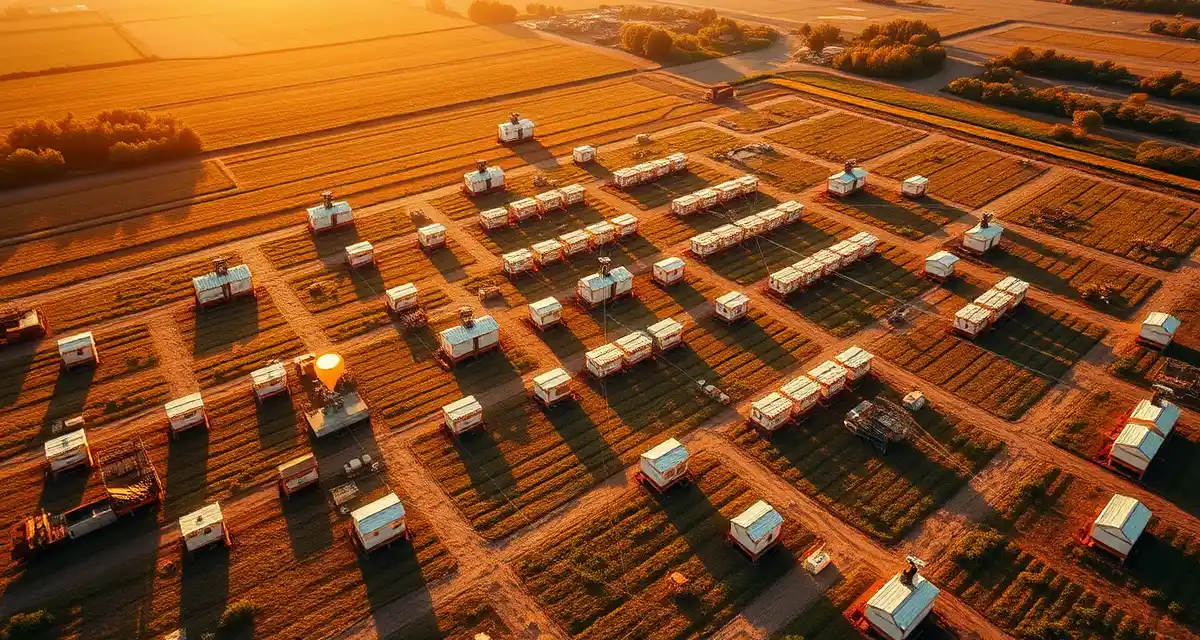
Managing Multiple Bee Yard Locations
Managing more than 5 yards manually increases scheduling error rates by 300%. That's not a minor operational tax. It's the difference between running your business and constantly reacting to mistakes you made in your own records.
Most commercial beekeepers hit the manual management ceiling somewhere between 8 and 12 yards. Below that threshold, a good spreadsheet and strong memory can work. Above it, the complexity of tracking dozens of locations, hive counts, move histories, and contract associations across multiple seasons is more than any manual system handles reliably.
Managing multiple bee yard locations well requires a system that scales without adding proportional administrative burden. PollenOps is built for that.
TL;DR
- Commercial beekeeping operations face two primary management challenges: operational logistics (hive health, transport, placement) and administrative coordination (contracts, payments, documentation).
- Most disputes and revenue losses in commercial beekeeping are preventable with better documentation and clearer contract terms.
- The operations that run most profitably are those with disciplined systems for tracking hive health, contract status, and fleet logistics in one place.
- PollenOps is built specifically for the operational complexity of commercial-scale pollination services, not adapted from a hobbyist tool.
- The most important management decisions (treatment timing, contract renewal, hive allocation) require accurate current data to make well.
Why Multiple Yard Management Gets Hard
Hive Tracks Pro supports yard management but lacks GPS history and contract integration. That combination matters more than it might seem.
GPS history means you can retrieve the exact location of a yard you visited once, two seasons ago, without relying on notes or memory. Contract integration means the yard record shows you not just what's there, but why: which grower, which contract, what the delivery and pickup obligations are.
Without those integrations, managing 25 yards means maintaining parallel records in separate systems, manually linking them, and updating them separately when conditions change. That's the manual overhead that drives error rates up.
With PollenOps, the yard record is the hub. Everything else (contract, move history, bloom alerts, employee assignments) attaches to the yard record and stays synchronized automatically.
Building Your Yard Database
Start with GPS, Not Addresses
The first principle of managing multiple yard locations is that every yard needs a precise GPS location, not just a mailing address. Addresses are ambiguous (which gate? which entrance?), sometimes wrong (rural addresses vary by county), and useless for navigation in areas without address coverage.
GPS coordinates captured by the PollenOps mobile app when you check in at the yard are unambiguous, accurate to 3-5 meters, and accessible from any device. Every team member with PollenOps access can navigate to the exact GPS pin.
Bulk yard import in PollenOps lets you add all existing yard locations in under five minutes if you have a list of coordinates. If you're building from scratch, check in at each yard on your next visit and the pin is set.
Layer in Yard Context
Beyond location, each yard record in PollenOps holds the operational context that makes it useful:
Access information. Gate codes, landowner contact, best access road, weight restrictions on the approach road.
Site characteristics. Water availability, shade coverage, proximity to pesticide risk areas, any special equipment needs.
Capacity. Maximum hive count the site can support based on foraging range and physical space.
Landowner agreement. Lease status, lease term, payment structure. See pollination yard lease management for how to track this alongside your pollination contracts.
Historical performance. How have hives performed at this site historically? Notes on exceptional honey flows, poor pollination performance, past incidents.
Assign Employees to Yards
For operations with multiple crew members, yard assignments establish responsibility. When a yard is assigned to a crew member in PollenOps, that person's check-ins appear prominently in the yard record and they receive notifications for that yard's upcoming events.
See beekeeper employee management for how team assignment and yard responsibility work in PollenOps.
Viewing All Yards on a Single Map
The map view in PollenOps shows every yard simultaneously as pins on an interactive map. Active yards (currently occupied with hives) and inactive yards (available for placement) are distinguished by different markers.
From the map view, you can:
- See the geographic distribution of all your yards at once
- Identify clustering opportunities for efficient routing
- Check which yards are near upcoming bloom alerts for your contracted crops
- Click any yard to see current hive count, last visit date, and any upcoming events
For operations managing 20 to 200 yard locations, this map view is the operational overview that replaces a whiteboard full of pushpins and colored strings.
Filtering the map by state, crop type, contract status, or activity status lets you focus on specific subsets without scrolling through every yard. If you want to see all your California almond yards with active contracts, you get that view in one click.
Managing Hive Count Across Many Yards
Hive count accuracy across multiple yards is one of the most practically important challenges in commercial bee yard management. At any given moment, you need to know your total deployed hive count, available hive count, and the distribution across yards.
PollenOps maintains a live hive inventory that updates automatically with each check-in. When a move event records 80 hives departing yard A and 80 arriving at yard B, both yard records update simultaneously. Your total deployed count remains accurate without manual reconciliation.
Available hive count updates in real time as contracts are signed and hives are moved. This live inventory is what prevents overbooking, the costly mistake of committing more hives to contracts than you have available.
For hive inventory management, the connection between yard records and contract commitments is what makes the inventory meaningful. A yard with 100 hives under a contract commitment shows as committed, not available for a new contract.
Keeping Track of 20 or More Yard Locations
Establish a Naming Convention
Consistent yard naming makes searching and filtering practical. A format like [State]-[Region]-[Landmark] works well: CA-SJV-Smith, WA-Yakima-Johnson, ME-Downeast-Berry1.
Avoid generic names like "Yard 14" or "New Site," as these become unidentifiable in a list of 30 records. Name yards in a way that tells you something about their location at a glance.
Set a Regular Review Cadence
With many yard records, it's easy for some to go stale: no recent visits, outdated hive counts, expired landowner agreements. Set a monthly review of your full yard database in PollenOps.
During the review: which yards haven't had a check-in in over two weeks? Which yards have lease agreements expiring this season? Which yards have inconsistent hive counts between what the record shows and what your last delivery confirmed?
Use the Activity Log for Accountability
Every visit to every yard creates a timestamped activity log entry. If you have employees visiting yards, the activity log shows you who visited, when, and what they recorded, without requiring them to self-report.
For remote yards that you can't personally visit every week, the activity log is your visibility into what's actually happening at the site. A yard that shows no check-ins in three weeks is a yard that may have a problem you don't know about yet.
Archive Inactive Yards Properly
When a yard location is no longer in use, archive it rather than deleting it. Archived yards retain their full history (GPS location, move history, contract associations) but don't appear in your active yard views. This keeps your working dashboard clean while preserving the historical record.
You may need that historical record for a dispute, a state inspection, or your own planning several seasons later.
Can I Assign Employees to Specific Yard Locations in PollenOps?
Yes. PollenOps team management allows you to assign specific yards to specific crew members. The assigned crew member:
- Receives upcoming event notifications for their yards (move alerts, assessment reminders)
- Appears as the responsible party in the yard record
- Can check in and submit field records from the mobile app
From the manager view, you can see all yard assignments, check-in histories by employee, and which yards have no assigned crew member.
This assignment system is particularly useful during peak season when you have multiple crews running in different regions simultaneously. You can see at a glance which yards each crew is responsible for and whether they're staying current with their check-ins.
FAQ
How do I keep track of 20 or more bee yard locations?
Use PollenOps GPS yard database with consistent naming conventions, offline-capable mobile check-ins on every visit, and a weekly or bi-weekly review of your yard dashboard. The map view shows all yards simultaneously with current hive counts and upcoming events. Filter by status, state, or contract to focus on specific subsets. Set up employee yard assignments so each location has a designated responsible team member. Archive inactive yards to keep your working view clean without losing historical records.
Can I assign employees to specific yard locations in PollenOps?
Yes. PollenOps team management allows yard-level employee assignments. Assigned employees receive notifications for upcoming events at their yards and their check-ins are prominently associated with those yard records. From the manager dashboard, you can see all assignments and check-in histories by employee. For operations with multiple crews in different regions, yard assignments create clear accountability without requiring constant phone check-ins.
How do I see all my yards on a single map?
Open the yard dashboard in PollenOps and select the map view. All active and inactive yards appear as pins on an interactive map. Clicking any pin shows the yard summary: current hive count, last visit, upcoming events, and contract status. Use map filters to display only yards matching specific criteria: state, crop type, contract status, or activity. The map view works on desktop and mobile.
What is the difference between commercial and hobby beekeeping?
Commercial beekeeping is distinguished by scale (typically 100+ hives, often 500-5,000+), revenue source (pollination contracts and bulk honey sales rather than local honey retail), and management approach (systematic protocols applied across yards rather than individual colony attention). Commercial operators manage bees as an agricultural enterprise, with the administrative, regulatory, and logistical complexity that entails. Most commercial operators derive the majority of their income from pollination services; honey production is a supplementary revenue stream.
How many hives are needed to make commercial beekeeping a full-time income?
Most beekeeping economists put the full-time commercial threshold at 500-800 hives, assuming efficient operations management and a combination of pollination and honey revenue. At 500 hives and $200/hive for almond pollination, almond season alone generates $100,000 in gross revenue before expenses. Net margins depend on operational efficiency, but well-run operations can achieve 30-50% net margins on pollination revenue. Additional crops and honey production improve per-hive economics but require additional management capacity.
What is the annual revenue potential for a 1,000-hive commercial operation?
A 1,000-hive operation running an almond season ($200/hive) plus blueberry or apple contracts ($80-100/hive) plus summer honey production ($25-40/hive after extraction costs) can generate $300,000-360,000 in annual gross revenue. Net margins after transport, crew, equipment, and hive replacement costs typically run 25-40% for well-managed operations, putting net income at $75,000-145,000 annually. The specific number depends heavily on circuit efficiency, loss rates, and contract quality.
Try These Free Tools
Sources
- USDA Agricultural Research Service
- Bee Informed Partnership
- American Beekeeping Federation (ABF)
- American Honey Producers Association
- Project Apis m.
Scale Without the Chaos
Managing 20 yards doesn't have to feel harder than managing 5. The difference is whether you have a system that scales with you or one that demands more manual work at every new yard.
Get Started with PollenOps
Managing a commercial beekeeping operation involves more data, more deadlines, and more moving parts than any general-purpose tool was designed to handle. PollenOps brings contracts, yard records, health documentation, and fleet logistics together in one platform built for the realities of commercial-scale beekeeping.