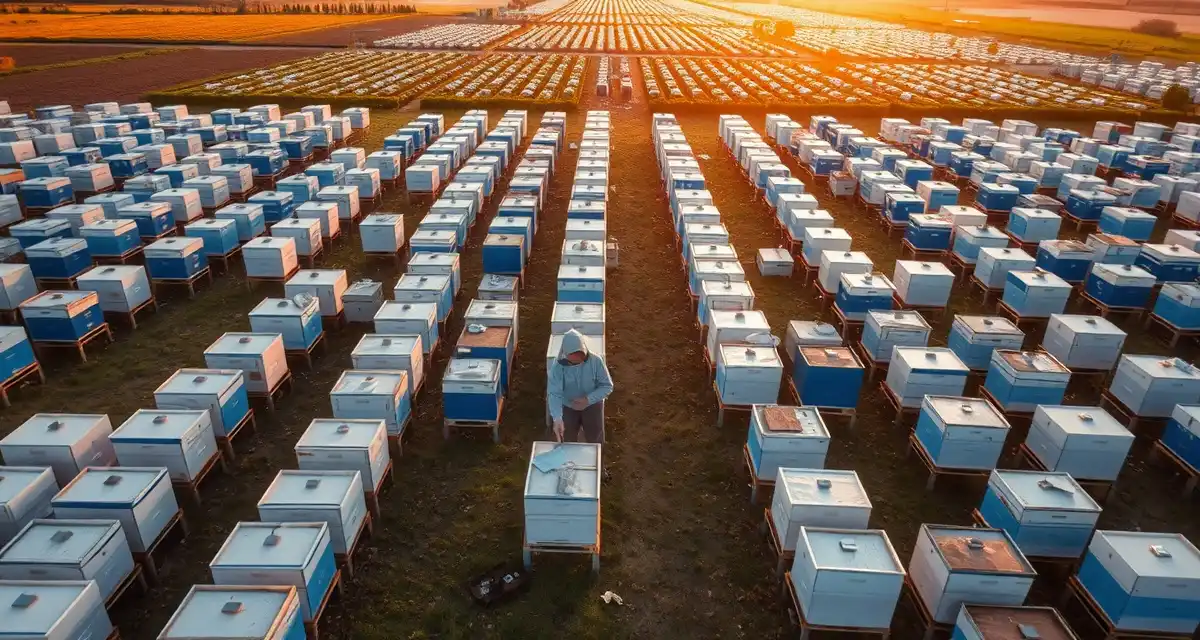
PollenOps for Large Commercial Beekeeping Operations
Operations above 2,000 hives manage an average of 40-120 simultaneous pollination contracts. At that scale, the question isn't whether you need software. It's whether your software was built for what you're running.
PollenOps is purpose-built for operations from 2,000 to 10,000+ hives. The $89/month commercial plan scales to unlimited hives with full team management and API access. No tier that stops at 500 hives, no feature walls, no adding seats as a cost center. If you're running a large commercial operation and your current tools are a patchwork of apps that don't talk to each other, this is the alternative.
TL;DR
- Commercial beekeeping operations that manage contracts on spreadsheets and phone calls spend 5-10 hours per week on administrative tasks that software handles automatically.
- Purpose-built beekeeping software centralizes contract lifecycle management, yard records, health documentation, and fleet logistics in one platform.
- The primary ROI drivers for operations software are fewer contract disputes, faster invoicing, and reduced time spent on administrative coordination.
- PollenOps is built specifically for commercial-scale pollination operations; it is not a hobbyist platform adapted for commercial use.
- Moving from spreadsheets to dedicated software typically pays for itself within one season in time savings and dispute prevention.
What Changes at Scale
Small operations have one beekeeper who knows everything. Large operations have teams, trucks, yards spread across multiple states, dozens of active grower relationships, and simultaneous contracts that all need documentation and management.
The problems that emerge at scale:
Team coordination: Multiple crew members working different yards need to record assessments, deliveries, and health data in the same system. A paper log in one truck doesn't help the manager reviewing colony status from the office.
Contract complexity: 40-120 simultaneous contracts means 40-120 growers, 40-120 delivery windows, 40-120 invoices. Managing this manually is a full-time job for multiple people.
Fleet logistics: 5-15 trucks moving colonies between California, Washington, Oregon, and other states require coordinated routing that paper and phone can't reliably manage.
Compliance tracking: Operating in 8-12 states means 8-12 sets of permit and registration requirements, all with different expiration dates and renewal processes.
Data visibility: When an operation this size has a problem, the manager needs to see it in real time, not when a field crew calls in at the end of the day.
Enterprise Features in PollenOps
Multi-User Team Management
Every PollenOps commercial plan supports multiple user accounts at no additional cost per seat. You define role permissions for each team member:
- Managers/admins: Full access to all features, contracts, financial data, and settings
- Field supervisors: Access to their assigned yards, assessment tools, and delivery recording
- Drivers: GPS-enabled delivery recording, yard access information, and their route assignments
- Office staff: Invoice management, grower communication, payment tracking
Field crew record assessments and deliveries on their phones. That data is instantly visible to the manager on the dashboard. No phone calls, no transcription, no delay.
Contract Pipeline at Scale
Managing 100 simultaneous contracts in PollenOps is operationally similar to managing 10. The platform is built for volume.
The contract pipeline view shows all active contracts sorted by delivery date, payment status, or grower. You can filter by crop, by state, by payment status, or by crew assignment. When an invoice is overdue, it's flagged in the pipeline without you having to scan through individual contracts.
For large-scale pollination operations, the contract pipeline is the single most-used feature for daily management visibility.
GPS Fleet Management
Large operations run multiple trucks on coordinated routes. PollenOps fleet management includes:
- GPS tracking for all fleet vehicles in real time
- Route optimization for multi-yard moves
- Yard-by-yard scheduling with crew assignments
- Fuel and mileage logging
- Truck availability and maintenance tracking
When you have three trucks running to different yards in two states on the same day, the fleet view shows you where each vehicle is, what yards they've completed, and what's still outstanding. No calls asking "where are you?"
API Access for Custom Integrations
Large operations often have proprietary tools: custom accounting systems, proprietary inventory management, IoT sensor networks. PollenOps API access (included in the commercial plan) lets you connect external tools to PollenOps data.
Common large-operation API use cases:
- Exporting invoice data to enterprise accounting systems
- Connecting IoT hive sensors to PollenOps health monitoring
- Building custom dashboards on top of PollenOps data
- Integrating PollenOps contract data with accounting or ERP systems
Health Monitoring at Scale
For operations managing 2,000-10,000 hives, manual visual inspection of every colony on a monthly schedule isn't operationally feasible. PollenOps health monitoring connects to acoustic sensor networks that monitor colony health between manual inspections.
The health module flags colonies showing abnormal acoustic signatures associated with disease stress, queen failure, or varroa infestation. The alert is linked to the contract for that yard, so a health problem in a contracted yard shows up as a contract risk alert, not just a health note.
Early detection at scale changes your management calculus. Instead of discovering a colony problem at delivery, you're catching it 2-3 weeks earlier when there's time to treat, combine, or replace.
Scaling Without Proportional Overhead
The operational question for large operations isn't just "does it work?" It's "can it scale without requiring proportional staff growth?"
The answer PollenOps provides is yes. Operations at 2,000 hives using PollenOps run with roughly the same administrative overhead as operations at 600 hives on paper and phone systems. The work that scales in a paper system (more contracts = more filing, more phone calls, more manual invoicing) doesn't scale in PollenOps because the system automates it.
An operation that grows from 1,000 to 3,000 hives without adding administrative staff is growing its margin, not just its revenue.
For pollination contract management that scales with your operation, the PollenOps commercial plan is designed for operations where unlimited hive count and team access are requirements, not premium features.
Frequently Asked Questions
What enterprise features does PollenOps offer for large operations?
PollenOps commercial plan features for large operations include unlimited hive tracking, unlimited user accounts with role-based permissions, multi-truck GPS fleet management, a full API for custom integrations with external tools, acoustic sensor integration for remote colony health monitoring, the contract pipeline view for managing 40-120 simultaneous contracts, and automated invoice generation from delivery records. All of these features are included in the flat-rate commercial plan at $89/month, with no per-hive or per-seat fees that would scale with your operation size. The architecture was designed specifically for operations above 2,000 hives that need enterprise-level tools without enterprise-level pricing.
How does PollenOps scale for a 5,000-hive commercial pollination operation?
A 5,000-hive operation can manage all contracts, yards, health records, fleet movement, and grower portals in a single PollenOps account without any architectural changes. The platform handles unlimited hives and unlimited contracts in the commercial tier. For 5,000 hives with 80-150 simultaneous contracts, the contract pipeline view is the primary daily management tool, showing all contracts by delivery date, payment status, and risk flags. Multi-user team access means your field supervisors, drivers, and office staff are all working in the same system, with their data visible to you in real time. API access allows integration with your accounting system and any custom tools.
Can PollenOps support a multi-team beekeeping operation with 15+ employees?
Yes. PollenOps commercial plan includes unlimited user accounts with role-based permissions. You can create accounts for all crew members and assign them specific access levels: drivers who see only their routes and delivery tools, field supervisors who manage their assigned yards and can view health and assessment data, and managers with full administrative access. All 15+ users work in the same platform, and their actions are all logged with user IDs and timestamps. This creates an accountability trail across your entire team and lets you see at a glance who assessed what, who delivered what, and who recorded what payment.
What does purpose-built commercial beekeeping software do that a spreadsheet cannot?
Dedicated software connects data across your operation in ways spreadsheets cannot: a contract record links to the specific hives assigned to it, which links to the yard location, which links to health inspection records and treatment logs. When a grower calls to dispute a hive count, you can pull the delivery record, timestamped photos, and GPS-confirmed location in 30 seconds rather than searching three spreadsheets and an email thread. This integration is where the time savings and dispute-prevention value comes from.
How long does it take to migrate from spreadsheets to beekeeping software?
Most commercial operators complete the core migration in 2-4 weeks, starting with current contract records and active yard locations. Historical data (past seasons' inspection records, old contracts) can be migrated over time rather than all at once. The practical recommendation is to start with the current season's live data and add historical records as time allows. The operational improvement from having current data in the system is immediate; the historical data adds analytical depth over subsequent seasons.
Is there a free trial available for PollenOps?
Contact PollenOps directly to confirm current trial and demo options. Most commercial operators benefit from a walkthrough of the contract management and yard tracking modules against their own operation's data before committing, since the fit between the platform and your specific circuit and crop mix is the most important evaluation factor.
Try These Free Tools
Sources
- USDA Agricultural Research Service
- Bee Informed Partnership
- American Beekeeping Federation (ABF)
- American Honey Producers Association
- Project Apis m.
Get Started with PollenOps
Commercial beekeeping operations that move from spreadsheets to purpose-built software consistently report fewer disputes, faster invoicing, and less time on administrative work during peak season. PollenOps is built specifically for commercial-scale pollination operations. See how the platform fits your operation.