Pollination Service Invoicing That Ends Grower Disputes
Invoice disputes are the number one reason commercial beekeepers lose repeat grower contracts. The dispute itself rarely costs more than the revenue from one contract. The loss of the ongoing relationship is what actually hurts.
HoneyBook invoicing lacks hive count verification and bloom timing context. Invoice line items auto-populate from GPS-verified hive arrival data when you're using PollenOps. The difference between those two approaches is the difference between invoices that create disputes and invoices that close them.
This guide covers what goes on a pollination invoice, how to set up your invoicing to prevent disputes, and how to handle the ones that happen anyway.
TL;DR
- Commercial beekeeping operations face two primary management challenges: operational logistics (hive health, transport, placement) and administrative coordination (contracts, payments, documentation).
- Most disputes and revenue losses in commercial beekeeping are preventable with better documentation and clearer contract terms.
- The operations that run most profitably are those with disciplined systems for tracking hive health, contract status, and fleet logistics in one place.
- PollenOps is built specifically for the operational complexity of commercial-scale pollination services, not adapted from a hobbyist tool.
- The most important management decisions (treatment timing, contract renewal, hive allocation) require accurate current data to make well.
How Do I Invoice a Grower for Pollination Services?
The mechanics of pollination invoicing are straightforward. The execution is what separates professional beekeeping businesses from informal ones.
When to Invoice
Invoice as close to delivery as possible. Same day is best practice. Within 48 hours is acceptable. Invoicing weeks after delivery is where accuracy problems start: you're relying on memory for count and timing details that should have been captured at delivery.
If your delivery documentation is systematic (GPS records, hive count per pallet, photographs) then invoicing from that documentation is fast and accurate. You're not remembering what you delivered; you're reading what the system recorded.
Invoice Delivery Method
Commercial growers expect invoices electronically. Email with a PDF attachment is the minimum standard. A portal where growers can log in and access current and historical invoices is the professional standard.
Send the invoice to the right person. Large grower operations may have different contacts for operations (who coordinates delivery timing) and accounts payable (who processes payments). Know who your invoice goes to and send it there.
Payment Method Options
Include clear payment instructions on every invoice. The easier you make it to pay, the faster you get paid:
- Bank ACH transfer (preferred for large amounts, no processing fee)
- Check (acceptable but slower)
- Credit card (fast, but processing fees apply; decide whether to absorb or pass through)
Specify preferred method on the invoice, with secondary options noted. Don't make growers guess how you want to be paid.
What Should a Pollination Invoice Include?
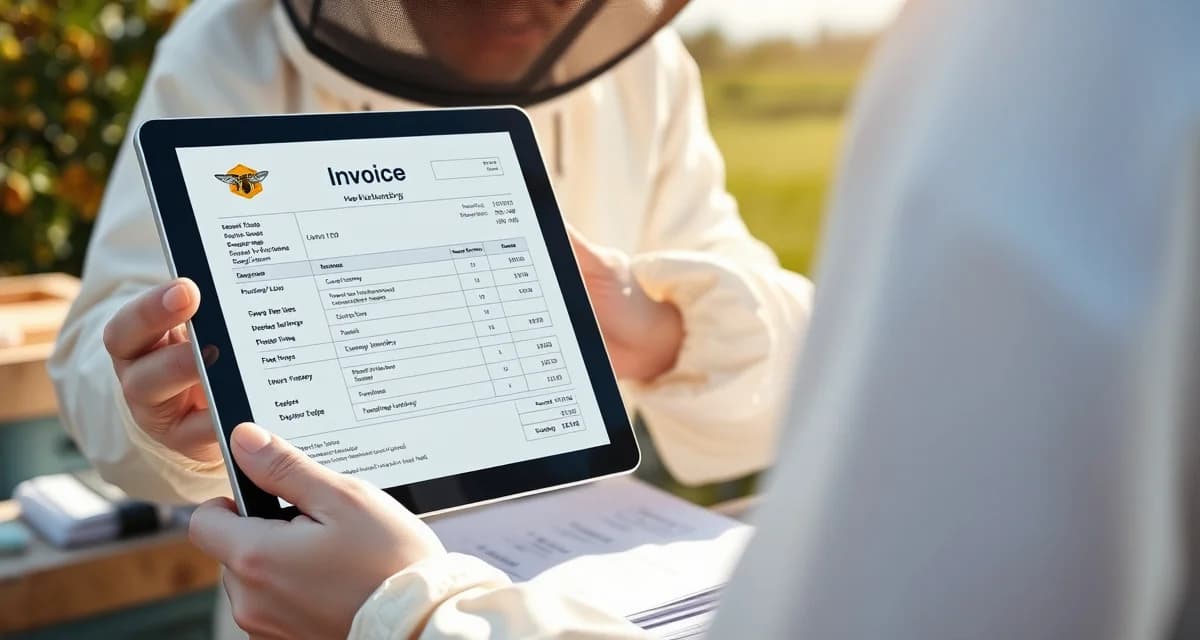
A complete, professional pollination invoice contains:
Header information:
- Your business name, address, and contact information
- Invoice date and unique invoice number
- Payment due date
- Grower name and billing address
Contract reference:
- Contract number or reference
- Contract date
Delivery details:
- Delivery date(s)
- Delivery location (specific yard address or GPS coordinates)
- Number of hives delivered
- Colony strength at delivery (frames of bees, especially important for contracts with strength guarantees)
- Comparison to contracted quantity (e.g., "200 hives delivered per 200-hive contract")
Financial summary:
- Per-hive rate
- Total hives × rate
- Any applicable early removal fees, fuel surcharges, or other contractual adjustments
- Total amount due
Supporting documentation references:
- Reference to attached delivery documentation (GPS records, photos)
- Reference to inspection certificates if applicable
Payment terms and instructions:
- Due date (Net 30, Net 45, or as specified in contract)
- Late payment terms if applicable (interest rate or fee)
- Payment instructions (ACH routing info, mailing address for check)
This isn't bureaucratic overkill. Every element serves a purpose. The contract reference connects the invoice to the agreement. The delivery details confirm you performed. The documentation references give growers confidence in the numbers. The payment instructions eliminate friction.
Connecting Invoices to Delivery Documentation
The single biggest change that reduces invoice disputes is connecting invoice numbers to verified delivery data.
When your invoice says "200 hives delivered" and a grower calls to question that number, what happens next depends entirely on what documentation exists.
Without delivery documentation: "We counted 200." "We counted 185." Discussion goes nowhere. Grower relationship damaged.
With GPS-verified delivery records: "Here's the delivery record showing 200 hives at your yard, photographed and GPS-tagged at 11:47 PM on February 12th. Here's the breakdown: 4 pallets of 50 hives each." Discussion ends. Invoice gets paid.
This is why invoice line items should auto-populate from GPS-verified hive arrival data rather than being manually entered. When the delivery data and the invoice data come from the same source, discrepancies between what you delivered and what you invoiced don't happen. And when a grower questions your count, you're pointing to the same objective record they could look up themselves.
How Do I Handle Partial Payment Disputes on a Pollination Contract?
Partial payment disputes happen when a grower pays less than the invoiced amount, either explicitly (sending a reduced payment with an explanation) or implicitly (just sending a check for a different amount).
Step 1: Document the Discrepancy Immediately
When a partial payment arrives, note it immediately with the date, amount received, and the difference from the invoiced amount. Send a written acknowledgment that the payment has been received and note the outstanding balance.
Don't let partial payments sit unaddressed. "I'll deal with that later" turns into a much harder conversation 90 days later.
Step 2: Request the Grower's Explanation
Call the grower or send a professional inquiry: "We received your payment of $X for invoice #XYZ. Per our records, the outstanding balance is $Y. Could you let me know if there was a discrepancy we should address?"
Most growers who send partial payment have a specific reason: a count dispute, a strength dispute, or a mistake in their accounts payable process. Get the specific reason before responding.
Step 3: Compare to Your Documentation
If the grower believes you delivered fewer hives than invoiced, pull your delivery documentation. GPS records and photographs don't lie. If your documentation shows 200 hives and the grower says 180, present the documentation.
If the grower has their own documentation (photos, a count from their agronomist), request it. Disputes resolved by comparing documentation are objective. Disputes resolved by who argues more persuasively are not.
Step 4: Resolution Options
In the most common scenarios:
- Your documentation confirms your count → send a formal demand for the outstanding balance with documentation attached
- Documentation is genuinely ambiguous → negotiate a compromise payment that reflects reasonable uncertainty
- You discover an error on your invoice → correct it and accept the correct amount
Step 5: Prevention is Cheaper Than Resolution
Every dispute resolved is a relationship strained. Strong delivery documentation prevents most disputes entirely. The hive count verification process (GPS records, photography, written count) costs 15 minutes per delivery and prevents hours of dispute resolution work.
Late Payment Management
Commercial beekeeping has a well-documented late payment problem. The seasonal concentration of revenue (most pollination income arrives February through May) creates cash flow pressure for growers in agricultural commodity businesses who may themselves be waiting on financing or crop sale proceeds.
Payment Terms That Work
Contract terms should specify payment timing explicitly:
- On delivery: Aggressive, rarely accepted by large operations
- Net 15: Tight for agricultural payments but appropriate for small contracts
- Net 30: Standard for most commercial pollination
- Net 45 or Net 60: More common with large agricultural operations that have AP processing cycles
Include a late payment provision in your contract, typically 1.5% to 2% per month on outstanding balances after the due date. Whether you enforce this rigidly depends on the relationship and the amount, but having it in the contract creates urgency to pay on time.
Following Up on Late Invoices
Follow up systematically:
- 5 days before due date: friendly reminder ("Just wanted to confirm invoice #XYZ is on your radar for payment by [date]")
- 7 days after due date: professional inquiry ("Invoice #XYZ was due on [date]. Can you let us know the payment status?")
- 21 days after due date: firm communication with documentation attached and discussion of next steps
Most commercial growers are not trying to stiff you. They're often dealing with their own cash flow, AP backlogs, and processing cycles. Persistent, professional follow-up resolves most late payments.
Pollination Contract Software for Invoicing
Pollination service invoicing works best when it's connected to the rest of your contract management system. An invoice that auto-populates from verified delivery data, connects to a grower-facing portal where they can access it, and tracks payment status automatically is a fundamentally different experience than manually building an invoice in Excel and emailing a PDF.
The connection between delivery documentation, invoice generation, and payment tracking is where beekeeping invoicing software creates real operational value. When those three functions share data, accuracy improves and the overhead of managing accounts receivable across a large grower portfolio becomes manageable.
FAQ
How do I invoice a grower for pollination services?
Invoice electronically, as close to delivery as possible. Base the invoice on your verified delivery documentation: GPS-recorded hive count and delivery confirmation. Include contract reference, delivery date and location, number of hives delivered (compared to contracted count), colony strength results, per-hive rate, total amount, payment terms, and payment instructions. Attach delivery documentation references so growers can verify the numbers independently.
What should a pollination invoice include?
A complete pollination invoice includes: your business identification and the grower's billing information, invoice date and unique number, contract reference, delivery date and location, number of hives delivered versus contracted, colony strength at delivery, per-hive rate and total due, payment due date and late payment terms, payment instructions, and references to supporting delivery documentation. The delivery details are what distinguish a pollination invoice from a generic service invoice and are what prevent disputes about what was actually delivered.
How do I handle partial payment disputes on a pollination contract?
Document the discrepancy immediately when partial payment arrives. Contact the grower to understand the basis for the reduced payment. Compare the grower's stated reason against your delivery documentation: GPS records and photographs. If your documentation supports your original invoice, present it formally and request the outstanding balance. If documentation is genuinely ambiguous, consider a negotiated compromise. Prevention is far more valuable than resolution: systematic GPS-verified delivery documentation prevents most count disputes before they become payment disputes.
What is the difference between commercial and hobby beekeeping?
Commercial beekeeping is distinguished by scale (typically 100+ hives, often 500-5,000+), revenue source (pollination contracts and bulk honey sales rather than local honey retail), and management approach (systematic protocols applied across yards rather than individual colony attention). Commercial operators manage bees as an agricultural enterprise, with the administrative, regulatory, and logistical complexity that entails. Most commercial operators derive the majority of their income from pollination services; honey production is a supplementary revenue stream.
How many hives are needed to make commercial beekeeping a full-time income?
Most beekeeping economists put the full-time commercial threshold at 500-800 hives, assuming efficient operations management and a combination of pollination and honey revenue. At 500 hives and $200/hive for almond pollination, almond season alone generates $100,000 in gross revenue before expenses. Net margins depend on operational efficiency, but well-run operations can achieve 30-50% net margins on pollination revenue. Additional crops and honey production improve per-hive economics but require additional management capacity.
What is the annual revenue potential for a 1,000-hive commercial operation?
A 1,000-hive operation running an almond season ($200/hive) plus blueberry or apple contracts ($80-100/hive) plus summer honey production ($25-40/hive after extraction costs) can generate $300,000-360,000 in annual gross revenue. Net margins after transport, crew, equipment, and hive replacement costs typically run 25-40% for well-managed operations, putting net income at $75,000-145,000 annually. The specific number depends heavily on circuit efficiency, loss rates, and contract quality.
Try These Free Tools
Sources
- USDA Agricultural Research Service
- Bee Informed Partnership
- American Beekeeping Federation (ABF)
- American Honey Producers Association
- Project Apis m.
Get Started with PollenOps
Managing a commercial beekeeping operation involves more data, more deadlines, and more moving parts than any general-purpose tool was designed to handle. PollenOps brings contracts, yard records, health documentation, and fleet logistics together in one platform built for the realities of commercial-scale beekeeping.