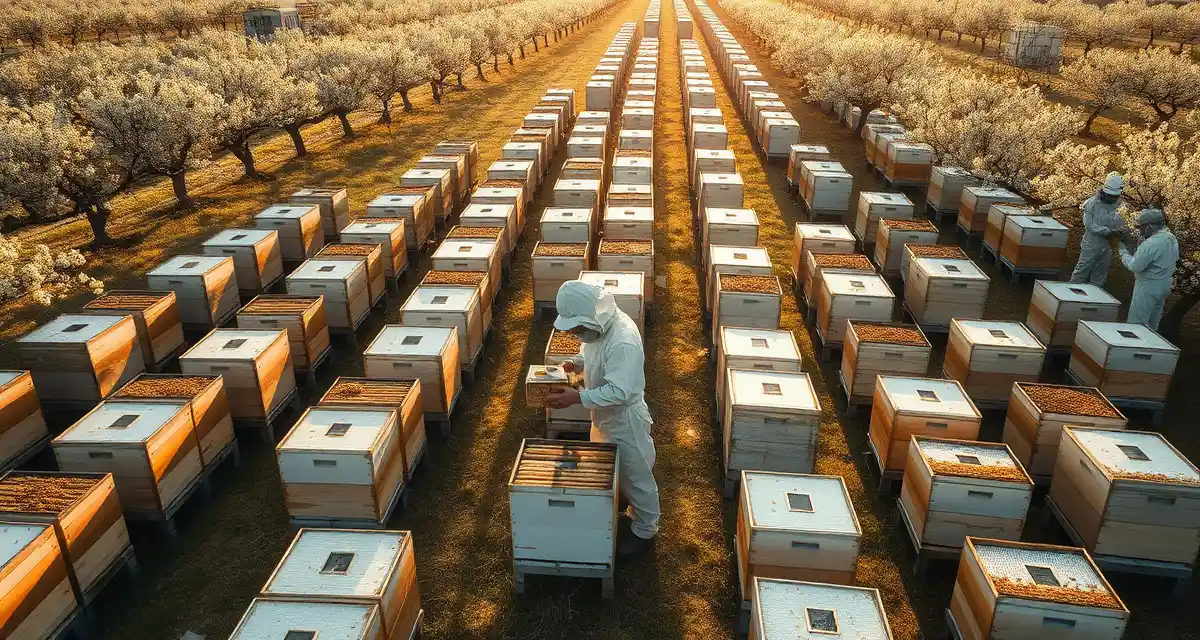
The Complete Pollination Service Business Guide
Commercial pollination beekeepers earn an average of $2,000 to $8,000 per season more than non-pollination beekeepers. That spread represents the value of having the systems, relationships, and operational capability to service commercial growers effectively.
This guide covers every stage of building and running a profitable commercial pollination service, from your first grower conversation to managing a multi-state migratory operation. Each section connects to the PollenOps tools that support that part of your business.
TL;DR
- Commercial beekeeping operations face two primary management challenges: operational logistics (hive health, transport, placement) and administrative coordination (contracts, payments, documentation).
- Most disputes and revenue losses in commercial beekeeping are preventable with better documentation and clearer contract terms.
- The operations that run most profitably are those with disciplined systems for tracking hive health, contract status, and fleet logistics in one place.
- PollenOps is built specifically for the operational complexity of commercial-scale pollination services, not adapted from a hobbyist tool.
- The most important management decisions (treatment timing, contract renewal, hive allocation) require accurate current data to make well.
Part 1: The Economics of Commercial Pollination
Understanding Your Revenue Model
Commercial pollination generates revenue through per-hive contract fees paid by growers in exchange for placing your colonies at their orchards or fields during bloom.
The key revenue variables:
- Hive count: How many hives you can deploy to paying contracts
- Per-hive rate: What each hive earns, which varies by crop and region
- Season length: How many weeks your fleet is earning contract income
A 300-hive operation that works two crops (almonds at $200/hive plus blueberries at $80/hive for 150 hives each) generates $42,000 in gross contract revenue. A 300-hive operation that only works honey production at $100 net per hive per year generates $30,000. The pollination operation earns 40% more.
Your True Cost Floor
Before setting rates, know your costs. True pollination service costs include:
- Variable contract costs: fuel, driver wages, inspection labor
- Overhead allocation: truck depreciation, insurance, software
- Colony maintenance: winter feeding, treatments, queen replacement
- Business costs: accounting, legal, registration fees
Most beekeepers starting pollination services discover their true cost floor is higher than they expected, which means they initially underpriced their work. Building an honest cost model from the start lets you price for profitability, not just to win contracts.
Revenue Benchmarks by Scale
50-100 hives: $10,000-$25,000 per season for a well-managed 1-2 crop operation
200-500 hives: $40,000-$120,000 per season for 2-3 crop contracts
500-1,000 hives: $100,000-$250,000 per season, typically requiring migratory capability
1,000-3,000 hives: $200,000-$700,000 per season for a full migratory operation
These ranges assume primarily pollination income. Honey production adds revenue on top for operations that do both.
Part 2: Building Your Contract Foundation
What Every Pollination Contract Must Include
A verbal agreement is not a contract. A text message thread is not a contract. The document that protects your revenue is a signed written contract that specifies:
Hive count: Exact number of hives contracted. The number you invoice from.
Hive strength minimum: Minimum frames of bees required for contract compliance. For almonds, typically 6-8 frames. For blueberries, typically 5-6 frames. This should be in the contract, not assumed.
Delivery terms: Where, when, and by what bloom percentage threshold hives must be delivered.
Service period: Start date, end date, and any conditions that extend or terminate the service period early.
Payment terms: Total amount, deposit amount and timing, balance due date, payment method, late payment provisions.
Cancellation terms: What happens if the grower cancels, what happens if you cannot deliver.
Dispute resolution: How hive count or strength disputes will be handled, including what documentation governs resolution.
PollenOps pollination contract template includes all standard terms pre-populated, which you can customize for each grower relationship.
Pricing Your Contracts
Pricing starts with your cost floor and adjusts based on market rates and hive quality.
The per-hive rate calculator in PollenOps uses your assessed colony strength and regional market data to suggest a justified price range. When you walk into a grower conversation, you know what the market is paying and what your specific hive quality is worth.
Current market ranges (2025):
- California almonds: $180-$230/hive
- Pacific Northwest cherry: $95-$130/hive
- Michigan blueberry: $70-$90/hive
- Pacific Northwest apple: $50-$80/hive
Building Long-Term Grower Relationships
Your best customers are growers who've worked with you before. Renewal rates of 3+ season clients typically exceed 85%, while first-season clients renew at 55%. The lifetime value of a retained grower client is substantially higher than the cost of acquiring a new one.
What builds retention:
- Consistent, on-time delivery against contract terms
- Professional documentation (grower arrival reports, strength records, invoices)
- Clean, fast dispute resolution when issues arise
- Proactive communication during unusual circumstances
PollenOps grower-facing pollination reports send professional arrival reports within hours of each delivery, establishing a documentation standard that growers come to expect and value.
Part 3: Bloom Timing and Operations
The Bloom Timing Problem
Missing a 3-day peak bloom window can reduce a grower's crop set by 20-40%. For a beekeeper, it affects contract performance scores and renewal conversations. The manual approaches to bloom timing tracking, last year's dates, grower phone calls, farm publications, are all too imprecise for a multi-contract, multi-crop operation.
PollenOps bloom timing alerts solve this by monitoring real-time bloom conditions at your specific yard locations and firing alerts 5-7 days before peak receptivity. The alerts connect to your contract calendar so you go from alert to action without re-entering data.
Crop-Specific Timing Considerations
Almonds: 10-25% bloom is the target placement window. Earlier is better than later. District-specific alerts for the Central Valley cover the 2-3 week bloom window that sweeps from Bakersfield north.
Cherries: 5-10 day bloom window with elevation-adjusted timing across the Pacific Northwest. Cascade scheduling from lower to higher elevation orchards is the key operational pattern.
Blueberries: Highbush and wild varieties bloom separately. Michigan main season runs mid-May. Maine wild blueberry runs June. Oregon Willamette Valley runs late April through May.
Apples: Stage-based tracking from green tip through petal fall. Placement target is pink to 5% bloom.
Pre-Move Strength Assessment
Before any hive leaves your yard for a contract placement:
- Open and assess every hive (frames of bees, frames of brood)
- Record scores in PollenOps mobile checklist
- Flag any hive below the contract minimum
- Generate the pre-move strength report
- Load only hives that meet contract specifications
This process, systematically applied, eliminates the most common source of pollination contract disputes: the delivered-below-minimum claim.
Part 4: Documentation and Compliance
The Documentation Chain
Every contract placement should generate a complete documentation chain:
- Signed contract with all terms specified
- Pre-move strength assessment report
- GPS delivery record with timestamp and hive count
- Grower arrival notification with report attached
- Service period compliance records
- GPS pickup record with final hive count
- Invoice referencing the delivery record data
This chain creates a defensible record for every contract from first handshake to final payment.
Interstate Compliance
Migratory operations add compliance requirements at every state border:
- Health certificate (30-day validity, required in most states)
- Home state apiary registration
- Destination state apiary registration
- County-level registration in California
- Border station declaration for California entry
- Compliance with any active quarantine orders
PollenOps transport compliance tools track required documentation by state and route, with expiration alerts for health certificates and permits.
Dispute Resolution
When a grower disputes your hive count or delivery, your documentation is the evidence. GPS delivery timestamp shows when bees arrived. GPS delivery location shows where they were placed. Hive count from check-in shows how many were delivered. Strength assessment shows colony condition at delivery.
With complete documentation, most disputes resolve quickly from the facts. Without it, disputes become "my word vs. yours" conversations that take weeks to resolve and sometimes result in partial or lost payment.
Part 5: Scaling Your Operation
The Growth Stages
50-150 hives: Local market focus, 1-3 crop types, direct grower relationships
200-500 hives: Regional market, 2-4 crop types, possible short-haul migratory routes
500-1,000 hives: Full regional or early migratory operation, dedicated truck, 5-15 contracts
1,000-3,000 hives: Multi-state migratory, fleet of trucks, full-time staff, 20-50+ contracts
3,000+ hives: Enterprise-level migratory, multiple crew leads, 50-100+ contracts, multi-region capability
Each stage requires different operational systems. The systems that work at 200 hives don't scale to 2,000 without intentional platform upgrades.
When to Hire
The hire decision often comes at the 300-500 hive level when:
- You can't physically service all your yards on your own schedule
- Contract deliveries require simultaneous truck runs
- Pre-move assessments take more time than your personal schedule allows
- Administrative work (contracts, invoices, compliance) is consuming time you should spend on bees
The first hire is often the hardest operational transition. Systems that work when only you know the full picture need to be documented and systematized for someone else to execute reliably. PollenOps creates those systems as a byproduct of daily documentation.
Financing Growth
Commercial beekeeping growth is capital-intensive. Adding 200 hives requires purchasing equipment, managing increased operational costs before the revenue arrives, and building the contractual commitments that justify the investment.
Growth financing options include:
- USDA FSA loans for beginning farmers and established agricultural operations
- State agricultural development loans (available in many major beekeeping states)
- Equipment financing for trucks and trailers
- Retained earnings reinvestment (the slowest but most common path)
The revenue predictability that formal contracts create is an asset for financing conversations. A lender or investor looking at $150,000 in contracted pollination revenue for the coming season has something concrete to evaluate.
Part 6: Technology and Systems
Why Software Is an Operational Necessity at Scale
At 50 hives and 3 contracts, you can manage with spreadsheets. At 500 hives and 25 contracts, spreadsheets generate the errors that lose you contracts, revenue, and grower relationships.
The shift from "works fine" to "failing" typically happens between 200-500 hives. By the time operations reach this size, they've usually had at least one painful experience, a missed bloom window, a disputed invoice, an overbooking error, that would have been prevented by integrated software.
The most successful commercial pollination operators adopt software before they need it, not after a failure forces the issue.
PollenOps as Your Operational Platform
PollenOps handles the full operational stack for commercial pollination:
- hive inventory: Live count by location, condition, and contract status
- GPS yard tracking: All yard locations on a single map with offline capability
- contract management: Pollination-specific templates connected to field data
- Bloom timing alerts: 20+ US crops by region
- Move planning: Route optimization with fleet and contract integration
- Team management: Multi-user access with role-specific permissions
- Invoicing: Auto-generated from GPS-verified delivery data
- Compliance tracking: Interstate documents with expiration alerts
- Reporting: Yard history, grower reports, contract compliance summaries
Starting at $49 per month for operations up to 50 hives, with the commercial plan at $89 per month for unlimited hives.
Frequently Asked Questions
What does it take to run a successful commercial pollination service?
A successful commercial pollination service requires strong colonies that consistently meet contract strength specifications, reliable delivery execution with professional documentation, grower relationships built on consistent performance, and operational systems that scale with your hive count. The technical beekeeping skills matter, but the business system, contracts, documentation, bloom timing awareness, is what separates occasional pollination income from a professional commercial operation.
How do I grow a pollination service from 50 hives to 500 hives?
Growth follows a pattern: build your local reputation at small scale with documented performance, use that track record to secure larger regional contracts, reinvest contract revenue into additional hives and equipment, and expand your geographic reach as your capacity and operational systems can support it. The scaling inflection point at 200-300 hives is where most operators transition from spreadsheets to integrated software like PollenOps, because that's where manual systems start generating errors at a meaningful rate.
What are the biggest mistakes new pollination beekeepers make?
The most common mistakes: not using written contracts (leaving revenue unprotected in disputes), underpricing based on incomplete cost calculation, failing to document colony strength before delivery, missing bloom windows by relying on last year's dates, and overcommitting hive inventory by signing contracts without tracking committed capacity. All of these are preventable with the right contract management and documentation systems in place from the beginning.
What is the difference between commercial and hobby beekeeping?
Commercial beekeeping is distinguished by scale (typically 100+ hives, often 500-5,000+), revenue source (pollination contracts and bulk honey sales rather than local honey retail), and management approach (systematic protocols applied across yards rather than individual colony attention). Commercial operators manage bees as an agricultural enterprise, with the administrative, regulatory, and logistical complexity that entails. Most commercial operators derive the majority of their income from pollination services; honey production is a supplementary revenue stream.
How many hives are needed to make commercial beekeeping a full-time income?
Most beekeeping economists put the full-time commercial threshold at 500-800 hives, assuming efficient operations management and a combination of pollination and honey revenue. At 500 hives and $200/hive for almond pollination, almond season alone generates $100,000 in gross revenue before expenses. Net margins depend on operational efficiency, but well-run operations can achieve 30-50% net margins on pollination revenue. Additional crops and honey production improve per-hive economics but require additional management capacity.
What is the annual revenue potential for a 1,000-hive commercial operation?
A 1,000-hive operation running an almond season ($200/hive) plus blueberry or apple contracts ($80-100/hive) plus summer honey production ($25-40/hive after extraction costs) can generate $300,000-360,000 in annual gross revenue. Net margins after transport, crew, equipment, and hive replacement costs typically run 25-40% for well-managed operations, putting net income at $75,000-145,000 annually. The specific number depends heavily on circuit efficiency, loss rates, and contract quality.
Try These Free Tools
Sources
- USDA Agricultural Research Service
- Bee Informed Partnership
- American Beekeeping Federation (ABF)
- American Honey Producers Association
- Project Apis m.
Get Started with PollenOps
Managing a commercial beekeeping operation involves more data, more deadlines, and more moving parts than any general-purpose tool was designed to handle. PollenOps brings contracts, yard records, health documentation, and fleet logistics together in one platform built for the realities of commercial-scale beekeeping.