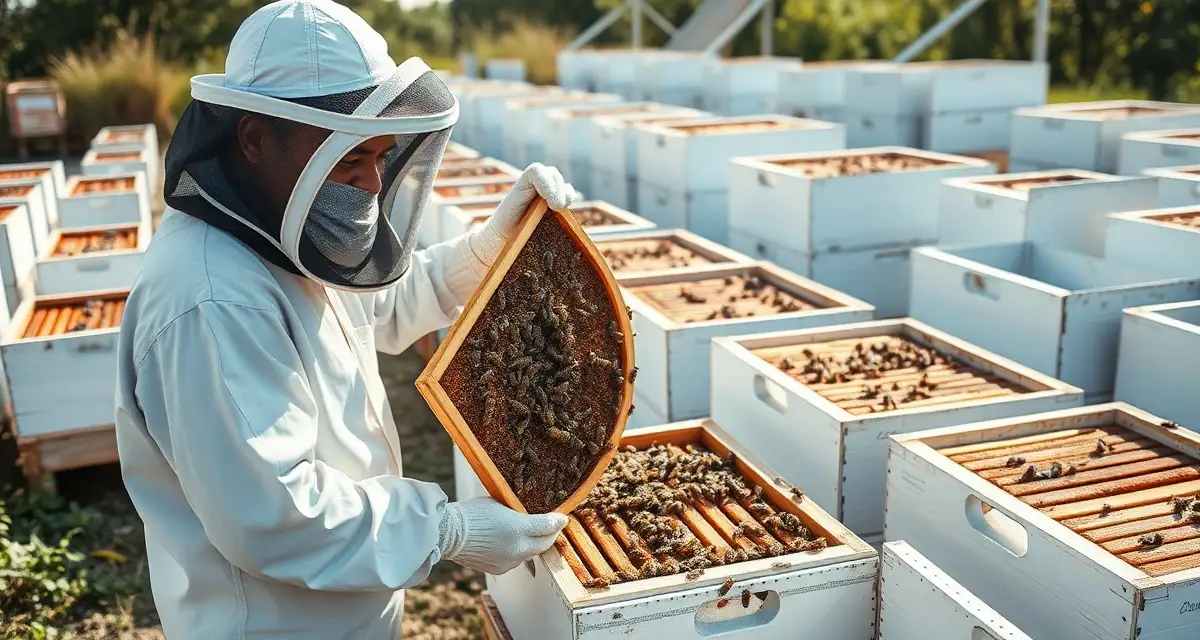
USDA Grants and Programs for Commercial Beekeepers
USDA EQIP's Pollinator Initiative has paid out millions to beekeepers for colony management practices. Most commercial operators who could qualify never apply. The reasons are usually the same: the application process looks complicated, the payments seem small relative to the business, or nobody took the time to figure out which programs actually apply to a large migratory operation.
The USDA Noninsured Crop Disaster Assistance Program covers honey bees and honey production. That alone is worth knowing. But it's one of several USDA programs that provide real money to commercial beekeepers, if you do the paperwork.
TL;DR
- Commercial beekeeping operations face two primary management challenges: operational logistics (hive health, transport, placement) and administrative coordination (contracts, payments, documentation).
- Most disputes and revenue losses in commercial beekeeping are preventable with better documentation and clearer contract terms.
- The operations that run most profitably are those with disciplined systems for tracking hive health, contract status, and fleet logistics in one place.
- PollenOps is built specifically for the operational complexity of commercial-scale pollination services, not adapted from a hobbyist tool.
- The most important management decisions (treatment timing, contract renewal, hive allocation) require accurate current data to make well.
Environmental Quality Incentives Program (EQIP)
EQIP is the primary USDA program that pays commercial beekeepers for management practices. Administered through USDA's Natural Resources Conservation Service (NRCS), EQIP provides cost-share payments for practices that improve conservation outcomes, and several eligible practices align directly with commercial beekeeping management.
Practices that commercial beekeepers can get EQIP payments for:
- Integrated Pest Management for Varroa: EQIP will cost-share varroa management practices including mite monitoring protocols and approved treatment applications. Documentation of varroa counts, treatment timing, and treatment type qualifies for per-colony payments.
- Pollinator Habitat Enhancement: If your operation manages any land that can be seeded with pollinator forage, EQIP cost-shares seed purchase and establishment costs. This is more relevant for operations with fixed yards on owned or leased land.
- Colony Health Monitoring: Some NRCS state offices approve cost-share for acoustic monitoring equipment and colony health assessment systems.
- Winter Feed Supplementation: Protein supplement and carbohydrate feed programs for overwintering can qualify in certain states.
Payment rates are set at the state level and vary significantly. A varroa management practice in California might pay differently than the same practice in North Dakota. Contact your local NRCS office, every county has one, for current payment schedules.
How to apply for EQIP:
- Visit your local NRCS office or apply online at farmers.gov
- Complete a Conservation Program application including operation description and practice list
- NRCS scores applications by resource concern priority, pollinator health scores well in most states
- If funded, you'll receive a contract specifying practices, payment rates, and timeline
The competitive ranking means not every application is funded in the first cycle. Reapply if you're not funded, EQIP allocations vary by year.
Noninsured Crop Disaster Assistance Program (NAP)
NAP covers honey bee colonies and honey production for losses due to natural disasters, adverse weather, or other qualifying events. For commercial beekeeping operations, this is crop insurance for situations where formal crop insurance doesn't exist.
What NAP covers:
- Colony loss due to qualifying disaster events (drought, flood, hurricane, freeze)
- Honey production losses where your actual production falls below the guaranteed amount
- Does not cover normal varroa losses or management failures
To participate in NAP:
- File an application with your local FSA (Farm Service Agency) office before the crop year begins
- Pay a service fee (based on crop and county)
- Report your intended colony count and expected honey production
- If a qualifying disaster occurs, file a Notice of Loss within 15 days of the event
NAP is not automatic. You have to sign up each year before the filing deadline. For commercial migratory operations with colonies in multiple states, you file in your home state or in each state where you have significant production. Talk to your FSA county office about multi-state operations, there's guidance for migratory beekeeping.
The limitation: NAP covers only catastrophic losses under the basic coverage level. Supplemental coverage levels (50-65% of expected production) are available at a higher premium cost but provide meaningful protection against partial production losses.
Livestock Forage Disaster Program (LFP) and Emergency Assistance
Emergency programs that apply to beekeepers:
Emergency Assistance for Livestock, Honeybees, and Farm-raised Fish (ELAP): This is specifically designed for honey bees. ELAP covers losses of honey bee colonies and colony feed due to:
- Adverse weather events
- Disease (including Colony Collapse Disorder qualifying events)
- Naturally occurring events not covered by other programs
ELAP payments are calculated at a flat rate per colony lost above normal mortality thresholds (currently 30% over normal). For commercial operators with documented colony counts, ELAP can provide meaningful recovery payments after significant loss events.
To file an ELAP claim:
- Report colony inventory before the loss event to FSA
- File a Notice of Loss within 30 days of the loss date or 30 days from when the loss is apparent
- Provide documentation: colony counts before and after, loss cause documentation, management records
Without pre-loss documentation of colony counts, ELAP claims are difficult to substantiate. Keep FSA updated on your colony inventory throughout the year, this isn't about compliance, it's about being able to prove your losses.
Specialty Crop Block Grants
The Specialty Crops Competitiveness Act funds grants to state departments of agriculture for projects that enhance specialty crop production, including pollination services. State-level specialty crop grants funded through USDA have supported commercial beekeeping research, pollinator habitat projects, and beekeeper training programs.
These grants don't go directly to individual operations, they go to state agencies or organizations that run programs. But commercial beekeeping associations in your state may have access to specialty crop grant funding for programs you can benefit from, including disease management training, equipment subsidies, or market access programs.
How to benefit: Engage with your state beekeeping association and state department of agriculture. If you're a dues-paying member of a state or national commercial beekeeping organization, those organizations sometimes administer specialty crop grants that benefit members.
SARE (Sustainable Agriculture Research and Education) Grants
SARE funds research and education in sustainable agriculture. The Farmer-Rancher Grant program provides small grants ($7,500-25,000) directly to producers for on-farm research projects.
For commercial beekeepers, SARE grants have funded:
- Varroa management protocol comparisons
- Colony health monitoring technology evaluation
- Pollinator habitat establishment on commercial operations
- New queen rearing system evaluations
The application process involves writing a research proposal with a defined question, methodology, and expected outcomes. If you're already experimenting with different management approaches, which most serious commercial operators are, formalizing that as a SARE project generates both funding and documentation of results.
Applications are competitive and reviewed regionally. SARE regional offices are in the Northeast, North Central, South, and Western US. Contact the relevant regional office for current application cycles and eligibility requirements.
Farm Loan Programs
USDA Farm Service Agency loan programs relevant to commercial beekeeping:
Microloans: Up to $50,000 for operating expenses or equipment. Simplified application process. Relevant for smaller commercial operations buying equipment, bees, or vehicles.
Operating Loans: Up to $400,000 for operating expenses including feed, treatments, and seasonal labor costs. Available to farms that can demonstrate repayment ability.
Farm Ownership Loans: For buying or improving farm real estate. Relevant if your operation owns or plans to buy land for your extraction facility, honey house, or equipment storage.
Interest rates are set by FSA and are typically below commercial bank rates. Application requires a farm business plan, financial statements, and FSA documentation of your operation.
Keeping Documentation for Grant Compliance
Every USDA program requires documentation. The programs that pay the most, EQIP, ELAP, NAP, require records that most commercial operations don't maintain in a form that makes filing easy.
What you need:
- Colony count records by yard and date: Required for NAP and ELAP. A yard-by-yard count at least annually, more often for ELAP.
- Management practice records: Required for EQIP. Varroa monitoring results, treatment applications with dates and products, feed application records.
- Loss documentation: Photos, dead colony counts, weather event records for ELAP and NAP claims.
Paper records work, but they're fragile and hard to transmit. Digital records in an operations platform maintain the audit trail that program administrators require. If you're spending money on varroa treatments and protein supplement anyway, documenting those expenditures in a way that supports EQIP cost-share applications is money left on the table otherwise.
FAQ
What USDA programs are available for commercial beekeepers?
The main programs are: EQIP (cost-share payments for varroa management and colony health practices), NAP (crop insurance for honey production and colony losses from natural disasters), and ELAP (emergency payments for colony losses from weather, disease, or adverse events). USDA FSA loan programs also serve commercial operations needing operating capital. Most programs require advance enrollment, you can't retroactively apply for coverage after a loss event.
How do you apply for EQIP pollinator funding?
Apply through your local USDA Natural Resources Conservation Service (NRCS) office. File a Conservation Program application that identifies your operation, your colony count, and the eligible practices you want to implement. NRCS ranks applications by resource concern score, varroa management for honey bee health scores well in most states. Payment rates are state-specific. Contact your county NRCS office to get current practice payment schedules before applying.
What documentation is required for beekeeping USDA grants?
Documentation requirements vary by program but generally include: colony count records by location and date, management practice records (varroa monitoring results, treatment logs, feed records), financial records demonstrating you're an active commercial producer, and for loss claims, evidence of the loss event and pre-loss colony inventory. Filing with FSA before you need a claim, registering your colony counts, enrolling in NAP, is the step most operations skip and then regret when a disaster year hits.
What is the difference between commercial and hobby beekeeping?
Commercial beekeeping is distinguished by scale (typically 100+ hives, often 500-5,000+), revenue source (pollination contracts and bulk honey sales rather than local honey retail), and management approach (systematic protocols applied across yards rather than individual colony attention). Commercial operators manage bees as an agricultural enterprise, with the administrative, regulatory, and logistical complexity that entails. Most commercial operators derive the majority of their income from pollination services; honey production is a supplementary revenue stream.
How many hives are needed to make commercial beekeeping a full-time income?
Most beekeeping economists put the full-time commercial threshold at 500-800 hives, assuming efficient operations management and a combination of pollination and honey revenue. At 500 hives and $200/hive for almond pollination, almond season alone generates $100,000 in gross revenue before expenses. Net margins depend on operational efficiency, but well-run operations can achieve 30-50% net margins on pollination revenue. Additional crops and honey production improve per-hive economics but require additional management capacity.
What is the annual revenue potential for a 1,000-hive commercial operation?
A 1,000-hive operation running an almond season ($200/hive) plus blueberry or apple contracts ($80-100/hive) plus summer honey production ($25-40/hive after extraction costs) can generate $300,000-360,000 in annual gross revenue. Net margins after transport, crew, equipment, and hive replacement costs typically run 25-40% for well-managed operations, putting net income at $75,000-145,000 annually. The specific number depends heavily on circuit efficiency, loss rates, and contract quality.
Try These Free Tools
Sources
- USDA Agricultural Research Service
- Bee Informed Partnership
- American Beekeeping Federation (ABF)
- American Honey Producers Association
- Project Apis m.
Get Started with PollenOps
Managing a commercial beekeeping operation involves more data, more deadlines, and more moving parts than any general-purpose tool was designed to handle. PollenOps brings contracts, yard records, health documentation, and fleet logistics together in one platform built for the realities of commercial-scale beekeeping.