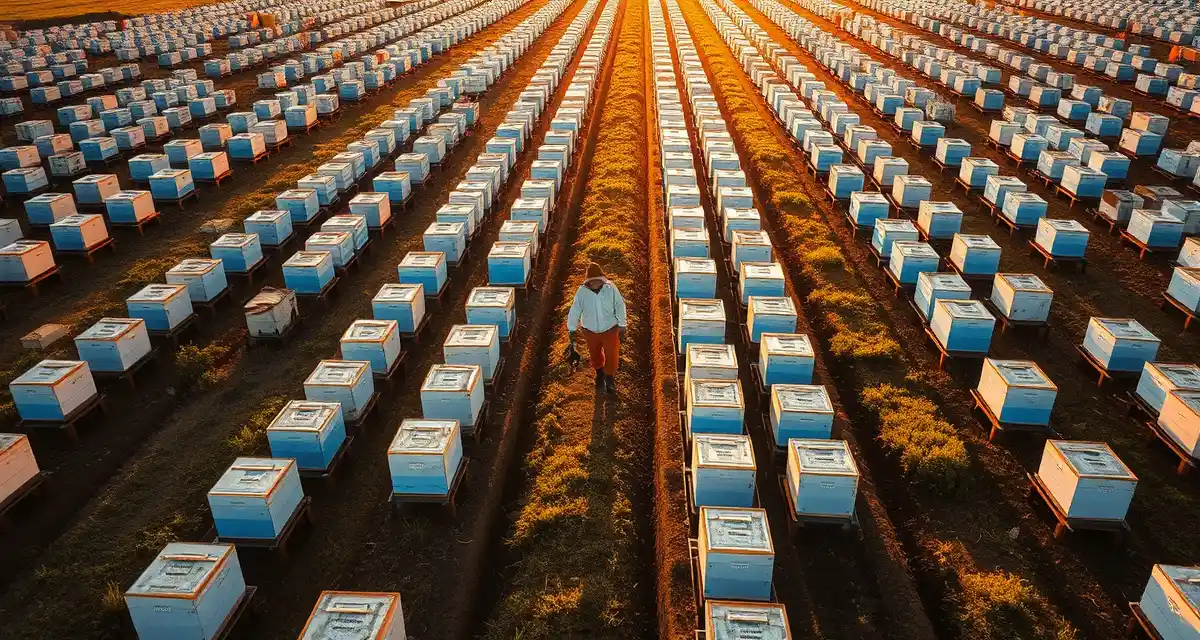
Building a 1000-Hive Beekeeping Operation from Scratch
One thousand hives is the milestone that separates hobby-scale commercial beekeeping from a serious agricultural enterprise. It's the minimum scale for reliable almond pollination contracts income, the revenue anchor that makes commercial beekeeping financially viable for most operators.
The jump from 200 to 1,000 hives requires $400,000 to $600,000 in capital and systematic operations management. You can't think your way through 1,000 hives. You need systems.
This guide covers the actual roadmap: capital requirements, timeline, equipment, staffing, and the operational infrastructure that separates operations that reach 1,000 from those that plateau at 300.
TL;DR
- Commercial beekeeping operations face two primary management challenges: operational logistics (hive health, transport, placement) and administrative coordination (contracts, payments, documentation).
- Most disputes and revenue losses in commercial beekeeping are preventable with better documentation and clearer contract terms.
- The operations that run most profitably are those with disciplined systems for tracking hive health, contract status, and fleet logistics in one place.
- PollenOps is built specifically for the operational complexity of commercial-scale pollination services, not adapted from a hobbyist tool.
- The most important management decisions (treatment timing, contract renewal, hive allocation) require accurate current data to make well.
Why 1000 Hives Is the Real Commercial Threshold
At 500 hives, you can generate meaningful income. At 1,000 hives, you're building a defensible business.
The difference comes down to contract reliability. California almond growers signing contracts for 200+ hive placements want predictable suppliers. They're not interested in operators who might have 400 hives or might have 300 depending on the winter. They want partners who reliably deliver the contracted count, at the required strength, within the specified window.
At 1,000 hives with managed loss rates, you can absorb 30 to 40% winter losses and still meet 600 to 700 hive worth of contracts. At 400 hives, a bad winter wipes out your ability to fulfill any contracts at all.
Scale provides operational resilience. That's why 1,000 hives is the real commercial threshold.
Phase 1: Foundation (0 to 100 Hives)
Most successful 1,000-hive operations started with 20 to 50 hives and grew systematically over 5 to 10 years. Phase 1 isn't about scale. It's about learning.
What to Build in Phase 1
varroa management competency. This is the skill that determines whether your operation survives. Learn to assess mite loads accurately, treat at the right time, and verify treatment effectiveness. Operators who figure this out in phase 1 have dramatically better outcomes at scale.
Seasonal management rhythm. Learn what your colonies need in each month and in each region. This knowledge compounds over years. Each season you understand your specific operation's patterns better.
Local relationships. Connect with other commercial beekeepers in your region. The beekeeping community is more collaborative than competitive. Experienced operators who respect your commitment will share practical knowledge you can't get anywhere else.
Your first local contracts. Even small local pollination contracts at 50 hives teach you what commercial contracting requires: documentation, reliability, grower communication.
Phase 1 capital requirements: $15,000 to $40,000. Most of this is self-funded.
Phase 2: Early Commercial Scale (100 to 300 Hives)
Phase 2 is where the operation becomes recognizably commercial. You have enough hives to justify a proper truck, you're targeting regional pollination contracts, and you're starting to understand what systematic management requires.
Key Phase 2 Investments
Commercial truck. At 100+ hives, moving bees with a pickup and trailer becomes impractical. A flatbed capable of carrying 80 to 100 hives is a necessity. Budget $30,000 to $60,000 for a used commercial truck.
Pallet and forklift equipment. Loading hives by hand at commercial scale is unsafe and slow. A used forklift or dedicated pallet mover ($8,000 to $25,000) transforms your loading efficiency.
Systematic record keeping. At 300 hives spread across 5 to 10 yard locations, memory doesn't work. Start building systematic records now: colony counts, treatment records, yard locations, contract terms.
Your first California relationships. Even if you're not ready for California almond contracts, start visiting and meeting growers. California relationships take years to build. Start early.
Phase 2 capital requirements: $50,000 to $120,000 in additional capital beyond Phase 1.
Phase 2 revenue: $60,000 to $120,000 annually, depending on pollination rates and honey production.
Phase 3: Scaling to 500 Hives
Phase 3 is where most beekeepers hit their first major wall. Scaling from 200 to 500 hives requires more capital than most operators have accumulated, and the operational demands increase non-linearly.
The Capital Challenge
Adding 300 hives to reach 500 means:
- Hive equipment for 300 additional colonies: $45,000 to $90,000
- Additional truck (second truck required for this hive count): $30,000 to $60,000
- Increased treatment, feed, and operating costs: $15,000 to $25,000 additional per year
- Working capital for first California season: $20,000 to $40,000
Total additional capital: $110,000 to $215,000. This is where USDA FSA loans and Farm Credit financing become important tools.
The Contract Development Challenge
Getting California almond contracts at 300 to 500 hives typically requires:
- At least one season of California presence, even without contracts
- Demonstrable colony strength documentation from previous seasons
- References from other growers or industry contacts
- Willingness to start with smaller placements (50 to 100 hives) and build
Don't expect to call a California almond grower and get a 500-hive contract in your first conversation. The relationship has to be built.
The Operations Challenge
At 500 hives, the administrative load becomes substantial. You're managing:
- Multiple yard locations across multiple states
- Multiple pollination contracts with different terms and timing
- Colony health records across hundreds of colonies
- Fleet logistics for multiple moves per year
- Compliance documentation for interstate permits
This is where your commercial beekeeping business plan needs to include an operations management approach, not just a financial model.
Phase 4: The 500 to 1000 Hive Scale-Up
This is the hardest phase for most operators. The capital requirements are substantial, the operational complexity is high, and the margin for error is low because you're carrying real debt load.
Capital Requirements
To go from 500 to 1,000 hives:
| Item | Low Estimate | High Estimate |
|---|---|---|
| Hive equipment (500 additional) | $75,000 | $150,000 |
| Third truck | $35,000 | $70,000 |
| First employee (annual labor cost) | $40,000 | $60,000 |
| Queen rearing infrastructure | $10,000 | $25,000 |
| Extraction equipment upgrade | $15,000 | $40,000 |
| Working capital | $30,000 | $60,000 |
| Total | $205,000 | $405,000 |
Most operators scaling from 500 to 1,000 hives access a combination of: accumulated operating profits, FSA equipment loans, Farm Credit lines of credit, and sometimes SBA-backed loans.
Hiring Your First Employee
At 700+ hives, one person can no longer run the operation solo during busy season. Your first full-time employee (typically a skilled beekeeper who can work yard management independently) is a major milestone.
Budget $40,000 to $60,000 per year for a full-time experienced beekeeper. In addition, you'll need part-time or seasonal labor for loading nights and peak periods.
Finding and retaining good beekeeping labor is one of the hardest operational challenges at this scale. Pay competitively, invest in training, and build a work environment that retains people.
Operations Systems at 1000 Hives
At 1,000 hives, operational systems are not optional. You need:
Colony tracking: Every colony tracked by location, health status, queen status, and treatment history.
contract management: Every pollination contract logged with delivery dates, required hive counts, payment terms, and grower contact information.
Fleet and logistics: Every truck movement planned and documented. Yard locations confirmed and coordinated with landowners.
Compliance documentation: Interstate movement permits for every state. Inspection certificates current. Registration records organized.
Spreadsheets can theoretically handle this at 500 hives if you're disciplined. At 1,000 hives, spreadsheets become a liability. The documentation demands are too high and the coordination needs are too complex for manual systems.
Timeline: How Long Does It Take?
The honest answer depends heavily on your starting capital, your ability to access financing, and whether you experience major loss events.
Aggressive timeline (strong capital, no major losses):
- Year 1 to 2: 0 to 100 hives
- Year 3 to 4: 100 to 300 hives
- Year 5 to 6: 300 to 500 hives
- Year 7 to 9: 500 to 1,000 hives
Typical timeline:
- Year 1 to 3: 0 to 100 hives
- Year 4 to 5: 100 to 250 hives
- Year 6 to 8: 250 to 500 hives
- Year 9 to 12: 500 to 1,000 hives
A bad winter at year 7 can push the timeline by 2 years. The beekeepers who reach 1,000 hives are the ones who plan for setbacks rather than assuming everything goes to plan.
Operational Systems Needed at 1000 Hives
Beyond equipment and capital, the thing most 1,000-hive aspirants underestimate is the operational systems requirement.
What You Actually Need
Contract tracking: Know exactly what you owe which grower, when, at what strength, and what you're getting paid. Missed contract requirements cost real money, either in payment disputes or lost future contracts.
Colony health records: Track varroa loads, treatment records, queen replacement dates, and strength assessments at the colony level. This data drives management decisions and insurance claims.
Fleet and yard coordination: Know where every truck and every pallet is at all times. Coordinate driver schedules, loading nights, and permit requirements across multiple states.
Financial management: Track revenue by contract, expenses by category, and cash flow by month. Seasonal beekeeping cash flow is extreme, with big income in February through April and expenses running all year.
FAQ
What capital is required to reach 1000 hives?
Building from scratch to 1,000 hives typically requires $600,000 to $1,000,000 in total capital deployed over the buildout timeline. This includes hive equipment, trucks, operating costs, working capital, and employee costs. Most of this capital comes from a combination of operating profits reinvested over many years and agricultural financing from FSA or Farm Credit. Very few operators fully self-fund to 1,000 hives without any outside financing.
How long does it take to scale from 200 to 1000 hives?
Under favorable conditions (good financing access, no major loss years, established contract relationships) scaling from 200 to 1,000 hives takes 4 to 7 years. With typical challenges including bad winters, contract development time, and capital constraints, 7 to 10 years is more realistic. Operators who accelerate this timeline usually do so by purchasing established operations or colonies rather than building purely through splits and packages.
What operational systems are needed at 1000 hives?
At 1,000 hives you need: colony-level tracking for health, treatment, and queen status; contract management covering all grower agreements and delivery commitments; fleet and logistics coordination across multiple trucks and yard locations; interstate permit and compliance documentation; and financial management tracking seasonal cash flow. These systems need to be integrated enough that the operation can run reliably even when the owner isn't in the yard every day, because at 1,000 hives spread across multiple states, they can't be.
What is the difference between commercial and hobby beekeeping?
Commercial beekeeping is distinguished by scale (typically 100+ hives, often 500-5,000+), revenue source (pollination contracts and bulk honey sales rather than local honey retail), and management approach (systematic protocols applied across yards rather than individual colony attention). Commercial operators manage bees as an agricultural enterprise, with the administrative, regulatory, and logistical complexity that entails. Most commercial operators derive the majority of their income from pollination services; honey production is a supplementary revenue stream.
How many hives are needed to make commercial beekeeping a full-time income?
Most beekeeping economists put the full-time commercial threshold at 500-800 hives, assuming efficient operations management and a combination of pollination and honey revenue. At 500 hives and $200/hive for almond pollination, almond season alone generates $100,000 in gross revenue before expenses. Net margins depend on operational efficiency, but well-run operations can achieve 30-50% net margins on pollination revenue. Additional crops and honey production improve per-hive economics but require additional management capacity.
What is the annual revenue potential for a 1,000-hive commercial operation?
A 1,000-hive operation running an almond season ($200/hive) plus blueberry or apple contracts ($80-100/hive) plus summer honey production ($25-40/hive after extraction costs) can generate $300,000-360,000 in annual gross revenue. Net margins after transport, crew, equipment, and hive replacement costs typically run 25-40% for well-managed operations, putting net income at $75,000-145,000 annually. The specific number depends heavily on circuit efficiency, loss rates, and contract quality.
Try These Free Tools
Sources
- USDA Agricultural Research Service
- Bee Informed Partnership
- American Beekeeping Federation (ABF)
- American Honey Producers Association
- Project Apis m.
Get Started with PollenOps
Managing a commercial beekeeping operation involves more data, more deadlines, and more moving parts than any general-purpose tool was designed to handle. PollenOps brings contracts, yard records, health documentation, and fleet logistics together in one platform built for the realities of commercial-scale beekeeping.