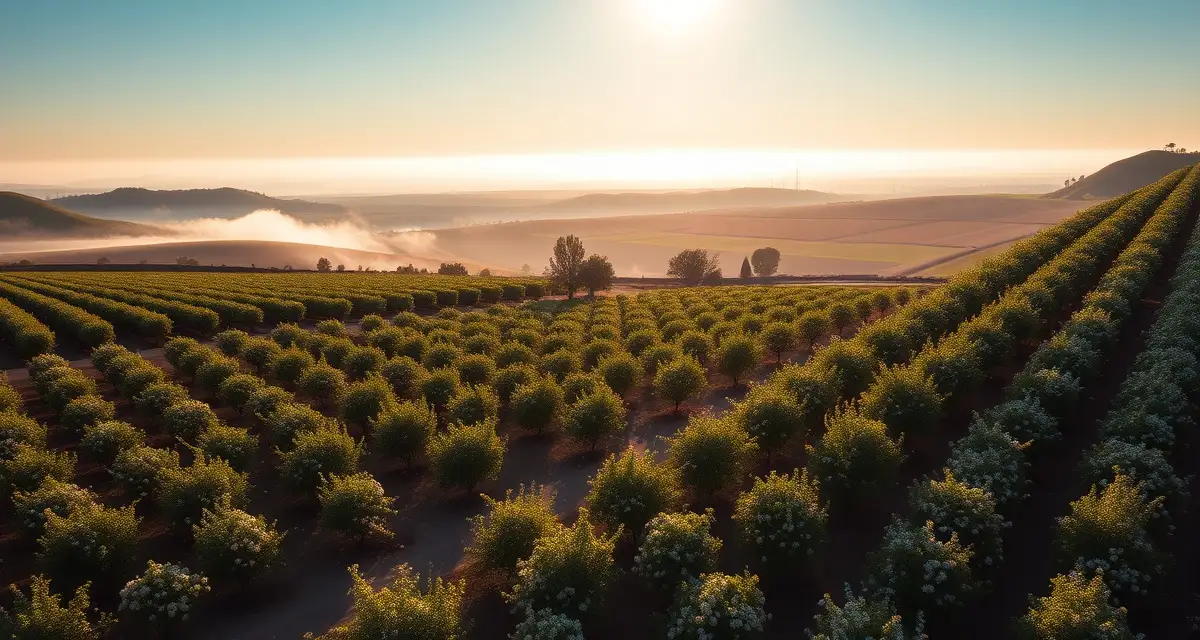
Climate Zone Bloom Alerts for Pollination Beekeepers
Regional bloom timing averages tell you roughly when to expect bloom. But the orchard in the valley bottom that drains cold air at night blooms differently than the orchard on the south-facing slope 400 feet above it. The coastal strawberry fields that get morning fog until late May bloom on a completely different schedule than fields 10 miles inland.
Unusual warm spells advance bloom by 7-14 days with less than 48 hours of warning in about 1 in 4 years. If your alert is calibrated to the regional average and the microclimate at your specific yard is running ahead of that average, you're going to be late.
PollenOps accounts for microclimate variation at the yard level so your bloom alerts reflect what's actually happening at your specific locations, not just what's happening across the broader region.
TL;DR
- Commercial beekeeping operations face two primary management challenges: operational logistics (hive health, transport, placement) and administrative coordination (contracts, payments, documentation).
- Most disputes and revenue losses in commercial beekeeping are preventable with better documentation and clearer contract terms.
- The operations that run most profitably are those with disciplined systems for tracking hive health, contract status, and fleet logistics in one place.
- PollenOps is built specifically for the operational complexity of commercial-scale pollination services, not adapted from a hobbyist tool.
- The most important management decisions (treatment timing, contract renewal, hive allocation) require accurate current data to make well.
What Is a Microclimate and Why Does It Affect Bloom Timing?
A microclimate is the localized climate conditions that differ from the broader regional pattern. These differences are caused by:
Topography: Valley floors collect cold air that drains from surrounding slopes at night (cold air drainage). Orchards on valley floors often experience frost risk longer into spring and may bloom later than nearby orchards on slopes, despite being at lower elevation.
Slope aspect: South-facing slopes receive more direct solar radiation than north-facing slopes, warming faster in late winter and early spring. The same variety on a south-facing slope can bloom 5-10 days before the same variety on a north-facing slope.
Proximity to water: Lakes, rivers, and large water bodies moderate temperature extremes. Orchards near water bloom more evenly, while orchards far from any water body are more susceptible to the sharp temperature swings that can push bloom timing in either direction.
Urban heat islands: Orchards near urban areas may experience elevated nighttime temperatures from urban heat, which can advance bloom relative to rural orchards in the same region.
Elevation: The standard estimate is a 3-4 day bloom delay per 1,000 feet of elevation gain, but this is a rough average. Actual delay depends on the other factors above.
How PollenOps Accounts for Microclimate Differences
Standard bloom alert systems use regional weather data and apply it uniformly across a zone. PollenOps uses local weather station data from stations near your registered yard locations to calculate chilling hours and growing degree days at the yard level, not the regional average level.
When you register a yard in PollenOps, the system identifies the nearest weather station with relevant data and begins tracking bloom-relevant inputs for that specific location. If your yard is in a valley microclimate that accumulates growing degree days faster than the surrounding region, your bloom alert will fire earlier than the regional average would suggest. If your yard is in a cool, north-facing site that runs behind the regional average, your alert adjusts accordingly.
The microclimate adjustment uses local weather station data to refine bloom timing by up to 5 days compared to a regional average alone. Over the course of a season, 5 days is the difference between hitting the ideal placement window and arriving after peak receptivity has passed.
What Happens to My Bloom Alerts During an Unusually Warm Spring?
This is where the real value of microclimate-aware alerts shows up.
In an average year, a 5-day refinement between regional estimate and local estimate is helpful. In an unusually warm year, the regional estimate may be off by 7-14 days, and the local estimate may be off by less but still significantly wrong if it's relying on historical averages rather than current conditions.
PollenOps updates bloom timing projections as current weather data is received, not just at the start of the season. If temperatures spike in late January, the accumulated growing degree day calculation for your yard updates in real time, and the projected bloom date moves forward accordingly.
Your alert fires when the updated projection says bloom is 5-7 days out, not when the historical calendar says it should be. In a year when bloom is 10 days early, you get your alert 10 days earlier than you would if you were relying on last year's date.
The flip side also works. In a cold, late spring, when bloom is tracking behind the historical average, your alerts fire later than expected. You don't have trucks sitting at yards waiting for a bloom that's still a week away.
Can I Manually Adjust Bloom Timing Thresholds for a Specific Yard Location?
Yes. There are situations where the system's default thresholds don't match your operational reality:
You know a specific orchard microclimate runs ahead of the data. Some orchards are in spots that consistently bloom earlier than the nearest weather station would predict. If you've worked the same orchard for 5 years and it always blooms 3 days before the model suggests, you can set a custom offset for that yard.
Your logistics require more lead time than the default. If you're working a cherry orchard in Washington from a winter yard in California, you may need 10 days of advance notice rather than 5-7. Set the alert threshold for that yard to trigger at the 10-day mark.
The contracted placement requirement differs from bloom timing. Some growers specify placement requirements tied to specific bloom stages (5% bloom, 10% bloom) rather than days before bloom. You can set custom thresholds tied to the specific stage trigger your contract requires.
You're calibrating for a new region. When you're working a region for the first time, you may want to be conservative with your lead time. Setting earlier alert thresholds while you're learning the local microclimate patterns is a reasonable precaution.
Building Microclimate Awareness Into Your Yard Strategy
Understanding microclimate patterns at your established yards is valuable knowledge that compounds over time. Every season you work a specific location, you accumulate a better understanding of how its microclimate behaves relative to regional averages.
This knowledge should feed back into your bloom alert calibration. If you've noticed that your almond yard in a specific Fresno County valley bottom consistently blooms 4 days later than the regional forecast, record that offset and apply it to future seasons.
PollenOps yard history reporting maintains a multi-season record for each yard location, including the bloom timing data associated with each placement. Over time, this history lets you identify patterns specific to each yard's microclimate and refine your alert thresholds based on observed rather than estimated variation.
Regional vs Yard-Level Bloom Planning
The most effective approach combines both levels:
Regional bloom forecasts give you the framework for season planning months in advance. You can build your contract calendar, set service period dates, and plan your truck routes based on when different regions expect bloom.
Yard-level microclimate alerts give you the precise timing you need for operational decisions in the weeks before each placement. When the regional forecast says "mid-April" and your specific orchard's microclimate data says "first week of April," you move on the yard-level data.
PollenOps bloom timing alerts operate at both levels simultaneously. The bloom timing by region view supports season planning. The per-yard alert system supports execution.
Frequently Asked Questions
How does PollenOps account for microclimate differences in bloom timing?
PollenOps uses local weather station data from stations near your registered yard locations to calculate chilling hours and growing degree days at the yard level rather than applying a regional average. This allows bloom timing projections to account for the specific temperature patterns at each yard location, which may differ from the regional average by several days due to topography, slope aspect, proximity to water, and other microclimate factors.
What happens to my bloom alerts during an unusually warm spring?
PollenOps updates bloom timing projections continuously as current weather data is received. When temperatures rise faster than the historical average, growing degree day accumulation accelerates at your specific yard locations, and projected bloom dates move forward accordingly. Your alert fires based on the updated projection, not the historical calendar, so in an early year you receive earlier-than-expected alerts that give you time to respond.
Can I manually adjust bloom timing thresholds for a specific yard location?
Yes. You can set custom alert thresholds for any yard or contract. Common reasons to customize include orchards that consistently run ahead or behind the model, logistics that require more lead time than the default 5-7 days, or contractual placement requirements tied to specific bloom stages rather than days before bloom. Custom thresholds override the system default for that specific yard.
What is the difference between commercial and hobby beekeeping?
Commercial beekeeping is distinguished by scale (typically 100+ hives, often 500-5,000+), revenue source (pollination contracts and bulk honey sales rather than local honey retail), and management approach (systematic protocols applied across yards rather than individual colony attention). Commercial operators manage bees as an agricultural enterprise, with the administrative, regulatory, and logistical complexity that entails. Most commercial operators derive the majority of their income from pollination services; honey production is a supplementary revenue stream.
How many hives are needed to make commercial beekeeping a full-time income?
Most beekeeping economists put the full-time commercial threshold at 500-800 hives, assuming efficient operations management and a combination of pollination and honey revenue. At 500 hives and $200/hive for almond pollination, almond season alone generates $100,000 in gross revenue before expenses. Net margins depend on operational efficiency, but well-run operations can achieve 30-50% net margins on pollination revenue. Additional crops and honey production improve per-hive economics but require additional management capacity.
What is the annual revenue potential for a 1,000-hive commercial operation?
A 1,000-hive operation running an almond season ($200/hive) plus blueberry or apple contracts ($80-100/hive) plus summer honey production ($25-40/hive after extraction costs) can generate $300,000-360,000 in annual gross revenue. Net margins after transport, crew, equipment, and hive replacement costs typically run 25-40% for well-managed operations, putting net income at $75,000-145,000 annually. The specific number depends heavily on circuit efficiency, loss rates, and contract quality.
Try These Free Tools
Sources
- USDA Agricultural Research Service
- Bee Informed Partnership
- American Beekeeping Federation (ABF)
- American Honey Producers Association
- Project Apis m.
Get Started with PollenOps
Managing a commercial beekeeping operation involves more data, more deadlines, and more moving parts than any general-purpose tool was designed to handle. PollenOps brings contracts, yard records, health documentation, and fleet logistics together in one platform built for the realities of commercial-scale beekeeping.