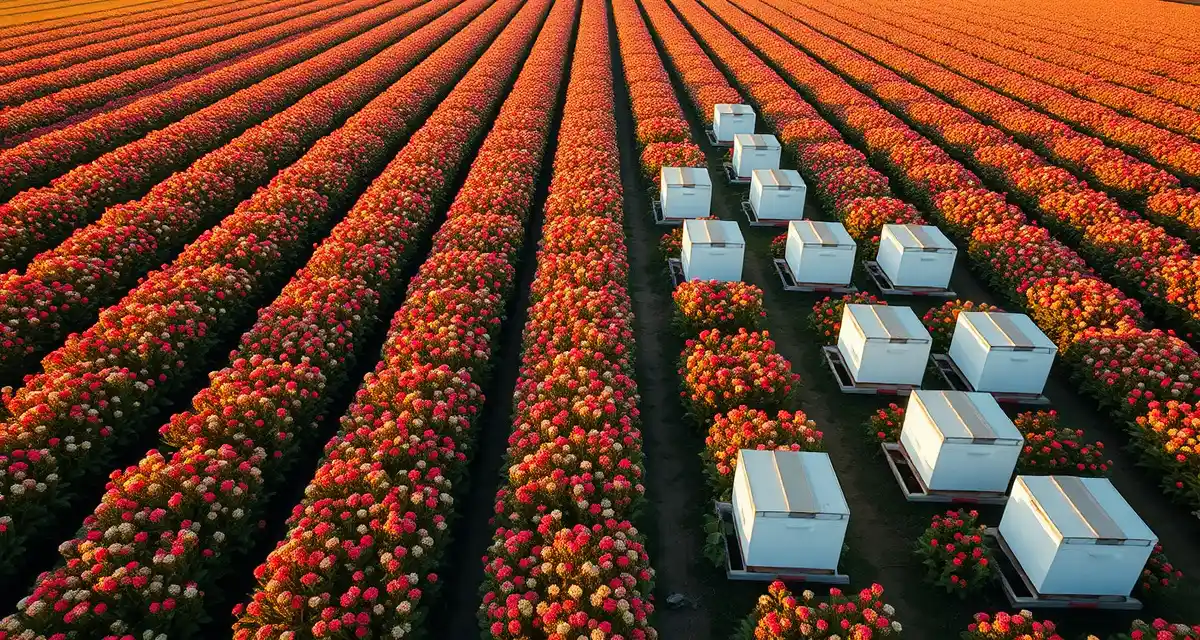
Clover Seed Pollination Management Software
Oregon and Idaho are the top clover seed states and require intensive commercial pollination services, with red clover requiring 3 to 5 hives per acre for commercial seed set and white clover needing somewhat lower density. Clover seed placement alerts fire separately for red clover and white clover varieties on different timing schedules in PollenOps, since the two species have meaningfully different bloom timing and pollination requirements.
Managing clover seed pollination contracts differs from managing forage pollination or honey production because the commercial objective (seed set) is more demanding per individual bee visit than general pollination. Clover seed growers need high-density placement of strong, actively foraging colonies to produce viable commercial seed crops.
TL;DR
- Clover seed and sunflower pollination represent two different models: clover seed requires 2-4 hives per acre, while sunflower typically requires 1 hive per acre.
- North Dakota is the center of both US sunflower and honey production, with summer flows that can generate 100+ pounds of honey per colony in good years.
- Clover seed production in the Pacific Northwest (Oregon, Idaho, Washington) requires precise placement timing tied to blooming stage.
- Sunflower pollination rates typically run $40-70 per hive; honey production value from the placement can supplement contract revenue.
- Managing clover or sunflower contracts alongside honey production requires tracking both revenue streams on the same calendar.
Clover Seed Market Background
Commercial clover seed production is concentrated in the Willamette Valley of Oregon (particularly Linn County, which is sometimes called the "Grass Seed Capital of the World"), southwestern Idaho around the Nampa and Caldwell area, and parts of Washington state. These regions produce the planting seed that goes into forage and pasture seedings nationally.
Red clover (Trifolium pratense) is the primary commercial seed crop and has the most demanding pollination requirements. Red clover's floret structure requires a bee large enough to depress the floret and access the nectar while contacting the anthers. Bumble bees are more effective per individual visit, but honey bees at high density provide adequate coverage. The commercial standard is 3 to 5 hives per acre for red clover seed production.
White clover (Trifolium repens) is more accessible to honey bees and requires lower density (1 to 3 hives per acre) for commercial seed set. Alsike clover and sweet clover have their own pollination requirements and timing differences that matter for contract planning.
Bloom Alert Timing for Clover Seed
Clover seed bloom timing runs July in the Pacific Northwest, overlapping with other summer crops in the Willamette Valley and southern Idaho agricultural zones. The specific bloom timing for clover seed production fields depends on variety, planting date, and local temperature accumulation.
PollenOps clover seed bloom alerts account for the distinct timing difference between red clover and white clover varieties. In most Pacific Northwest production areas, white clover blooms somewhat earlier than red clover in the same growing season, and placement timing that targets peak red clover bloom may be late for white clover. Contracts for mixed-variety clover seed operations need variety-specific alert configurations.
The July bloom window for clover seed also overlaps with mint seed production in the same Oregon and Idaho geographies, creating potential competition for hive capacity between two demanding specialty seed contracts that run in the same timeframe.
Remote Yard Logistics for Clover Seed
Clover seed fields in the Willamette Valley and southwestern Idaho are often in agricultural areas with variable road access. Many clover seed operations are on rural properties with gravel access roads that require planning for delivery truck weight and turning radius. Confirm access specifics for each new contract site before the delivery season.
The remoteness of some clover seed production areas (particularly in the Idaho high desert agricultural zones) means GPS tracking is important both for your own logistics and for grower documentation purposes. PollenOps offline GPS mode captures yard locations and check-ins without cell service, syncing when you return to coverage.
Multiple sequential placements are sometimes requested by clover seed growers who need fresh, high-strength colonies for the full bloom period rather than allowing an initial placement to age in place. This mid-season colony rotation increases your service complexity but also increases your revenue per grower relationship.
Contracts and Rates for Clover Seed
Clover seed pollination rates run $90 to $130 per hive for red clover, reflecting the high density requirement and the demanding per-acre placement standard. White clover rates are somewhat lower, $80 to $110 per hive. At 3 to 5 hives per acre for red clover, a 50-acre seed production operation requires 150 to 250 hives and generates $13,500 to $32,500 at those rates.
Contract terms for clover seed should specify:
- Variety type (red clover, white clover, other)
- Contracted hives per acre and total acreage
- Colony strength at delivery (8 frames or more for red clover)
- Delivery date or bloom-stage trigger
- Water access requirement at yard site
The clover seed pollination contracts overview and bloom timing alerts Pacific Northwest calibration provide additional market context.
Honey Production During Clover Seed Placement
Clover seed fields are excellent honey production sites. Red and white clover produce abundant nectar during bloom, and hives placed in clover seed fields can produce substantial honey alongside their seed set service. This dual income opportunity is one of the most attractive features of clover seed contracts for beekeepers: you collect the placement fee and the honey.
Confirm with the grower whether honey supers are permitted during the placement period. Most clover seed growers don't object to honey production alongside pollination, since the same foraging behavior that produces honey also produces seed set. Some seed growers prefer colonies without supers to maximize forager time in the flowers rather than wax-processing activity, but this preference is uncommon.
Clover honey produced in seed production fields is high quality, since the crop is the same white and red clover species that make up classic clover honey. Extract promptly and keep it separate from sunflower or other strongly flavored honey types.
Frequently Asked Questions
When should hives be placed for red clover seed pollination?
Hives should be placed when the first red clover florets are opening on the bloom heads, typically at 5 to 10 percent bloom stage. This ensures foragers are established and actively foraging on clover before peak bloom rather than arriving at or after peak. In the Pacific Northwest, this typically occurs in early to mid-July for most red clover production operations, though planting date and current-year temperature patterns affect exact timing. PollenOps bloom alerts calculate placement window based on growing degree day accumulation from planting date.
How many hives per acre do clover seed growers require?
Red clover seed production requires 3 to 5 hives per acre for commercial seed set. White clover requires 1 to 3 hives per acre. The higher density for red clover reflects its floret structure, which requires more bee visits per flower than white clover for adequate pollination. Some seed growers specify both a total hive count and a minimum per-acre density to ensure even distribution across the field rather than concentrated clusters that leave distant areas under-pollinated.
How are clover seed pollination contracts typically priced?
Red clover seed pollination runs $90 to $130 per hive. White clover runs $80 to $110 per hive. At the standard density of 3 to 5 hives per acre for red clover, per-acre contract value runs $270 to $650, making clover seed one of the higher-value summer specialty crop contracts on a per-acre basis. The honey production income during the placement period adds further value. At 5 hives per acre and $120 per hive plus 50 pounds of honey per hive at $2.00 per pound, each acre of red clover seed placement generates $700 in combined pollination and honey income.
What is the difference between commercial and hobby beekeeping?
Commercial beekeeping is distinguished by scale (typically 100+ hives, often 500-5,000+), revenue source (pollination contracts and bulk honey sales rather than local honey retail), and management approach (systematic protocols applied across yards rather than individual colony attention). Commercial operators manage bees as an agricultural enterprise, with the administrative, regulatory, and logistical complexity that entails. Most commercial operators derive the majority of their income from pollination services; honey production is a supplementary revenue stream.
How many hives are needed to make commercial beekeeping a full-time income?
Most beekeeping economists put the full-time commercial threshold at 500-800 hives, assuming efficient operations management and a combination of pollination and honey revenue. At 500 hives and $200/hive for almond pollination, almond season alone generates $100,000 in gross revenue before expenses. Net margins depend on operational efficiency, but well-run operations can achieve 30-50% net margins on pollination revenue. Additional crops and honey production improve per-hive economics but require additional management capacity.
What is the annual revenue potential for a 1,000-hive commercial operation?
A 1,000-hive operation running an almond season ($200/hive) plus blueberry or apple contracts ($80-100/hive) plus summer honey production ($25-40/hive after extraction costs) can generate $300,000-360,000 in annual gross revenue. Net margins after transport, crew, equipment, and hive replacement costs typically run 25-40% for well-managed operations, putting net income at $75,000-145,000 annually. The specific number depends heavily on circuit efficiency, loss rates, and contract quality.
Try These Free Tools
Sources
- USDA Agricultural Research Service
- Bee Informed Partnership
- American Beekeeping Federation (ABF)
- Project Apis m.
- North Dakota Department of Agriculture
Get Started with PollenOps
Clover seed and sunflower pollination often overlap with summer honey production on the same circuit, creating two revenue streams from the same hives. PollenOps tracks both so your financial picture reflects the full value of each yard assignment.