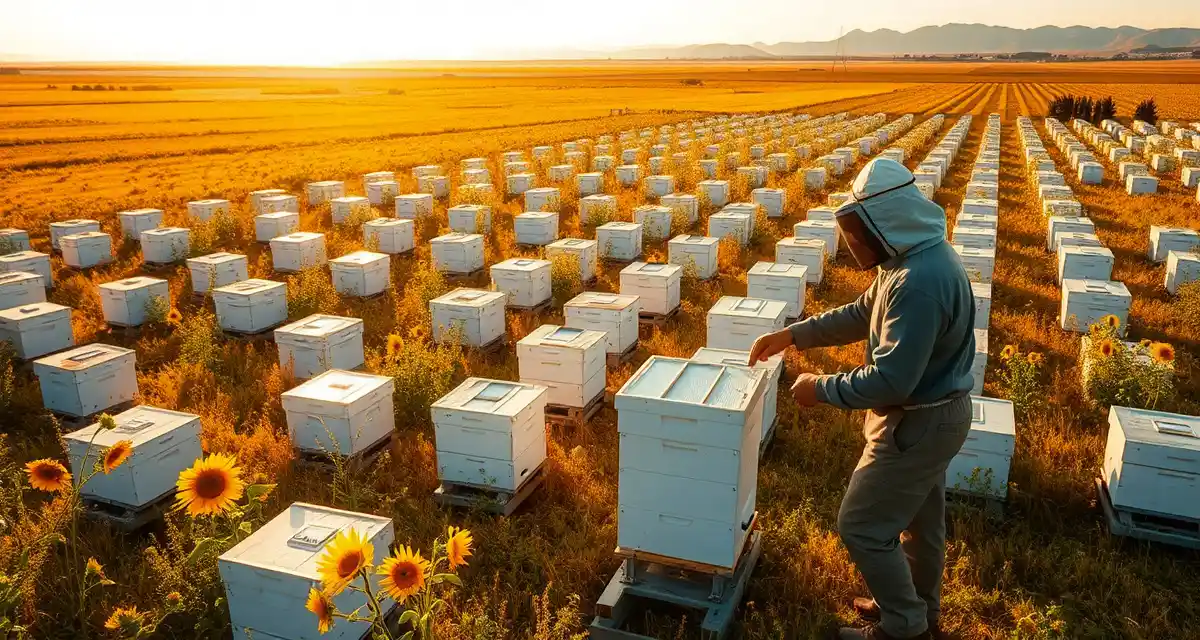
The Northern Plains Beekeeping Circuit: Clover, Sunflower, and Canola
A 2,000-hive Northern Plains honey circuit can produce $400,000 or more in bulk honey revenue annually. The Northern Plains states (North Dakota, South Dakota, Montana, and Minnesota) are the highest-volume honey production region in the United States, and the circuit that covers them well can generate remarkable honey yields from a single season.
The Plains circuit runs: North Dakota sunflower → South Dakota clover → Montana wildflower → Minnesota canola. The exact sequencing depends on your home base and where you want to position colonies for maximum forage access.
TL;DR
- Commercial beekeeping operations face two primary management challenges: operational logistics (hive health, transport, placement) and administrative coordination (contracts, payments, documentation).
- Most disputes and revenue losses in commercial beekeeping are preventable with better documentation and clearer contract terms.
- The operations that run most profitably are those with disciplined systems for tracking hive health, contract status, and fleet logistics in one place.
- PollenOps is built specifically for the operational complexity of commercial-scale pollination services, not adapted from a hobbyist tool.
- The most important management decisions (treatment timing, contract renewal, hive allocation) require accurate current data to make well.
The Northern Plains Bloom Calendar
May-June (Montana and Western North Dakota):
Spring honey production begins with dandelion and other early spring forage. Canola blooms in Montana and North Dakota from late May through June, providing a strong early-season nectar flow.
June-July (Central Plains):
Sweet clover (Melilotus) blooms across North Dakota, South Dakota, and Minnesota from late June through July. This is the foundation of Plains honey production. Sweet clover honey is mild, light-colored, and widely valued in bulk markets.
July-August (North Dakota Sunflower):
North Dakota is the top sunflower-producing state in the US. Sunflower honey is distinct: darker in color, crystallizes quickly, and is sold at a slight discount to light clover honey in bulk markets. However, the nectar volumes in North Dakota sunflower country are enormous, and well-positioned hives can produce 80-120 lbs per hive in a strong year.
August-September (Late-Season):
Goldenrod and late wildflower honey production continues into September in favorable years. Fall honey is typically darker and stronger-flavored, often blended with summer production.
Building a Plains Circuit Route
The Northern Plains circuit covers a large geographic area efficiently when the route is designed around bloom timing rather than convenience.
A typical 2,000-hive circuit:
- May: Position in eastern Montana or western North Dakota for canola and spring forage
- June: Move to central North Dakota or South Dakota for sweet clover
- July: Move to sunflower country in eastern North Dakota (Cass, Richland, Ransom counties)
- August: Move to Minnesota for goldenrod and late-season wildflower production
This route keeps 2,000 colonies in productive forage for 4-5 months. At an average of 60-80 lbs per hive across the season and bulk honey prices of $2.00-$2.50/lb, total honey revenue for 2,000 hives runs $240,000-$400,000.
For migratory route planning for the Plains circuit, PollenOps migratory route planning handles multi-state movement planning, permit tracking, and colony positioning across the full circuit.
North Dakota Specifics
North Dakota consistently produces more honey than any other state, typically 25-35 million pounds per year in good production years. The state's combination of sweet clover, canola, and sunflower forage creates a long, productive season.
Key production areas:
- Northeast ND (Walsh, Pembina counties): Strong canola and clover honey
- Southeast ND (Cass, Richland, Ransom counties): Prime sunflower production
- South-central ND (Emmons, Logan, McIntosh counties): Mixed sweet clover and sunflower
Landowner access is critical in North Dakota. Most honey operations work on established landowner agreements for yard access, typically in exchange for a honey payment or small cash rental. Building and maintaining landowner relationships in ND is a competitive advantage.
Permit Requirements for the Plains Circuit
Each state has different entry requirements:
North Dakota: Annual apiary registration; certificate of health for colonies entering from other states. North Dakota inspections can be arranged at entry points.
South Dakota: Certificate of health required; state apiary registration for operations placing hives.
Montana: Certificate of health required; Montana Department of Agriculture entry permit.
Minnesota: Certificate of health required; annual apiary registration with Minnesota Board of Animal Health.
Build your permit calendar in March for the following season. Confirm current requirements directly with each state, as they update periodically.
The Financial Model
For a 2,000-hive Northern Plains honey operation:
Honey production revenue:
- Production estimate: 2,000 hives × 65 lbs average = 130,000 lbs
- Bulk price range: $2.00-$3.00/lb
- Gross honey revenue: $260,000-$390,000
Supplemental pollination:
Some Plains operators add clover seed or sunflower pollination contracts to their circuit, adding $50-80/hive for these placements. At 2,000 hives with 30% contracted: ~$30,000-$48,000
Total circuit gross: $290,000-$440,000
Frequently Asked Questions
How do you design a Northern Plains honey production circuit?
Start by mapping the bloom sequence across the region: canola in Montana and western ND in May-June, sweet clover across the Plains in June-July, and North Dakota sunflower in July-August. Your circuit should move colonies north and east through the season, following the bloom. Identify specific yard locations in each zone with landowner permission, then sequence your moves to minimize backtracking. PollenOps route optimization tools help sequence multi-state moves efficiently. Plan permit requirements for each state in advance; North Dakota, South Dakota, Montana, and Minnesota all have different entry documentation.
What forage does the Plains circuit offer by month?
May: Dandelion and spring wildflower in Montana and western North Dakota. Late May-June: Canola in Montana, North Dakota, and southern Manitoba border areas. June-July: Sweet clover across North Dakota, South Dakota, and Minnesota. This is the volume foundation of Plains honey production. July-August: Sunflower in eastern North Dakota, particularly Cass, Richland, and Ransom counties. August-September: Goldenrod and mixed late-season wildflower across the region. In favorable years, the Plains circuit produces quality honey for 4-5 continuous months.
What permits are required for a Northern Plains hive movement circuit?
Each state requires a certificate of health issued by your home state's apiarist and state-specific registration or entry permits. North Dakota requires annual apiary registration and health certificate inspection at entry. South Dakota requires a certificate of health for incoming colonies. Montana requires a Department of Agriculture entry permit and health certificate. Minnesota requires registration with the Minnesota Board of Animal Health and a certificate of health. Coordinate with each state's agriculture department in late winter (February-March) for the following season's permits. Some states allow advance permit applications; others process at entry point.
What is the difference between commercial and hobby beekeeping?
Commercial beekeeping is distinguished by scale (typically 100+ hives, often 500-5,000+), revenue source (pollination contracts and bulk honey sales rather than local honey retail), and management approach (systematic protocols applied across yards rather than individual colony attention). Commercial operators manage bees as an agricultural enterprise, with the administrative, regulatory, and logistical complexity that entails. Most commercial operators derive the majority of their income from pollination services; honey production is a supplementary revenue stream.
How many hives are needed to make commercial beekeeping a full-time income?
Most beekeeping economists put the full-time commercial threshold at 500-800 hives, assuming efficient operations management and a combination of pollination and honey revenue. At 500 hives and $200/hive for almond pollination, almond season alone generates $100,000 in gross revenue before expenses. Net margins depend on operational efficiency, but well-run operations can achieve 30-50% net margins on pollination revenue. Additional crops and honey production improve per-hive economics but require additional management capacity.
What is the annual revenue potential for a 1,000-hive commercial operation?
A 1,000-hive operation running an almond season ($200/hive) plus blueberry or apple contracts ($80-100/hive) plus summer honey production ($25-40/hive after extraction costs) can generate $300,000-360,000 in annual gross revenue. Net margins after transport, crew, equipment, and hive replacement costs typically run 25-40% for well-managed operations, putting net income at $75,000-145,000 annually. The specific number depends heavily on circuit efficiency, loss rates, and contract quality.
Try These Free Tools
Sources
- USDA Agricultural Research Service
- Bee Informed Partnership
- American Beekeeping Federation (ABF)
- American Honey Producers Association
- Project Apis m.
Get Started with PollenOps
Managing a commercial beekeeping operation involves more data, more deadlines, and more moving parts than any general-purpose tool was designed to handle. PollenOps brings contracts, yard records, health documentation, and fleet logistics together in one platform built for the realities of commercial-scale beekeeping.