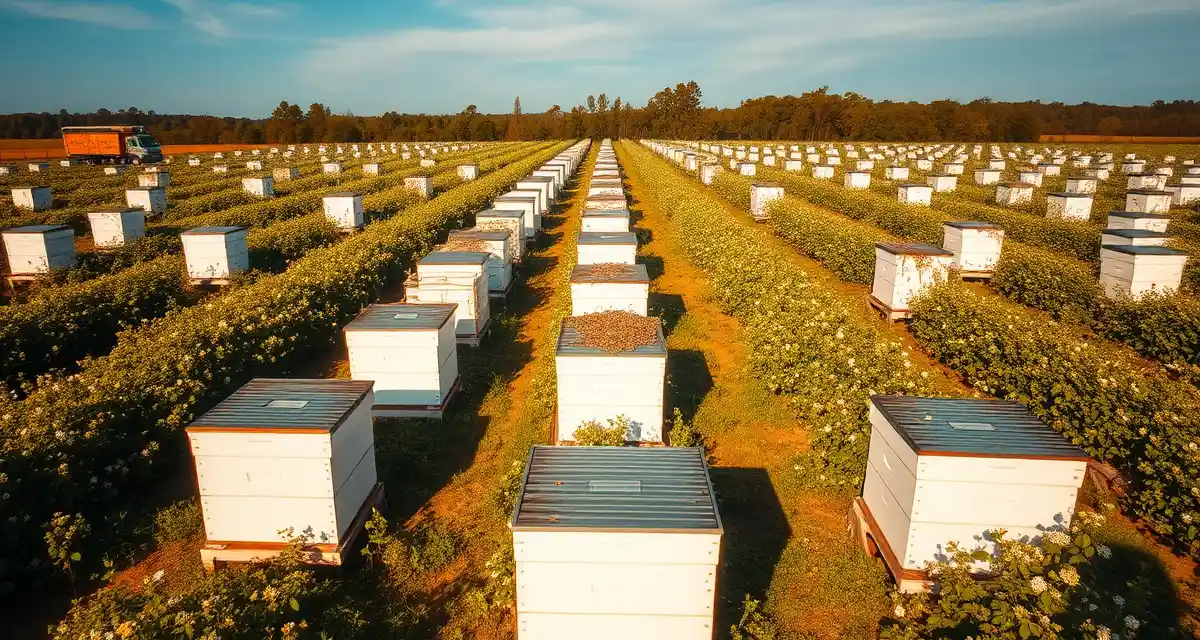
The Southeast Fruit Crop Circuit: Beekeeping from Georgia to Virginia
Georgia blueberries in March, North Carolina blueberries in April, Virginia apples in May. This three-stop Southeast circuit can generate $150 to $200 per hive across the spring season without returning to California, and it requires no more than a few hundred miles of truck movement between stops.
For commercial operators who want to build a Southeast-anchored spring operation, this circuit is the structural backbone. It combines three well-timed, geographically adjacent markets into a sequential spring season that fills the calendar from late February through late May.
TL;DR
- Commercial beekeeping operations face two primary management challenges: operational logistics (hive health, transport, placement) and administrative coordination (contracts, payments, documentation).
- Most disputes and revenue losses in commercial beekeeping are preventable with better documentation and clearer contract terms.
- The operations that run most profitably are those with disciplined systems for tracking hive health, contract status, and fleet logistics in one place.
- PollenOps is built specifically for the operational complexity of commercial-scale pollination services, not adapted from a hobbyist tool.
- The most important management decisions (treatment timing, contract renewal, hive allocation) require accurate current data to make well.
The Circuit Structure
Stop 1: Georgia Blueberries (Late February through early April)
Georgia's coastal plain blueberry production in the southeastern counties, anchored around Homerville and the Ware-Pierce-Bacon county cluster, blooms from late February through early April. This is the opening move of the circuit. Operators who winter in the Southeast, particularly in Florida, Alabama, or Georgia itself, can move directly to Georgia blueberry placements when bloom begins.
For the Georgia blueberry pollination market, rates run $70 to $100 per hive for a 3 to 4 week placement.
Stop 2: North Carolina Blueberries (Late April through late May)
After Georgia blueberry pickup in early to mid-April, the circuit moves north to North Carolina's coastal plain. The main production counties in eastern North Carolina bloom from late April through late May. The truck move from southeastern Georgia to eastern North Carolina is approximately 4 to 5 hours, making this a practical single-day repositioning.
For North Carolina blueberry contracts, rates run $65 to $90 per hive.
Stop 3: Virginia Apples (Mid-April through mid-May)
The Shenandoah Valley in Virginia is one of the East Coast's major apple production areas. Apple bloom runs mid-April through early May. The timing overlaps slightly with North Carolina blueberry, so operators need to sequence their NC pickup and VA apple delivery to avoid delivery gaps.
The drive from eastern North Carolina to the Shenandoah Valley is approximately 6 to 7 hours, a manageable overnight move. For Virginia apple pollination, rates run $90 to $130 per hive.
Revenue Per Hive Across the Circuit
For an operator running 300 hives through this circuit:
- Georgia blueberry: 300 hives × $85/hive × 1 placement = $25,500
- North Carolina blueberry: 300 hives × $75/hive × 1 placement = $22,500
- Virginia apple: 300 hives × $110/hive × 1 placement = $33,000
Total: $81,000 from 300 hives across 3 contracts, approximately $270 per hive for the spring circuit. This doesn't include honey production or any other income during the same period.
For larger operations, the math scales proportionally. The circuit economics are most favorable when the operator has strong relationships in all three markets and consistent colony quality that commands mid-to-upper rate ranges.
Colony Requirements Through the Circuit
The critical constraint is maintaining adequate colony strength across all three contract commitments without a major recovery window between stops.
Coming out of a Southeast winter, colonies should be in early-to-mid buildup in late February for Georgia blueberry. The Georgia placement provides 3 to 4 weeks for continued buildup. By early April, colonies should be at 5 to 7 frames heading into North Carolina. The North Carolina stop provides another 3 to 4 weeks, and by late May colonies should arrive in Virginia at 6 to 8 frames for apple bloom.
This trajectory assumes adequate nutrition, mite management, and no major disease events through the winter. Operators who run the Southeast circuit successfully do so by investing in colony health through fall and winter rather than hoping for good luck in spring.
For the broader migratory route planning framework, this circuit is a well-defined, repeatable structure that can be refined over multiple seasons.
Multi-State Compliance
Operating across Georgia, North Carolina, and Virginia requires compliance with each state's apiary registration and movement requirements. Each state wants health certificates for incoming colonies, and each requires annual apiary registration for operators with yard locations in the state.
For operators managing Southeast circuit compliance, see the individual state regulation guides for Georgia, North Carolina, and Virginia.
Frequently Asked Questions
How do you design a Southeast spring pollination circuit?
Start with the timing anchor points: Georgia blueberry in late February through early April, North Carolina blueberry in late April through late May, and Virginia apples in mid-April through mid-May. Build backward from each delivery date to understand what colony strength is needed at each placement. Map the truck routes between stops to confirm the move distances and timing. Develop grower relationships in each state independently, starting with outreach in the fall. The circuit becomes more efficient each season as grower relationships solidify and you learn the specific logistics of each stop.
What crops are included in a Southeast beekeeping circuit?
The core Southeast spring circuit includes: Georgia coastal plain blueberries (late February through April), North Carolina coastal plain blueberries (late April through late May), and Shenandoah Valley Virginia apples (mid-April through mid-May). Operators who want to extend the circuit can add South Carolina peaches (February through March), Maryland or Pennsylvania apples (late April through May), and New Jersey blueberries (late April through May) as additional revenue sources. The full extended circuit can run from February through early June with careful sequencing.
What permits are required for a multi-state Southeast pollination circuit?
Operating across Georgia, North Carolina, and Virginia requires annual apiary registration in each state and health certificates for incoming colonies from the previous state in the circuit. Georgia requires registration and may require health certificates for out-of-state colonies. North Carolina requires registration and health certificates. Virginia requires registration and health certificates. Plan your permit calendar in the fall, ensuring all state registrations are current and health certificates can be obtained in the time frames required. Multi-state compliance management tools help track renewal dates and documentation requirements across the full circuit.
What is the difference between commercial and hobby beekeeping?
Commercial beekeeping is distinguished by scale (typically 100+ hives, often 500-5,000+), revenue source (pollination contracts and bulk honey sales rather than local honey retail), and management approach (systematic protocols applied across yards rather than individual colony attention). Commercial operators manage bees as an agricultural enterprise, with the administrative, regulatory, and logistical complexity that entails. Most commercial operators derive the majority of their income from pollination services; honey production is a supplementary revenue stream.
How many hives are needed to make commercial beekeeping a full-time income?
Most beekeeping economists put the full-time commercial threshold at 500-800 hives, assuming efficient operations management and a combination of pollination and honey revenue. At 500 hives and $200/hive for almond pollination, almond season alone generates $100,000 in gross revenue before expenses. Net margins depend on operational efficiency, but well-run operations can achieve 30-50% net margins on pollination revenue. Additional crops and honey production improve per-hive economics but require additional management capacity.
What is the annual revenue potential for a 1,000-hive commercial operation?
A 1,000-hive operation running an almond season ($200/hive) plus blueberry or apple contracts ($80-100/hive) plus summer honey production ($25-40/hive after extraction costs) can generate $300,000-360,000 in annual gross revenue. Net margins after transport, crew, equipment, and hive replacement costs typically run 25-40% for well-managed operations, putting net income at $75,000-145,000 annually. The specific number depends heavily on circuit efficiency, loss rates, and contract quality.
Try These Free Tools
Sources
- USDA Agricultural Research Service
- Bee Informed Partnership
- American Beekeeping Federation (ABF)
- American Honey Producers Association
- Project Apis m.
Get Started with PollenOps
Managing a commercial beekeeping operation involves more data, more deadlines, and more moving parts than any general-purpose tool was designed to handle. PollenOps brings contracts, yard records, health documentation, and fleet logistics together in one platform built for the realities of commercial-scale beekeeping.