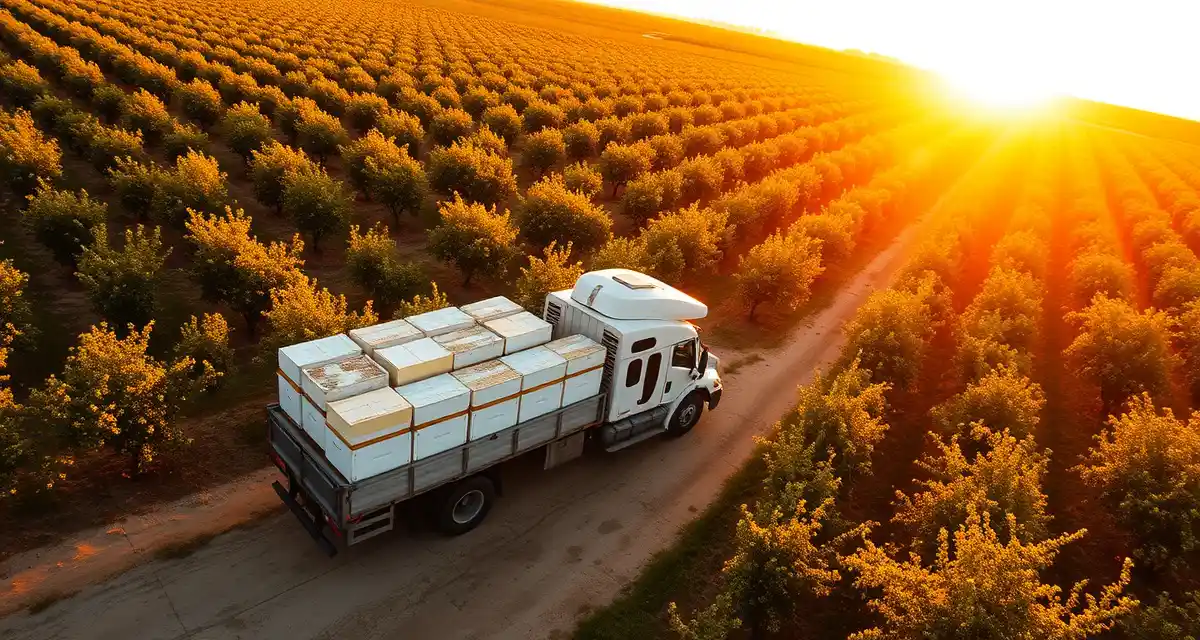
The Southeast Beekeeping Circuit: Florida to Virginia
The Southeast circuit avoids California competition entirely and targets underserved eastern markets. Starting with Florida citrus in winter and running through Georgia blueberry, North Carolina blueberry, and Virginia apple into late spring, an eastern operator can build a full-season circuit without ever loading a truck toward the Sierras.
The circuit: Florida citrus → Georgia blueberry → North Carolina blueberry → Virginia apple. The route moves steadily north as spring advances, with each leg arriving 3-5 weeks after bloom starts in the previous state.
TL;DR
- Commercial beekeeping operations face two primary management challenges: operational logistics (hive health, transport, placement) and administrative coordination (contracts, payments, documentation).
- Most disputes and revenue losses in commercial beekeeping are preventable with better documentation and clearer contract terms.
- The operations that run most profitably are those with disciplined systems for tracking hive health, contract status, and fleet logistics in one place.
- PollenOps is built specifically for the operational complexity of commercial-scale pollination services, not adapted from a hobbyist tool.
- The most important management decisions (treatment timing, contract renewal, hive allocation) require accurate current data to make well.
Why the Southeast Circuit Makes Sense
California avoidance: The California almond market is competitive, dominated by large western operations with established grower relationships. Eastern circuit operators building from scratch face real competition for almond contracts. The Southeast circuit builds a position in markets where the competition is less intense.
Established blueberry markets: Georgia is the top rabbiteye blueberry state, and North Carolina is in the top 10 nationally for blueberry production. Both markets have professional grower networks and consistent demand for reliable pollinators.
Year-round revenue potential: Starting in Florida in December gives Southeast operators a head start on annual revenue that northern operations don't see until March or April.
Reasonable travel distances: The circuit from Florida to Virginia runs approximately 800 miles. That's half the distance of a California migration from most eastern states.
The Circuit Sequence
December-February: Florida Citrus
Florida citrus bloom runs from late December through March, depending on variety and location. Orange bloom is concentrated in the Indian River, Polk County, and Peace River areas. Grapefruit runs in similar regions.
Citrus contracts pay $70-100/hive. Florida is a significant destination because citrus provides December-February revenue, a window where most northern operations have hives in winter management.
Moving into Florida requires a certificate of inspection. Florida has strict entry requirements that must be arranged before colonies cross the state line.
March-April: Georgia Blueberry
After Florida citrus wraps in February-March, the move to Georgia's coastal plain for southern highbush and rabbiteye blueberry begins.
Georgia southern highbush blooms late February-March. Rabbiteye, which is the larger market, peaks mid-March through late April.
Georgia blueberry rates run $75-100/hive. The coastal plain counties (Bacon, Brantley, Pierce, Ware) are the core production area.
April-May: North Carolina Blueberry
North Carolina rabbiteye blueberry follows Georgia's peak by approximately 2-3 weeks. Coastal plain counties in eastern NC (Bladen, Columbus, Sampson) host the primary production area.
Rates are comparable to Georgia at $75-110/hive. The timing gap from Georgia allows a clean sequential move.
May-June: Virginia Apple
Virginia's Shenandoah Valley is one of the top apple-producing regions on the East Coast. Apple bloom runs mid-to-late May in the Shenandoah, with timing variation by variety and elevation.
Apple pollination in Virginia pays $90-120/hive. The Shenandoah Valley apple market has fewer resident pollination operators than the Pacific Northwest, making it more accessible for operators building new grower relationships.
Revenue Model for 500 Hives
| Crop | Rate | Revenue |
|------|------|---------|
| Florida citrus (500 hives) | $85/hive | $42,500 |
| Georgia blueberry (500 hives) | $87/hive | $43,500 |
| NC blueberry (500 hives) | $92/hive | $46,000 |
| Virginia apple (500 hives) | $105/hive | $52,500 |
| Total | | $184,500 |
This circuit produces $369/hive across 4 contracts, comparable per-hive economics to the New England circuit and approaching Pacific Northwest rates.
Multi-State Permits
Every leg of this circuit crosses a state line. Requirements:
Florida: Certificate of inspection from your home state; Florida requires pre-entry approval. One of the strictest entry processes in the US.
Georgia: Certificate of health required; annual apiary registration.
North Carolina: Certificate of health required; NC DACS registration.
Virginia: Certificate of health required; Virginia Department of Agriculture registration.
Start your permit process in September for the following winter season. Florida entry in particular requires advance coordination that you can't leave to the last minute.
For multi-state permit tracking and commercial beekeeping fruit crop circuit planning, PollenOps manages permit deadlines, contract timelines, and migratory route planning across all four states.
Frequently Asked Questions
How do you design a Southeast spring pollination circuit?
Map the bloom sequence from south to north: Florida citrus in December-February, Georgia southern highbush and rabbiteye blueberry in March-April, North Carolina blueberry in April-May, and Virginia apple in May-June. The sequence aligns naturally with the northward progression of spring. Build contracts with growers in each state in September-October for the following season. Coordinate permits for all four states simultaneously; Florida requires the earliest action. Set bloom timing alerts for each crop and region in PollenOps so you're monitoring each delivery window independently. Plan your truck movement timing between each leg based on the expected end of bloom in each state.
What is the total income potential of a Southeast beekeeping circuit?
A 500-hive Southeast circuit running Florida citrus through Georgia, North Carolina, and Virginia apple can generate approximately $175,000-$210,000 in pollination revenue at mid-market rates. A 1,000-hive operation covering the same circuit generates $350,000-$420,000. These numbers are competitive with Pacific Northwest circuits without requiring the 2,000-mile California migration. Operations that add spring honey production in the mid-Atlantic states between North Carolina and Virginia, or summer honey production after the Virginia apple season, can push total season revenue significantly higher. The Southeast circuit's main advantage beyond economics is lower competition from established western operators.
What permits are required for a Southeast multi-state circuit?
The Southeast circuit requires documentation for each of the four states you operate in. Florida requires a certificate of inspection from your home state and pre-entry approval from the Florida Department of Agriculture; Florida is one of the strictest entry states and requires advance coordination. Georgia, North Carolina, and Virginia each require a certificate of health issued by your home state apiarist and annual apiary registration in each state. Start the permit process in September; Florida entry permits for December placement need to be arranged by October at the latest. Confirm current requirements with each state's agriculture department directly.
What is the difference between commercial and hobby beekeeping?
Commercial beekeeping is distinguished by scale (typically 100+ hives, often 500-5,000+), revenue source (pollination contracts and bulk honey sales rather than local honey retail), and management approach (systematic protocols applied across yards rather than individual colony attention). Commercial operators manage bees as an agricultural enterprise, with the administrative, regulatory, and logistical complexity that entails. Most commercial operators derive the majority of their income from pollination services; honey production is a supplementary revenue stream.
How many hives are needed to make commercial beekeeping a full-time income?
Most beekeeping economists put the full-time commercial threshold at 500-800 hives, assuming efficient operations management and a combination of pollination and honey revenue. At 500 hives and $200/hive for almond pollination, almond season alone generates $100,000 in gross revenue before expenses. Net margins depend on operational efficiency, but well-run operations can achieve 30-50% net margins on pollination revenue. Additional crops and honey production improve per-hive economics but require additional management capacity.
What is the annual revenue potential for a 1,000-hive commercial operation?
A 1,000-hive operation running an almond season ($200/hive) plus blueberry or apple contracts ($80-100/hive) plus summer honey production ($25-40/hive after extraction costs) can generate $300,000-360,000 in annual gross revenue. Net margins after transport, crew, equipment, and hive replacement costs typically run 25-40% for well-managed operations, putting net income at $75,000-145,000 annually. The specific number depends heavily on circuit efficiency, loss rates, and contract quality.
Try These Free Tools
Sources
- USDA Agricultural Research Service
- Bee Informed Partnership
- American Beekeeping Federation (ABF)
- American Honey Producers Association
- Project Apis m.
Get Started with PollenOps
Managing a commercial beekeeping operation involves more data, more deadlines, and more moving parts than any general-purpose tool was designed to handle. PollenOps brings contracts, yard records, health documentation, and fleet logistics together in one platform built for the realities of commercial-scale beekeeping.