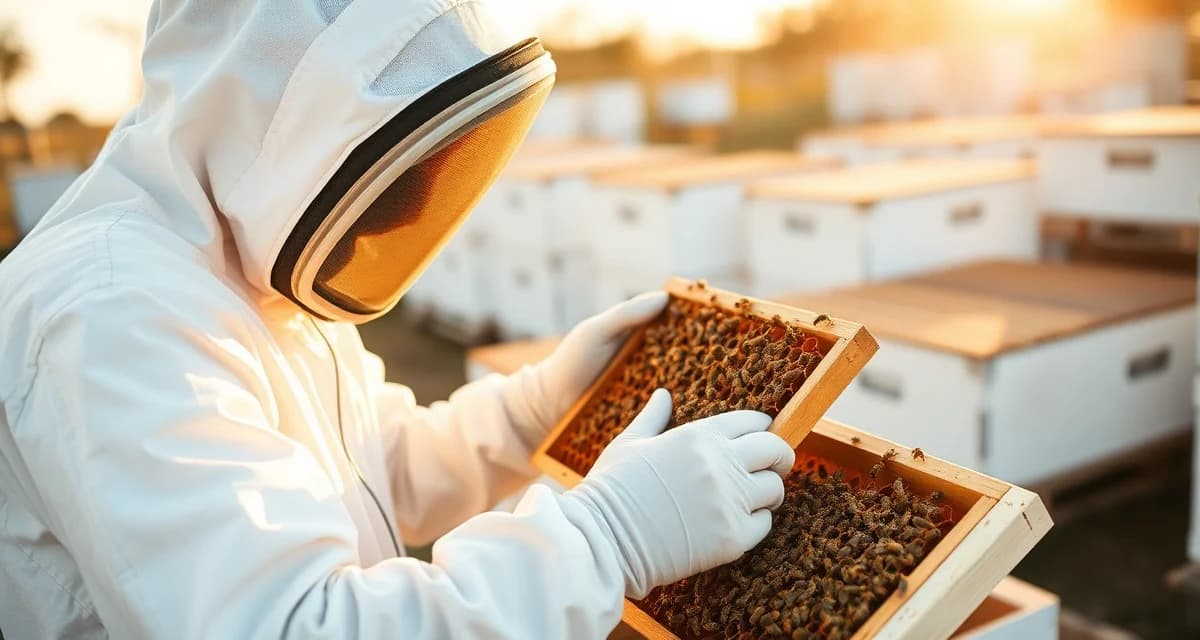
Business Plan Template for a Contract Pollination Beekeeping Operation
Beekeepers with a written business plan grow their operation 2x faster than those who operate informally. A business plan isn't primarily a document for banks or investors. It's a planning tool that forces you to be specific about how many hives you're building toward, which markets you're targeting, what your cost structure looks like, and how long it takes to reach profitability at your target scale.
For a contract pollination beekeeper, a business plan has three functional parts: a market and crop analysis, a financial model projecting revenue and expenses, and an operational plan covering hive management, staffing, and equipment.
TL;DR
- A well-written pollination contract covers hive strength requirements, payment terms, delivery/removal windows, pesticide liability, and dispute resolution.
- Standard payment structure is 50% on delivery and 50% on removal; push for no longer than 14-day net on the back half.
- Hive strength disputes are the most common source of non-payment; third-party inspection at delivery is the cleanest resolution.
- Pesticide kill provisions should require grower notification 24-48 hours before any application within foraging range of placed hives.
- Contracts signed by November have stronger pricing leverage than those negotiated in December or January.
Market and Crop Analysis
Start with the markets you're targeting and why. A pollination beekeeper targeting California almond plus Michigan blueberry has a different market analysis than one targeting Southeast cucurbits plus Southeast blueberry. The analysis should answer:
Which crops? List your primary and secondary target crops ranked by revenue potential and geographic fit with your existing location and equipment. Almond has the highest per-hive rate in the US; blueberry has the highest density requirement per acre and thus the most revenue per contract acre; cucurbits have lower rates but longer seasons.
Which states and counties? Be specific. "California almond" is vague; "Fresno and Kern County almond" is a plan. The specific counties determine bloom timing, drive time from your home base, competition from local beekeepers, and the specific grower networks you'll need to enter.
What's the demand? How many acres of your target crop are in your target counties? How many beekeepers currently serve that market? Are there supply gaps (markets where grower demand exceeds local beekeeper supply)?
What does the competitive market look like? Are established operators with long-term grower relationships the dominant players? Or is the market fragmented enough that a new professional operator with good documentation can enter quickly?
Financial Model
The financial model projects revenue and expenses by year to show when your operation becomes profitable and what the business is worth at your target scale.
Revenue projection:
Revenue = (Hive count) x (per-hive rate) x (contracts per season)
For a 200-hive operation targeting California almond at $200 per hive plus Michigan blueberry at $110 per hive (with 100 hives at each):
- Almond revenue: 100 hives x $200 = $20,000 per almond contract x 2 contracts = $40,000
- Blueberry revenue: 100 hives x $110 = $11,000 per blueberry contract x 2 contracts = $22,000
- Total season revenue: $62,000
PollenOps revenue reports export actual contract data that feeds directly into financial model inputs for existing operations.
Expense categories:
- Feed and supplies (syrup, pollen substitute, treatments, medications): Estimate $20 to $35 per hive per year
- Equipment (hive bodies, frames, tools): Varies by growth rate; budget for replacement and expansion
- Transportation (truck payment, fuel, maintenance, trailer): Estimate fuel at $0.35 to $0.50 per mile for a loaded hive transport truck
- Labor: Driver costs, seasonal help, payroll taxes
- Insurance: General liability, commercial vehicle, hive mortality if carried
- Software and professional services: PollenOps, accounting software, legal fees
- State registration and compliance: Variable by states operated in
Profitability timeline:
Map your projected revenue and expenses by year for 3 to 5 years. Year 1 is typically at or below breakeven for new operations due to setup costs and a limited contract portfolio. Year 2 to 3 typically shows meaningful profitability if hive inventory grows on plan and contracts are won as projected. Year 4 to 5 at target scale shows the steady-state economics of the mature operation.
Operational Plan
Hive inventory growth: How many hives do you have now, how many do you need at target scale, and how do you get there? Detail your splitting schedule, purchase plan, and expected loss rate. See the how to start pollination service business guide for hive inventory growth frameworks.
Contract acquisition: How will you find and sign your first 10 contracts? Your first 50? Grower associations, direct outreach, referrals, online directories? Be specific about the channels and the timeline.
Staffing: When will you hire your first driver? At what revenue level does a second driver make sense? What do drivers cost to hire, train, and equip?
Software and systems: PollenOps data integrates directly into your financial model via the season revenue export. See pollination contract software for how the platform supports business operations from contract signing through invoice collection.
Frequently Asked Questions
What should a pollination beekeeping business plan include?
A pollination beekeeping business plan should include: a market analysis covering target crops, states, counties, and competitive landscape; a financial model projecting revenue, expenses, and profitability by year for at least 3 years; an operational plan covering hive inventory growth, contract acquisition strategy, staffing, equipment, and transportation; and a risk analysis covering weather risk, colony loss scenarios, market rate changes, and competition. The financial model is the most important section because it forces you to test your assumptions: if your plan assumes $200 per hive in California almond and you actually land $175, does the business still work? If your colony loss rate is 30 percent instead of 20 percent, when does the operation recover?
How do I forecast revenue for a new pollination service business?
Build your revenue forecast from the bottom up: planned hive count per contract times target per-hive rate times number of contracts per season. Be conservative in your first two years: assume you win 60 to 70 percent of the contracts you pitch, not 100 percent. Assume your average per-hive rate starts at the lower end of the market range and grows toward the middle as you build a track record. Use current year rate benchmarks (available in the PollenOps rate reference or from industry sources) as your starting point, not optimistic projections. A forecast that holds up under a 20 percent revenue haircut is a business worth building; a forecast that requires everything to go right is a plan that fails at the first obstacle.
Does PollenOps provide data I can use in a business plan?
Yes. The PollenOps season revenue report provides actual contract revenue, broken down by grower, crop, and state, that feeds directly into the historical financial data section of a business plan. If you're presenting to a lender or investor, PollenOps reports provide documented revenue history rather than self-reported estimates. For operations in the planning stage (not yet using PollenOps), the platform's rate benchmarks and market data articles provide the external data inputs for your initial revenue projections. Once you're operating, your PollenOps records replace estimates with actuals, and your business plan updates from a projection to a performance record.
What are the most common clauses in a commercial pollination contract?
A standard commercial pollination contract covers: hive strength minimums at delivery, payment terms (typically 50% on delivery, 50% on removal), delivery and removal dates, pesticide notification requirements, liability provisions for colony losses, truck access and yard location details, and dispute resolution procedures. Force majeure clauses addressing crop failure and operator inability to deliver the full hive count are also standard in well-written contracts.
How should pesticide liability be addressed in pollination contracts?
The contract should require growers to notify operators at least 24-48 hours before any pesticide application within foraging range (2-3 miles), specify the operator's right to remove hives immediately upon notification, and define liability for documented colony losses attributable to pesticide exposure. Without this clause, recovering compensation for pesticide kills requires proving causation after the fact, which requires lab testing, communication records, and timestamped photos of dead bees collected before cleanup.
What is a typical contract renewal strategy for commercial beekeepers?
Most successful commercial operators begin renewal conversations with existing growers in July, confirming the coming season's hive count and rate before new grower outreach. Existing grower relationships command better pricing stability than new contracts and require less pre-season sales effort. Sending growers a season-end report documenting hive placements and colony performance reinforces the relationship and creates a natural opening for renewal discussion.
Try These Free Tools
Sources
- USDA Agricultural Research Service
- Bee Informed Partnership
- American Beekeeping Federation (ABF)
- American Honey Producers Association
- Project Apis m.
Get Started with PollenOps
Managing pollination contracts across multiple growers and crops is where most commercial operations have the most to gain from better systems. PollenOps centralizes contract lifecycle management from initial quote through signed agreement, delivery documentation, and final invoice. Try it for your next season.