Cucumber Pollination Management Software
US cucumber seed production requires 1 to 2 hives per acre and represents a growing commercial pollination market as domestic seed production expands. Cucurbit bloom alerts fire separately for monoecious and gynoecious cucumber varieties in PollenOps, which matters operationally because the two variety types have different pollination dynamics and hive density requirements.
Managing cucumber and cucurbit pollination contracts through PollenOps means having the right tool for a crop that doesn't behave like tree fruit. Cucurbit bloom windows are fast-moving, temperature-dependent, and variety-specific in ways that a generic contract management approach misses.
TL;DR
- Cucurbits (melons, cucumbers, squash, pumpkins) require bee pollination for fruit set and are grown commercially in multiple states with overlapping seasons.
- Watermelon and cantaloupe are the highest-value commercial cucurbit crops for pollination contracts, with demand concentrated in the Southeast and Southwest.
- Pollination rates for cucurbit crops typically run $50-90 per hive, lower than tree fruit but with shorter placement periods.
- Cucurbit crops are highly sensitive to pesticide exposure, requiring clear communication with growers about spray schedules.
- Bee placement timing is critical: hives should enter the field when 10-20% of female flowers are open.
How Cucumber Pollination Works
Cucumbers are cucurbit plants that produce separate male and female flowers. Standard monoecious varieties have both male and female flowers on the same plant; gynoecious commercial varieties produce predominantly or exclusively female flowers and require monoecious pollenizer rows to provide pollen. Bees transfer pollen from male flowers to female flowers, triggering fruit development.
The pollination requirement is direct and measurable: each female flower needs multiple bee visits for adequate pollen transfer, and the number of seeds per fruit is proportional to the number of successful pollen deliveries. Commercial cucumber production for fresh market requires uniform, well-developed fruits, and inadequate pollination produces misshapen, bitter, or poorly developed cucumbers that reduce pack-out percentage.
For gynoecious varieties with pollenizer rows, the bee's role is particularly important because pollen must travel from the limited pollenizer rows to the predominantly-female main variety. hive placement geometry affects how effectively bees work across the pollenizer-to-main-variety distance.
Bloom Alert Timing for Cucurbits
PollenOps bloom alerts for cucumber fire based on growing degree day accumulation from the planting date, accounting for the planting date variability that makes cucumber bloom timing less predictable than tree fruit bloom timing. A grower who plants cucumbers in early May versus mid-May has a significantly different bloom date, and a single regional bloom alert won't serve both accurately.
When you enter a cucumber contract in PollenOps, you specify the grower's planting date or planting window. The system calculates the expected first female flower date based on degree day accumulation from that planting date and fires the delivery alert with appropriate lead time.
For gynoecious variety contracts, a second alert fires for pollenizer row bloom timing to ensure you're placing hives when both pollen sources (pollenizer rows) and receptive flowers (main variety) are available simultaneously.
Hive Placement for Cucumber Fields
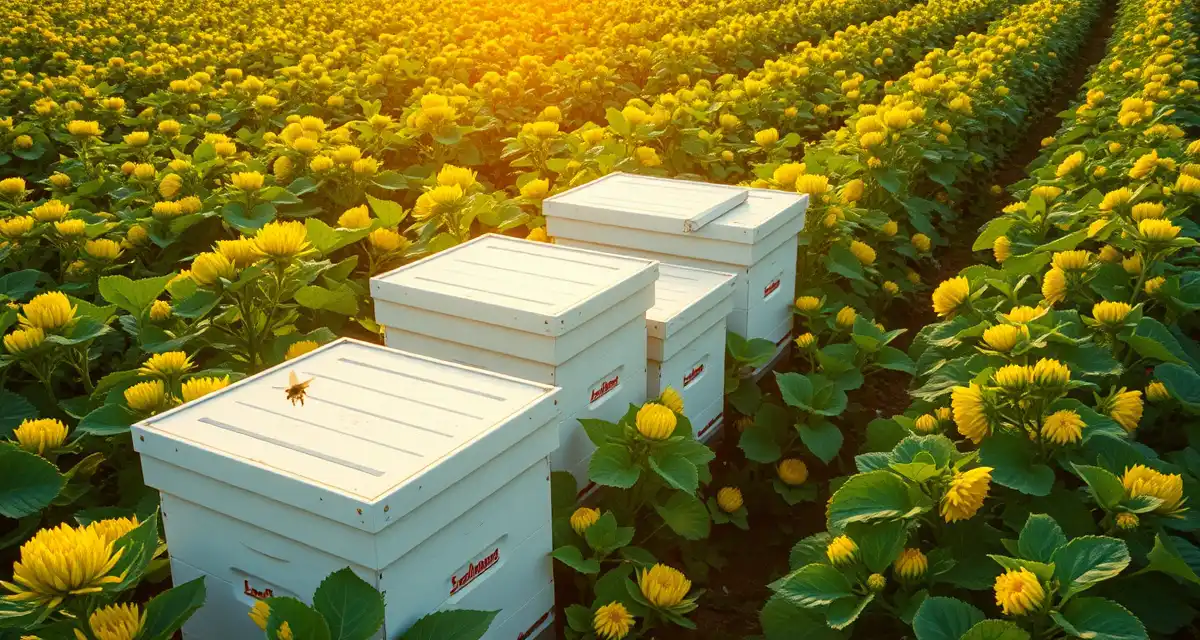
Cucumber fields are typically rectangular, often 20 to 80 acres per field, with access roads on the perimeter. Hive placement in small clusters at 300 to 400 meter intervals along the field perimeter is the standard approach for most commercial cucumber operations.
For gynoecious variety fields with pollenizer rows, placement near or adjacent to the pollenizer rows maximizes the probability of bees working those rows intensively and then moving into the main variety blocks. The pollenizer rows are typically 1 in 6 or 1 in 8 row ratios, creating a pattern that requires active bee foraging to cover the distance between pollenizer pollen source and female flower recipient.
PollenOps GPS placement documentation for cucumber fields records cluster positions on the field footprint and calculates per-acre density compliance. For operators managing multiple simultaneous cucurbit contracts across the Midwest or Southeast, the placement map history helps optimize cluster positioning based on prior season feedback from growers.
Cucumber Contract Terms That Differ from Tree Fruit
Cucumber pollination contracts differ from tree fruit contracts in several practical ways:
Shorter contract duration. A cucumber crop blooms for 3 to 6 weeks rather than the 2 to 3 week window of cherry or almond. Some contracts cover multiple planting dates with staggered bloom windows.
Multiple removal and replacement events. Some high-volume cucumber operations request fresh colonies mid-season as initial placements age, essentially requiring a colony rotation mid-contract.
Lower per-hive rates with longer placements. Cucumber rates of $60 to $90 per hive reflect both the crop's lower per-acre value and the longer placement period compared to tree fruit.
Proximity to residential areas. Some Midwest cucumber operations are in agricultural areas adjacent to suburban developments. Liability considerations for urban-proximate placements are worth confirming in your insurance coverage.
Midwest and Southeast Cucumber Markets
The primary US commercial cucumber markets for pollination services are:
Midwest: Indiana, Ohio, and Michigan pickling cucumber operations serve the major food processors. These operations run June through August, fitting naturally between blueberry season in late May-June and fall preparation.
Southeast: Georgia, North Carolina, and Florida fresh market cucumber operations run April through August on a staggered schedule. Florida's early season cucumber starts in April, while Georgia's main season runs May through September.
Mid-Atlantic: New Jersey and Maryland fresh market cucumber operations serve the metro area farm stand and farmers market channels.
For operators running Midwest circuits, the cucumber squash pollination contracts overview and the bloom timing alerts Midwest calibration provide the regional context for planning cucumber contract timing alongside other summer crops.
Frequently Asked Questions
When should hives be placed in cucumber fields for pollination?
Hive placement should occur at the beginning of female flowering, typically when the first female flowers are visible but before the main flush has opened. For monoecious varieties, this is when both male and female flowers are present. For gynoecious varieties, placement should coincide with pollenizer row bloom to ensure pollen is available when female flowers first open. PollenOps bloom alerts calculate expected first female flower date from the planting date and growing degree day accumulation, providing 48-hour advance notice of the target placement window.
How many hives per acre do cucumber growers need?
Commercial cucumber operations typically require 1 to 2 hives per acre. Standard fresh market cucumber at 1 hive per acre provides adequate pollination in most conditions. High-value seed production operations and gynoecious variety contracts with pollenizer row ratios often specify 1.5 to 2 hives per acre to ensure adequate pollenizer pollen coverage. The per-acre density in your contract should reflect the specific variety type and the grower's production goals rather than a single standard.
How do cucurbit pollination contracts differ from tree fruit contracts?
The main differences are contract duration (3 to 6 weeks for cucumber versus 2 to 3 weeks for cherry or almond), per-hive rates ($60 to $90 for cucumber versus $140 to $200 for cherry), and the bloom timing mechanism (growing degree day calculation from planting date versus accumulated heat unit from dormancy for tree fruit). Some cucumber operations also request mid-season colony rotation for extended placements. The core contract terms (hive count, strength at delivery, placement documentation, payment terms) are structured the same way as tree fruit contracts.
What is the difference between commercial and hobby beekeeping?
Commercial beekeeping is distinguished by scale (typically 100+ hives, often 500-5,000+), revenue source (pollination contracts and bulk honey sales rather than local honey retail), and management approach (systematic protocols applied across yards rather than individual colony attention). Commercial operators manage bees as an agricultural enterprise, with the administrative, regulatory, and logistical complexity that entails. Most commercial operators derive the majority of their income from pollination services; honey production is a supplementary revenue stream.
How many hives are needed to make commercial beekeeping a full-time income?
Most beekeeping economists put the full-time commercial threshold at 500-800 hives, assuming efficient operations management and a combination of pollination and honey revenue. At 500 hives and $200/hive for almond pollination, almond season alone generates $100,000 in gross revenue before expenses. Net margins depend on operational efficiency, but well-run operations can achieve 30-50% net margins on pollination revenue. Additional crops and honey production improve per-hive economics but require additional management capacity.
What is the annual revenue potential for a 1,000-hive commercial operation?
A 1,000-hive operation running an almond season ($200/hive) plus blueberry or apple contracts ($80-100/hive) plus summer honey production ($25-40/hive after extraction costs) can generate $300,000-360,000 in annual gross revenue. Net margins after transport, crew, equipment, and hive replacement costs typically run 25-40% for well-managed operations, putting net income at $75,000-145,000 annually. The specific number depends heavily on circuit efficiency, loss rates, and contract quality.
Try These Free Tools
Sources
- USDA Agricultural Research Service
- Bee Informed Partnership
- American Beekeeping Federation (ABF)
- USDA National Agricultural Statistics Service
- Project Apis m.
Get Started with PollenOps
Cucurbit pollination contracts cover a diverse range of crops, regions, and timing windows that require organized tracking to manage alongside your other seasonal commitments. PollenOps keeps all your contracts in one system regardless of crop type.