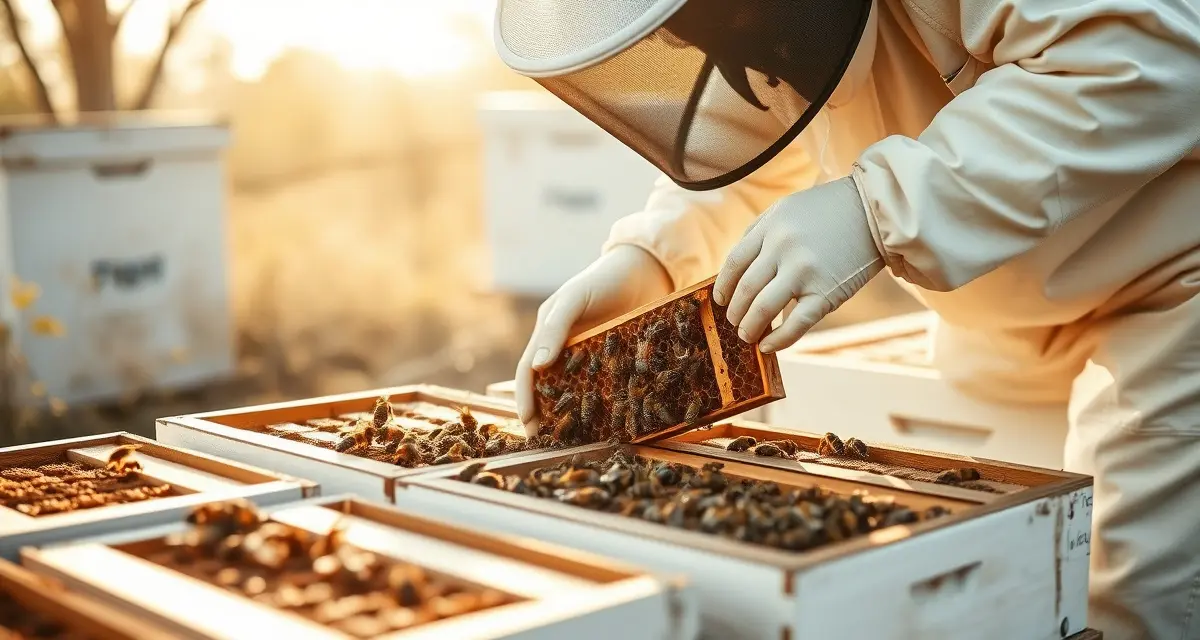
Hive Splitting Strategy for Pollination Season Preparation
Commercial beekeepers who split early enough can increase their contractable hive count by 20 to 30 percent annually. A split made in September or October gives a colony 5 to 6 months to develop into a full-strength pollination unit before the February almond season. A split made in January gives you a nucleus that might reach pollination strength by June, which is useful for summer crops but not for the most valuable early-season contracts.
Splitting strategy for pollination season is fundamentally a planning exercise: decide how many contractable hives you need at almond, build backward from that number accounting for expected splits that fail or develop slowly, and execute splits early enough that development time is on your side.
TL;DR
- Commercial beekeeping operations face two primary management challenges: operational logistics (hive health, transport, placement) and administrative coordination (contracts, payments, documentation).
- Most disputes and revenue losses in commercial beekeeping are preventable with better documentation and clearer contract terms.
- The operations that run most profitably are those with disciplined systems for tracking hive health, contract status, and fleet logistics in one place.
- PollenOps is built specifically for the operational complexity of commercial-scale pollination services, not adapted from a hobbyist tool.
- The most important management decisions (treatment timing, contract renewal, hive allocation) require accurate current data to make well.
Building Inventory for Almond Season
Almond season is the earliest major commercial pollination market and the most demanding in terms of colony strength. Most California almond contracts require 8 frames of bees at delivery in mid-February. Building new colonies from splits to meet that standard requires starting early enough that development runs its natural course.
A split made in late summer (August) from a strong colony with a mated queen (or a queen cell that develops quickly) has 5 to 6 months before the February delivery window. In a good forage year with supplemental feeding, that split can reach 6 to 8 frames by January. A split made in November has 3 months, which is tight for developing a pollination-ready colony in the northern hemisphere winter when population growth is naturally slow.
The practical rule for almond-season inventory building: splits intended for the almond delivery should be made by September 1 in most of the US. Splits made in October may reach almond strength in warm climates (California, Florida, Texas) with supplemental feeding. Splits made after October are generally not reliable almond candidates.
Split Timing for Summer Crop Pollination
Summer crop pollination (cucurbits in June, blueberry in May, canola in July) has less demanding strength requirements and a longer development window for split colonies.
A colony split in February that receives supplemental feeding and a mated queen can reach 4 to 5 frames (adequate for most cucurbit contracts) by May. A split made in March can reach adequate strength for July canola in most climates. The longer lead time for summer crops gives you flexibility that almond season doesn't.
If your almond season contracts are set at your current hive count and you want to grow into summer crop markets, winter and early spring splits are a viable expansion strategy. Build the splits, develop them on spring forage, and enter summer contracts at the expanded count.
How PollenOps Tracks Splits and Projects Inventory
When you record a split in PollenOps, the system creates a new hive record linked to the parent colony with the split date and the initial strength assessment. As the split develops, subsequent inspections update the strength record. Your total available hive count in the dashboard reflects all active colonies including developing splits.
PollenOps inventory projections show your expected contractable hive count at a future date based on current colony strength trajectories and historical development rates. If you're planning a new blueberry contract that requires 50 hives and your current available count is 42, the projection shows whether the 8 split colonies in development are likely to reach pollination strength by the contract delivery date.
The hive inventory management tool shows your full colony status across all yards. For planning your season's contract capacity against projected inventory, see annual pollination contract planning.
Managing Split Quality
Not all splits develop at the same rate. Common causes of slow or failed split development include:
Queen failure: The virgin queen doesn't mate successfully, or the queen cell fails to emerge. Check splits 3 weeks after creation for laying queen evidence. If no eggs are present, requeen immediately rather than waiting another cycle.
Insufficient population: A split too small to maintain warmth and development will struggle in cool weather. Splits in northern climates in fall need at least 3 to 4 frames of bees to survive winter and develop adequately by spring.
Feed support gaps: Splits without adequate nectar flow or supplemental feeding develop more slowly than splits on active forage or receiving syrup and pollen substitute. Feed your developing splits consistently rather than waiting for deficiency signs.
Disease inheritance: Splits from colonies with elevated varroa loads inherit the mite pressure. Treat for varroa before making splits to avoid establishing new colonies on a high mite foundation.
Frequently Asked Questions
How early should I split hives to build inventory for almond season?
Splits intended for February almond season should be made by September 1 in most of the US to give the colony adequate development time. September splits have 5 months before the February delivery window, enough time to reach 6 to 8 frames in a good management environment. October splits are possible in warm climates with supplemental feeding but are risky for colder regions where winter development is minimal. November and later splits don't reliably reach almond-season strength by February in any US climate. If you're making splits specifically to expand your almond contract capacity, September is your deadline.
How does PollenOps track hive splits and update my available inventory?
Record each split in PollenOps with the split date, parent colony, queen status (mated queen, virgin queen, or queen cell), and initial frame count. PollenOps creates a new hive record for the split and links it to the parent for lineage tracking. Subsequent inspection records update the split's strength status over time. Your total contractable inventory in the PollenOps dashboard includes all colonies above your defined minimum strength threshold, which updates automatically as splits develop. You can filter your inventory view to show developing colonies separately from full-strength pollination units so you have a clear picture of what you can commit now versus what will be available later.
What is the minimum colony size to split and still have a strong pollination hive?
As a rule, only split colonies with 8 or more frames of bees so both the parent and the split receive adequate population. A split receiving 4 frames of bees plus 2 frames of brood has enough population to develop into a pollination-ready colony in a reasonable timeframe with good management. Splits from weaker parent colonies (6 frames or fewer) tend to produce undersized splits that require more intensive management and longer development time. The parent colony also needs to remain strong after the split; a 6-frame colony split in half produces two struggling units rather than two developing ones. Wait until your strongest colonies are at 10 or more frames before splitting if you want reliable development from both units.
What is the difference between commercial and hobby beekeeping?
Commercial beekeeping is distinguished by scale (typically 100+ hives, often 500-5,000+), revenue source (pollination contracts and bulk honey sales rather than local honey retail), and management approach (systematic protocols applied across yards rather than individual colony attention). Commercial operators manage bees as an agricultural enterprise, with the administrative, regulatory, and logistical complexity that entails. Most commercial operators derive the majority of their income from pollination services; honey production is a supplementary revenue stream.
How many hives are needed to make commercial beekeeping a full-time income?
Most beekeeping economists put the full-time commercial threshold at 500-800 hives, assuming efficient operations management and a combination of pollination and honey revenue. At 500 hives and $200/hive for almond pollination, almond season alone generates $100,000 in gross revenue before expenses. Net margins depend on operational efficiency, but well-run operations can achieve 30-50% net margins on pollination revenue. Additional crops and honey production improve per-hive economics but require additional management capacity.
What is the annual revenue potential for a 1,000-hive commercial operation?
A 1,000-hive operation running an almond season ($200/hive) plus blueberry or apple contracts ($80-100/hive) plus summer honey production ($25-40/hive after extraction costs) can generate $300,000-360,000 in annual gross revenue. Net margins after transport, crew, equipment, and hive replacement costs typically run 25-40% for well-managed operations, putting net income at $75,000-145,000 annually. The specific number depends heavily on circuit efficiency, loss rates, and contract quality.
Try These Free Tools
Sources
- USDA Agricultural Research Service
- Bee Informed Partnership
- American Beekeeping Federation (ABF)
- American Honey Producers Association
- Project Apis m.
Get Started with PollenOps
Managing a commercial beekeeping operation involves more data, more deadlines, and more moving parts than any general-purpose tool was designed to handle. PollenOps brings contracts, yard records, health documentation, and fleet logistics together in one platform built for the realities of commercial-scale beekeeping.