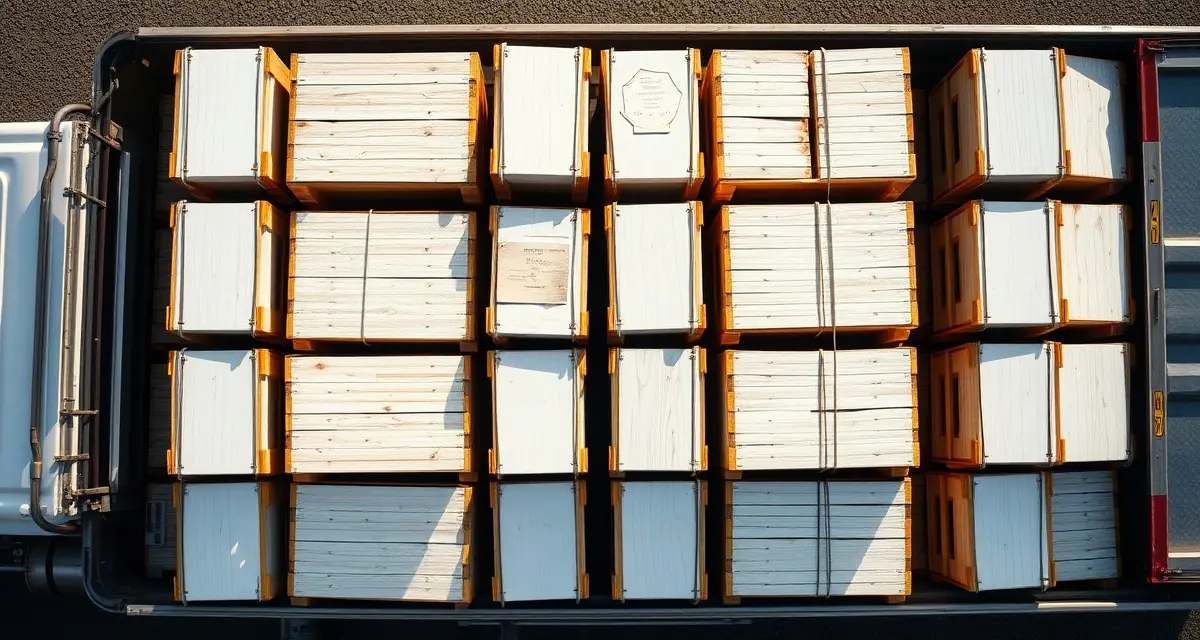
Hive Stack Configurations for Commercial Transport
Improper stacking causes colony losses in transport and increases trucking liability exposure. A standard 48-foot flatbed can carry 400-500 hive bodies using double-stack pallets, but reaching that capacity requires the right equipment, the right configuration, and load securement that actually holds at highway speeds through mountain passes.
This isn't theoretical. Bee trucks make some of the most challenging highway runs in agriculture: I-80 through the Donner Pass in January, mountain routes through the Cascades at night, the high desert on US-93 through Nevada. Your stack configuration needs to hold for 20 hours, not just for the first 3.
TL;DR
- Moving 1,000 hives to almonds requires 2-3 truck loads, with fuel costs of $3,500-5,000 per run at current California diesel prices.
- Loading at night when bees are clustered inside reduces escape and minimizes defensive behavior during transport.
- GPS-confirmed yard coordinates, not just addresses, should be in every contract to prevent access failures on delivery night.
- load planning that sequences multiple drops on a single truck run reduces total miles driven per hive.
- fleet logistics coordination -- vehicle assignments, load manifests, and crew scheduling -- requires a structured system at 500+ hives.
The Pallet System: Foundation of Commercial Transport
Commercial beekeeping transport is built around the 4-hive pallet. Standard dimensions:
- Width: 44-48 inches (matching forklift tine spacing)
- Length: 44-48 inches
- Height when loaded: 18-30 inches depending on how many hive bodies per colony
Each pallet carries 4 colonies in a 2x2 configuration. The pallet is designed for forklift handling: prongs slide under the pallet from any side on a 4-way pallet, from 2 sides on a standard pallet.
Pallet quality matters. A 4-hive pallet loaded with full double-deep colonies weighs 600-900 lbs. Pallets made from green or low-grade lumber that flex under load create instability when stacked. Commercial operations use kiln-dried 2x6 or 2x8 lumber pallets that hold their shape for seasons of use. Inspect pallets before loading. A cracked runner or a split deck board is a pre-move repair, not something to discover when the forklift drops the pallet at the delivery site.
Standard Configuration: Single-Story Pallets
The simplest configuration: pallets loaded one high on the truck bed with no stacking.
Capacity: A 48-foot flatbed with side boards holds approximately 40 pallets in a 4×10 configuration = 160 colonies. Shorter beds carry proportionally fewer.
Advantages: Maximum stability, lowest center of gravity, easiest loading and unloading. Ideal for rough terrain access roads, mountain routes, or shorter hauls where stability is prioritized over capacity.
Disadvantages: Poor space efficiency. Most almond-season loads exceed 200 colonies, requiring multiple trucks or a more space-efficient configuration.
Who uses it: Common for short hauls (within 200 miles) and for moves on unpaved or challenging roads. Some operations single-story load for mountain passes and restage the load at a staging yard before the final delivery leg.
Double-Stack Configuration
The industry standard for long-haul commercial beekeeping transport. Pallets are stacked two high using specialized double-stack equipment.
How it works: Standard 4-hive pallets are loaded to a typical height of 18-22 inches (single deep with honey super). A second pallet sits on top, with the pallet floor resting on the upper boxes. Colonies are sandwiched between the two pallets, with a bottom board at the lower pallet floor and the upper pallet acting as a top cover substitute.
Capacity: A 48-foot flatbed in double-stack configuration carries 300-400 colonies (75-100 pallets, 4 colonies each). With side boards and appropriate overwidth permits, capacity reaches 400-500.
Height: A double-stacked load with full colonies runs 7-9 feet from truck bed to top. Adding 4 feet for truck bed height gives a total load height of 11-13 feet. Standard highway clearance is 13'6", so this configuration fits but leaves little margin for height miscalculation. Measure your loaded height before you leave for any route with overhead restrictions.
Weight: 400 colonies × average 60 lbs per colony (single deep) = 24,000 lbs in bees and boxes alone, plus equipment weight. Adding the truck's tare weight of 30,000-35,000 lbs for a loaded flatbed: total GVW approaches 55,000-60,000 lbs. Well within the 80,000 lb federal limit for most configurations but verify axle weights.
Forklift Loading Sequence for Double-Stack
The loading sequence determines stability. Loading sequence for a double-stack configuration:
- Position pallets in the back of the truck first, working forward
- Load the first layer across the full truck width
- Position double-stack risers or place second pallets directly if the configuration allows
- Load second layer: stagger second layer so joints are offset from the first layer for stability
- Strap each row as you go; don't wait until the full truck is loaded
Strapping individual rows as you build the stack is more work but prevents any pallet movement from affecting the entire load. A pallet that shifts in the middle of an unstrapped 400-hive load creates a cascade problem. A pallet that shifts in a strapped row moves 2 inches and stops.
Side-Loader Configurations
Some commercial beekeeping operations use side-loader trucks (similar to moving truck or enclosed van configurations) for specific applications:
Covered transport for long summer hauls: Covered trucks reduce heat load during daytime summer moves. The downside is reduced ventilation, which can be fatal in hot weather if not carefully managed with screen entrances rather than sealed foam plugs.
Protected transport in precipitation: Open flatbeds in heavy rain mean wet colonies. For moves through Pacific Northwest rainy seasons or during unexpected weather, covered transport is preferable.
Higher per-truck costs: Side-loader configured trucks are more expensive to purchase and operate than standard flatbeds. Most operations use open flatbeds and accept weather risk for standard hauls.
Loading Frame Hives vs. NUCs vs. Production Colonies
The configuration differs based on what you're loading:
Single deep (nuclear or new colony): Lightest per colony. Higher colony count per truck. Used for replacement colony delivery and early-season build operations.
Double deep (production colony): Standard for almond pollination delivery. Heavier, takes more vertical space per colony.
Double deep with honey supers (post-honey-flow): Heaviest and tallest. Some operations move colonies with honey on board; others strip supers before transport. Moving with supers adds revenue (honey is transported and ready to extract) but increases weight and load height significantly.
Nucs (4-5 frame nucleus colonies): Nucs are transported in lighter nucleus boxes. Multiple nucs often pack into a smaller footprint than production colonies. Nuc delivery runs for colony replacement can carry more units per truck than full production colony loads.
Load Securement: What the FMCSA Requires
Federal Motor Carrier Safety Administration regulations require all cargo to be immobilized or secured against movement. For bee truck loads:
Minimum strap count: FMCSA guidance on agricultural loads typically requires strapping at intervals no greater than 10 feet plus front and rear restraints. For a 40-pallet load, that's at minimum 6-8 straps plus front/rear boards.
Strap rating: Use straps rated for the actual load weight divided by the working load limit per strap. A 20,000 lb partial load secured with 4 straps rated at 5,400 lbs WLL each exceeds the 1/2 times working load limit calculation. Calculate, don't assume.
Front/rear boards or barriers: Load boards at the front and rear of the load prevent forward and rearward movement under braking and acceleration. For bee trucks, the typical front board is a wooden plank across the front of the load; rear restraint may be straps to the truck's rear tie-down rings.
Edge protection: Straps running over the top of boxes can damage equipment. Commercial beekeepers often use rubber or foam edge guards under strap contact points to prevent box damage.
DOT Regulations Specific to Bee Trucks
No DOT regulations are uniquely specific to honey bee transport. Bee trucks are subject to the same commercial vehicle regulations as any other agricultural cargo truck. What applies:
- FMCSA hours of service for CDL drivers (agricultural exemption may apply for local trips)
- Commercial vehicle weight limits on federal and state highways
- Oversize/overweight permits if load dimensions exceed standard limits
- ELD (electronic logging device) requirements for CDL drivers
- State-specific agricultural exemptions that may modify hours of service requirements for beekeeping transport
The agricultural exemption to hours of service is a frequent question. Under federal rules, operators transporting agricultural commodities within a 150-air-mile radius from the source of the commodity are exempt from HOS regulations. For long-haul California almond runs covering 1,500+ miles, this exemption does not apply. CDL drivers on those runs must comply with standard HOS rules including the 11-hour driving limit, 10-hour rest requirement, and 14-hour on-duty window.
FAQ
What is the safest stacking configuration for hive transport?
Single-story loading (one pallet height) is the most stable configuration. For capacity efficiency, double-stack with straps applied row-by-row during loading provides good stability for long hauls. The critical safety factors are: all hive bodies strapped to their pallets before the pallets are moved by forklift, pallets strapped to the truck bed as each row is loaded, load height verified against bridge and overhead clearances on your route, and a final walk-around inspection before departure.
How many hives fit on a standard commercial flatbed?
A 48-foot flatbed in single-story configuration carries approximately 160 colonies (40 pallets × 4 colonies each). In a double-stack configuration, the same bed carries 300-400 colonies depending on colony size and pallet height. Capacity increases with overwidth permits but creates additional routing restrictions. Most operators with 400-hive California loads plan for one 48-foot flatbed in double-stack or occasionally two smaller loads if the route includes access restrictions.
What are the DOT regulations for transporting live bee colonies?
Honey bee colonies are transported under standard commercial vehicle regulations. There are no bee-specific federal DOT rules. CDL drivers on long-haul runs must comply with FMCSA hours of service regulations (11 hours driving maximum, 10-hour rest requirement). Load securement must meet FMCSA cargo securement standards for flatbed loads. Weight limits are standard federal and state limits (80,000 lb GVWR standard maximum). State entry requirements for colonies crossing state lines are separate from DOT and are managed through state agricultural agencies.
What is the standard approach for loading hives for overnight transport?
Load at night when bees are clustered inside, after temperatures have dropped below 60 degrees Fahrenheit. Secure entrances with foam or screened netting to prevent bee escape during transit. Use ventilation boards between layers for stacked hives to prevent heat buildup. Drive overnight to take advantage of cooler temperatures, which reduces stress on colonies during transport. Confirm GPS coordinates and truck access routes for every delivery yard before departure.
How do you track fleet movements and hive assignments across multiple delivery stops?
The practical requirement is a system that connects each truck assignment to specific hive pallets, which connect to specific yard locations, which connect to specific grower contracts. Paper manifests and phone calls work for a single delivery, but a 20-yard almond placement across 10 growers and 3 trucks requires digital coordination. PollenOps fleet module tracks load assignments, delivery sequencing, and yard confirmation in the same system as your contracts and health records.
What DOT requirements apply to commercial beekeeping trucks?
Commercial beekeeping vehicles hauling hives are subject to DOT regulations for commercial motor vehicles, including driver hours of service requirements, commercial driver license requirements for vehicles over 26,001 pounds GVWR, and vehicle inspection requirements. Some states have additional agricultural exception provisions that may apply to beekeeping operations. Consult with a transportation compliance specialist familiar with agricultural operations before your first large-scale move.
Try These Free Tools
Sources
- USDA Agricultural Research Service
- Bee Informed Partnership
- American Beekeeping Federation (ABF)
- USDA Animal and Plant Health Inspection Service (APHIS)
- American Honey Producers Association
Get Started with PollenOps
Moving hundreds of hives across multiple counties or states requires logistics coordination that goes beyond what a spreadsheet can manage reliably. PollenOps handles load planning, route scheduling, and crew assignments alongside your contract and yard records so your fleet operations are organized before the truck rolls.