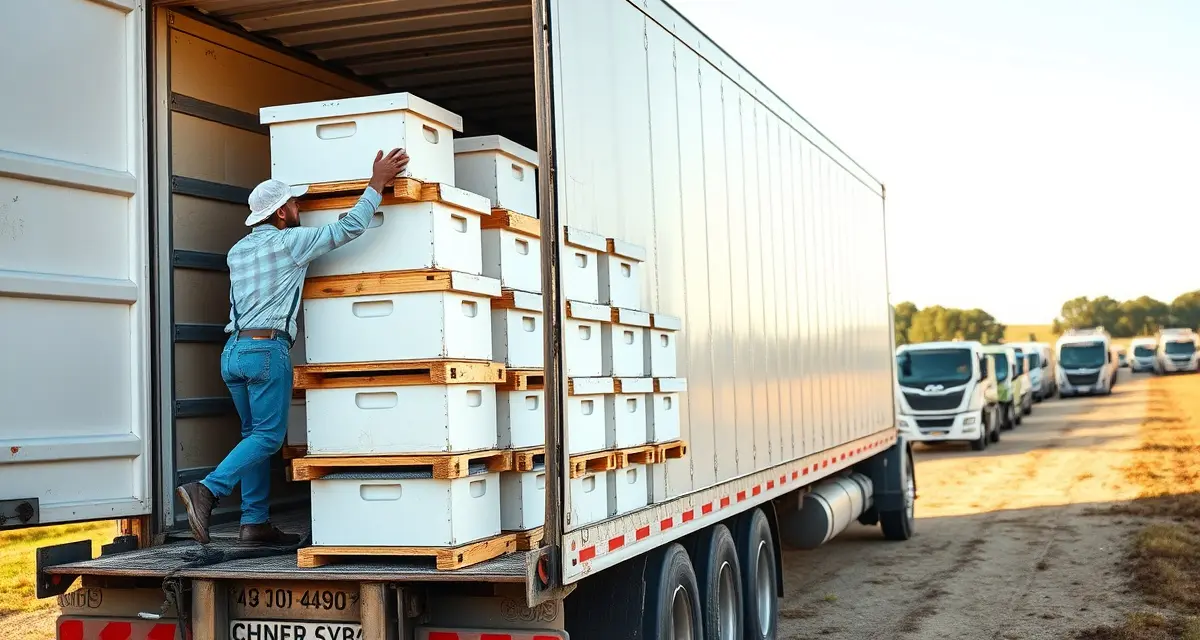
Load Planning for Migratory Beekeeping Operations
Overloaded or under-optimized trucks add an average of $1,200 per season in fuel waste per route. Multiply that across a fleet of three or four trucks running multiple routes through the season, and you're looking at $4,000-$5,000 in avoidable costs before you've considered the contract timing risks of getting load planning wrong.
Load planning for migratory beekeeping is part logistics, part regulatory compliance, and part contract management. Getting it right means every hive arrives on time, every truck runs within legal weight limits, and you're not paying for extra fuel miles from an inefficient sequence.
TL;DR
- Moving 1,000 hives to almonds requires 2-3 truck loads, with fuel costs of $3,500-5,000 per run at current California diesel prices.
- Loading at night when bees are clustered inside reduces escape and minimizes defensive behavior during transport.
- GPS-confirmed yard coordinates, not just addresses, should be in every contract to prevent access failures on delivery night.
- Load planning that sequences multiple drops on a single truck run reduces total miles driven per hive.
- fleet logistics coordination -- vehicle assignments, load manifests, and crew scheduling -- requires a structured system at 500+ hives.
What Load Planning Actually Involves
No competitor offers truck-capacity-aware load planning integrated with yard management the way PollenOps does. Generic logistics software handles route optimization. Yard management software handles hive counts. Neither connects these functions to bloom timing and contract deadlines in a single workflow.
Load planning for migratory beekeeping requires you to balance:
Hive count per truck. How many hives fit on your specific truck in your standard configuration, within state weight limits?
Hive weight. A hive heading to almonds in early February may be lighter than the same hive at the end of summer honey flow. Weight varies and affects how many hives you can legally carry.
Pallet configuration. 4-high vs 2-high, single vs double-wide. Different configurations affect how many fit and how they balance on the truck.
Route distance and timing. A 200-mile move has different operational constraints than a 1,000-mile move across three states.
Bloom timing. All of this planning has to produce an arrival that lands within your contracted delivery window aligned to bloom peak.
PollenOps move plan generator calculates optimal load sizes and routing based on your registered trucks. You input the move; the system tells you how many runs it takes, using your specific equipment configuration.
Calculating the Right Number of Hives Per Truck Load
Step 1: Know Your Truck's Rated Capacity
Your truck's rated capacity (GVWR, or gross vehicle weight rating) minus the truck's curb weight gives you your maximum payload. From that payload, subtract the weight of pallets, straps, and any equipment you carry.
The remainder is available for hive weight.
Step 2: Calculate Average Hive Weight
Hive weight varies throughout the year. A rough guide:
- Early spring (pre-bloom, no supers): 80-100 lbs per hive
- Mid-summer (supers on, active honey): 150-200 lbs per hive
- Fall (drawn out, heavy honey stores): 120-160 lbs per hive
Weigh a representative sample of your hives before planning loads, especially for long-distance moves.
Step 3: Calculate Hives Per Load
Divide your available payload by your average hive weight. This gives you maximum hives per load by weight. Then compare to your platform's physical space in your standard stacking configuration.
Use the lower of the two numbers. Don't plan loads at the weight limit. You need margin for variance. Plan at 90% of maximum.
Step 4: Calculate Number of Runs Required
Divide total contracted hive count by hives per load to get the number of truck runs. Round up. If your contract is 150 hives and your truck holds 70 per load, you need three runs, not two, because you can't leave 10 hives behind.
For hive movement tracking, each truck run is a separate check-out and check-in event in PollenOps. The system aggregates the runs into the total move event.
What Permits Do I Need to Move Hives Across State Lines?
This is the compliance layer that catches beekeepers off guard. Requirements vary by state and sometimes by species of concern in the origin region.
Health certificates. Required for interstate moves to most states. Your state's apiary inspector or veterinarian issues the health certificate, usually after a hive inspection. Plan for 1-2 weeks lead time. Check your state's requirements, as some states allow self-certification for experienced beekeepers.
Movement permits. Some states require advance notice or permit registration before hives enter. California, in particular, has specific requirements for hive entry related to Africanized bee monitoring.
Weight and dimension permits. If your loaded truck exceeds standard weight limits, you need an oversize/overweight permit for each state on your route. These are issued by state DOT departments and typically need 48-72 hours processing time.
Phytosanitary documentation. Some destination states require documentation certifying hives are free of specific diseases or pests.
PollenOps surfaces the relevant state requirements for each move based on your origin and destination states. The compliance checklist for each move auto-populates with the required permits and documentation so you know what to file before loading.
See also hive transport compliance for a detailed guide to interstate permit requirements by state.
How to Plan Loads for a 500-Mile Hive Relocation
Long-distance moves have operational considerations that short moves don't.
Pre-Move Assessment and Timing
For a 500-mile move, assess hives 24-48 hours before loading. Load at night or early morning when temperatures are cooler and bees are less active. Moving in cool conditions reduces heat buildup in the load and reduces bee mortality.
If you're crossing time zones, plan your arrival so hives can be unloaded in reasonable conditions rather than at midday in high heat.
Water and Feed Before Loading
Make sure hives have adequate feed and water before a long move. A colony that arrives stressed from dearth after a long transit is not going to perform at contract specifications.
Ventilation on the Truck
For long moves, ventilation matters as much as packing. Screened bottoms facing outward, adequate airspace between pallets, and route timing to avoid hot periods of the day all reduce transit stress.
Multiple-Day Moves
For moves exceeding 8-10 hours of driving, consider stopping at a registered yard for the day and completing the move the following night. Some states require bees to be off the truck within a specified number of hours.
Documentation for Each Leg
In PollenOps, each leg of a multi-day move is documented separately. The first day's travel from yard A to the stopover location is one move event. The second day from the stopover to the destination yard is another. The system maintains the full move chain in the movement log.
Building Load Efficiency Into Your Season Planning
The most efficient load planning happens at the season level, not the move level. When you build your full season move schedule in November or December, you can identify:
Opportunities to combine moves. Two moves in adjacent regions can sometimes be run by the same truck on a single trip, picking up from one yard and delivering to another on the same route.
Fleet requirements by period. How many trucks do you need during peak move periods? Can you supplement with a rental or a subcontractor for the two weeks of highest demand?
Timing conflicts. Two contract deliveries on the same date that require more runs than your fleet can handle. Better to know in December than in February.
For move planning software beekeeping at the season level, the integration with contract deadlines and bloom timing in PollenOps is what makes this seasonal planning practical. You're not planning moves in isolation. You're planning them as a coordinated system against real bloom windows.
FAQ
How do I calculate the right number of hives per truck load?
Calculate your available payload by subtracting truck curb weight and equipment from your GVWR. Divide by average hive weight (weigh a representative sample before loading) to get weight-limited capacity. Compare to your physical platform capacity in your standard stacking configuration. Use 90% of the lower number as your load target. Track load counts as hives are placed on the truck, not from inventory records, for accurate movement documentation.
What permits do I need to move hives across state lines?
At minimum: a health certificate issued by your state apiary inspector or veterinarian (required by most states). Many states also require movement permits or advance registration. If your loaded truck exceeds standard weight limits, you need oversize permits from each state DOT on your route. California has specific entry requirements including Africanized bee origin documentation. File permits at least one to two weeks before your planned move date. PollenOps compliance checklist surfaces the specific requirements for your origin and destination states.
How do I plan loads for a 500-mile hive relocation?
Assess hives 24-48 hours before loading. Load at night or early morning to minimize heat stress. Ensure adequate feed and water before departure. Plan ventilation on the truck for the transit duration. For moves exceeding 10 hours, plan a registered stopover yard rather than keeping bees confined on the truck for extended periods. Document each leg of the move separately in PollenOps so the full movement chain is preserved in your records. File all required permits for each state on the route at least one to two weeks in advance.
What is the standard approach for loading hives for overnight transport?
Load at night when bees are clustered inside, after temperatures have dropped below 60 degrees Fahrenheit. Secure entrances with foam or screened netting to prevent bee escape during transit. Use ventilation boards between layers for stacked hives to prevent heat buildup. Drive overnight to take advantage of cooler temperatures, which reduces stress on colonies during transport. Confirm GPS coordinates and truck access routes for every delivery yard before departure.
How do you track fleet movements and hive assignments across multiple delivery stops?
The practical requirement is a system that connects each truck assignment to specific hive pallets, which connect to specific yard locations, which connect to specific grower contracts. Paper manifests and phone calls work for a single delivery, but a 20-yard almond placement across 10 growers and 3 trucks requires digital coordination. PollenOps fleet module tracks load assignments, delivery sequencing, and yard confirmation in the same system as your contracts and health records.
What DOT requirements apply to commercial beekeeping trucks?
Commercial beekeeping vehicles hauling hives are subject to DOT regulations for commercial motor vehicles, including driver hours of service requirements, commercial driver license requirements for vehicles over 26,001 pounds GVWR, and vehicle inspection requirements. Some states have additional agricultural exception provisions that may apply to beekeeping operations. Consult with a transportation compliance specialist familiar with agricultural operations before your first large-scale move.
Try These Free Tools
Sources
- USDA Agricultural Research Service
- Bee Informed Partnership
- American Beekeeping Federation (ABF)
- USDA Animal and Plant Health Inspection Service (APHIS)
- American Honey Producers Association
Load Smart, Arrive Compliant
Every load that's planned correctly arrives on time, at the right weight, with the right documentation. That's the standard professional migratory operations hold themselves to.
Get Started with PollenOps
Moving hundreds of hives across multiple counties or states requires logistics coordination that goes beyond what a spreadsheet can manage reliably. PollenOps handles load planning, route scheduling, and crew assignments alongside your contract and yard records so your fleet operations are organized before the truck rolls.