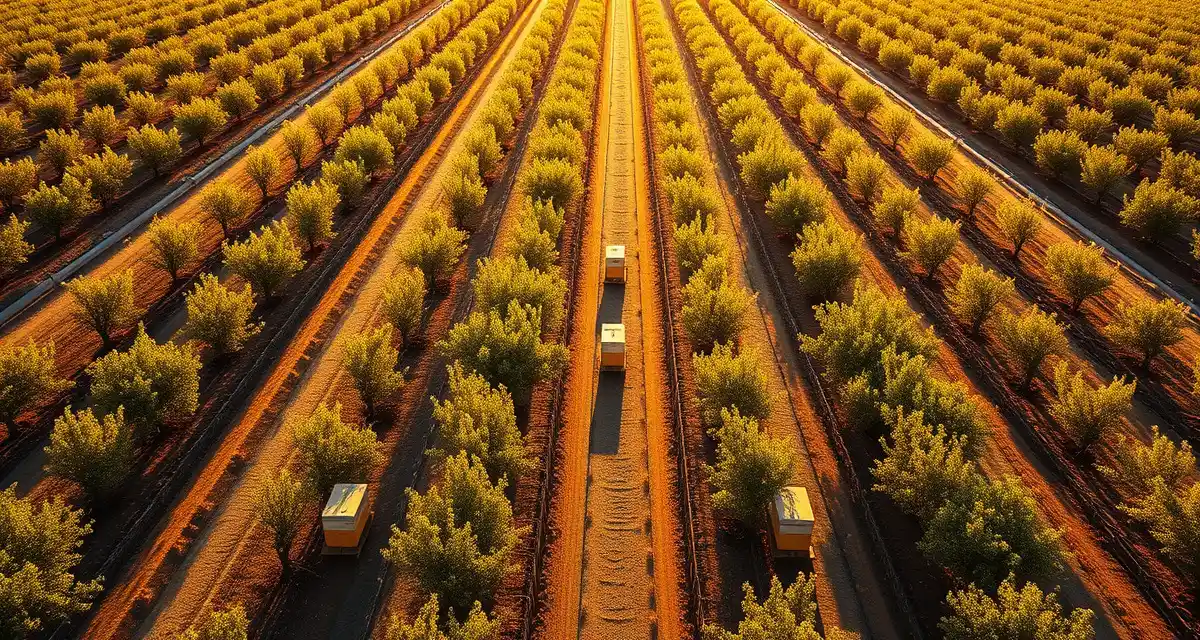
Water Availability and Almond Pollination: What Beekeepers Need to Know
California drought reduces almond acreage when water allocations are cut, affecting hive demand directly. Water rights and drought policy directly affect the long-term almond pollination market that commercial beekeepers depend on.
For a business built on California almond contracts, understanding the water situation is understanding the structural risk in your revenue base.
TL;DR
- California's primary commercial beekeeping role is shaped by its crop mix, climate, and position on the national pollination circuit.
- Pollination rates in California range $65-220/hive depending on crop depending on crop and colony strength requirements.
- Out-of-state operators entering California for pollination contracts must register with the state agricultural authority and obtain a Certificate of Health.
- California functions as either a primary pollination destination, a seasonal honey production location, or a transitional stop depending on the circuit.
- Tracking permit status, registration documents, and yard records for California operations requires organized record-keeping before the season opens.
How Water Drives Almond Acreage
Almond trees are perennial crops. Once planted, they represent 5-7 years of investment before reaching full production. Growers commit to water contracts and capital investment together: you don't plant almonds without a water plan.
California almond production depends on two primary water sources:
Surface water allocations: Water delivered through the Central Valley Project (federal) and State Water Project (state). Both systems are subject to year-to-year allocation cuts during drought. In severe drought years, some agricultural users receive 0% of their contracted surface water allocation.
Groundwater: The San Joaquin Valley sits over significant groundwater reserves that were historically used to supplement surface water during drought. However, the Sustainable Groundwater Management Act (SGMA), passed in 2014, requires groundwater sustainability by 2040. Basins must file sustainability plans; those that don't meet standards face state intervention.
SGMA is the structural water constraint that changes the long-term almond market. As groundwater extraction is curtailed to sustainable levels, some almond acreage on the west side of the San Joaquin Valley (primarily Fresno, Kings, and Tulare counties) will become economically unviable. Estimates from UC Cooperative Extension suggest 300,000-500,000 acres of San Joaquin Valley irrigated agriculture could come out of production as SGMA is implemented through 2030-2040.
The Impact on Hive Demand
If California almond acreage contracts significantly due to water constraints, hive demand contracts proportionally.
Current demand: 2.8-3.0 million hive rentals annually for 1.4-1.5 million bearing acres at 2 hives/acre.
Scenario 1 (mild water impact): 100,000 acres of almond removed from production over 10 years. Hive demand decreases by 200,000 placements. Rates may moderate but supply constraint remains.
Scenario 2 (significant water impact): 300,000 acres removed over 15 years. Hive demand decreases by 600,000 placements. Supply constraint eases significantly; rates face downward pressure.
Scenario 3 (severe water impact): 500,000 acres removed. Hive demand drops by 1 million placements. The supply-demand balance shifts. Rates face real pressure.
None of these scenarios eliminates the California almond pollination market. Even in Scenario 3, 900,000+ bearing acres remain, requiring 1.8 million hive rentals. That's still the largest single pollination market in US agriculture.
What Beekeepers Should Monitor
SGMA implementation progress: The State Water Resources Control Board and individual Groundwater Sustainability Agencies publish annual reports. Track which basins are in overdraft and which are on path to sustainability.
Almond acreage reports: USDA NASS publishes annual California almond acreage surveys. Bearing vs. non-bearing trends reveal whether the market is expanding or contracting.
Rate trends: If rates stop increasing or begin declining, it's a leading indicator that supply and demand are rebalancing.
Grower financial health: Growers on marginal water supplies are financial risks for payment. Track which growers have secure water rights and which depend on groundwater that may be curtailed.
Should Operators Diversify Away from California Almond Dependence?
The honest answer is: it depends on your time horizon.
In the next 5 years (2026-2030), the California almond market remains the strongest pollination opportunity in the US by a significant margin. Water constraints won't produce dramatic acreage reductions in this window.
Over 10-20 years, operators building businesses for the long term should diversify their circuit. Adding Pacific Northwest cherry and apple, eastern blueberry markets, and Plains-state summer circuits creates revenue diversification that reduces dependence on any single crop and region.
For almond pollination management in California and profitability analysis for commercial beekeeping, PollenOps revenue tracking helps you see exactly what percentage of your revenue depends on California almonds and model what diversification would look like for your operation.
Bloom Timing Effects of Drought
Water stress also affects bloom timing in individual orchards. Drought-stressed trees sometimes bloom earlier than well-watered trees in the same county. Conversely, water delivery cutoffs in late winter can sometimes cause stress-triggered delayed bloom.
These within-county timing variations are typically smaller than the county-level variation, but they're worth understanding for orchards where you know the grower is operating on restricted water.
Frequently Asked Questions
How does California drought affect almond pollination demand?
California drought reduces almond pollination demand when water allocation cuts lead growers to reduce irrigated acreage or when long-term groundwater constraints under SGMA force some almond orchards out of production. In the short term, a single drought year typically doesn't cause significant acreage reductions; growers tolerate reduced yields before removing established trees. Over a 5-10 year sustained drought, or as SGMA groundwater curtailments take effect, acreage reductions become more likely. Each 100,000 acres removed from almond production reduces hive demand by approximately 200,000 placements at the standard 2 hives/acre rate.
What happens to contract rates if almond acreage shrinks due to water?
If almond acreage declines meaningfully, the supply-demand gap that has driven rate increases narrows. With fewer orchard acres competing for the same colony count, the acute shortage eases and upward rate pressure moderates. A significant acreage reduction could stabilize rates or create modest downward pressure on current $185-$225 range prices. This effect would unfold over years, not seasons, giving operators time to adjust their business models. The offset is that SGMA water constraints may affect some colony-wintering regions too, potentially constraining supply alongside demand.
Should operators diversify away from California almond dependence?
For operations running 5 years or shorter time horizons, the California almond market remains the strongest single opportunity in US commercial pollination and doesn't warrant aggressive diversification. For operations building a business for 15+ years, building a multi-crop, multi-state circuit that includes Pacific Northwest tree fruit, eastern blueberry, and Plains honey production reduces the long-term risk of California almond demand contraction. A well-designed Pacific Coast and New England circuit can generate comparable annual revenue to a California-only model while spreading geographic and crop-specific risk.
What is the process for registering an out-of-state apiary in a new state?
Most states require out-of-state operators to register with the state department of agriculture apiary program before placing colonies. The process typically involves submitting a registration application (online or paper), paying a fee (usually $10-50 per location), and providing contact information for the operation. Some states also require the registration to be renewed annually. Contact the destination state's department of agriculture apiary program at least 60 days before your planned arrival to confirm current requirements.
What documentation do state apiary inspectors typically review?
State apiary inspectors review health certificates for out-of-state colonies, registration documentation, and colony inspection records during apiary visits. Inspectors check for signs of American foulbrood, European foulbrood, and other regulated pests and diseases. Operations with organized digital records that include treatment history and mite counts typically have faster, less complicated inspections than operations without documentation. Some state inspectors also verify that varroa mite loads are below state entry thresholds.
What triggers a state apiary inspection?
State apiary inspections can be triggered by routine inspection schedules (most states inspect a percentage of registered apiaries annually), neighbor or landowner complaints, disease reports from nearby operations, or inspection requirements tied to state entry permits. California, in particular, has the right to inspect incoming loads at port of entry for commercial beekeeping operations. Maintaining current registration and organized records makes required inspections faster and less disruptive.
Try These Free Tools
Sources
- USDA Agricultural Research Service
- Bee Informed Partnership
- American Beekeeping Federation (ABF)
- California Department of Agriculture
- Project Apis m.
Get Started with PollenOps
Commercial operations working in California face the same registration, permit, and documentation requirements as any state on the national circuit -- plus California's specific regulatory requirements. PollenOps tracks your California yard records, contract assignments, and permit documentation alongside your full operation, so entering a new state doesn't add a separate administrative burden. See how the platform fits operations working across multiple states.