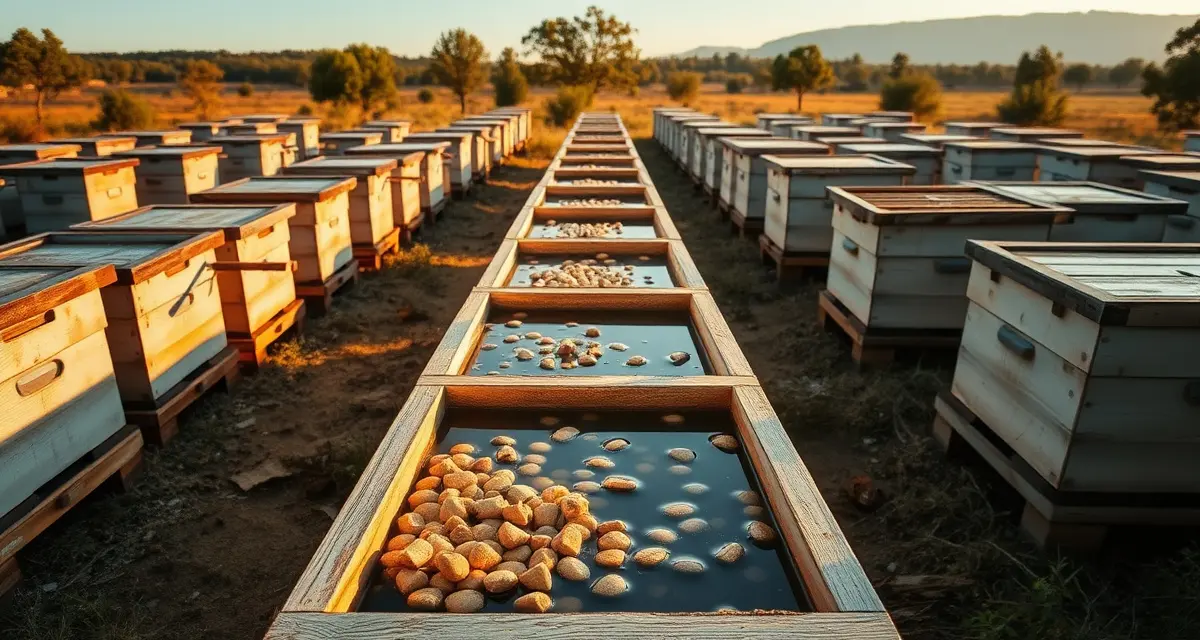
Water Management for Commercial Beekeeping Yard Sites
Water access is one of the most overlooked factors in commercial yard site selection, and it's one that creates real problems when it's ignored. A large commercial yard without adequate water supply will send foragers out to find water elsewhere. Those foragers will find your neighbor's birdbath, their stock tank, their swimming pool, or their irrigation system. That creates complaints, damages grower relationships, and in some cases creates genuine liability.
Large operations need roughly 1 to 2 gallons of water per colony per day during summer months when temperatures are high and colony populations are at peak. For a 500-hive yard, that's 500 to 1,000 gallons per day. Plan your water supply accordingly.
TL;DR
- Commercial beekeeping operations face two primary management challenges: operational logistics (hive health, transport, placement) and administrative coordination (contracts, payments, documentation).
- Most disputes and revenue losses in commercial beekeeping are preventable with better documentation and clearer contract terms.
- The operations that run most profitably are those with disciplined systems for tracking hive health, contract status, and fleet logistics in one place.
- PollenOps is built specifically for the operational complexity of commercial-scale pollination services, not adapted from a hobbyist tool.
- The most important management decisions (treatment timing, contract renewal, hive allocation) require accurate current data to make well.
Why Water Placement Matters
Bees will forage up to a mile for water if a reliable source isn't available close to the yard. But they have a strong preference for nearby sources. A water station within 50 yards of the yard will be heavily used, which reduces forager pressure on off-property water sources.
The other critical factor is training. Bees that have established a water source habit will continue using that source even when conditions change. If you want bees to use your supplied water station rather than the neighbor's drainage ditch, you need the water station in place and accessible before bees have a chance to find alternative sources.
Incorporating water source planning into your yard site selection checklist means you don't end up with an approved yard that becomes a neighbor relations problem three weeks into the season.
Water Station Options for Remote Yards
Remote commercial yards often lack piped water supply, which requires creative solutions.
Portable tanks and troughs: Agricultural water tanks in the 250 to 1,500 gallon range can be filled periodically and provide reliable supply for 1 to 4 weeks between refills depending on colony count and temperature. Position the trough with some shade to reduce evaporation. Float valves that maintain a consistent level work better than fixed-depth containers because they prevent the tank from going completely dry.
Barrel and pump systems: Some operators use agricultural water barrels set on elevated platforms so gravity feed maintains a trough at ground level. These are simple and reliable but require periodic truck-based resupply.
Natural sources with landing platforms: If a creek, pond, or irrigation ditch is available on the property, adding wooden landing boards or floating corks gives bees safe access without drowning risk. Position landing boards so bees approach from uphill or upwind of the open water.
Rainwater catchment: In areas with regular summer rain, a simple gutter and tank system on a covered storage shed or shelter can provide meaningful supplemental water supply. This works better as a supplement than as a primary source in dry summer conditions.
Preventing Off-Property Water Foraging
If neighbor water sources are a concern, your best tool is ensuring your on-property water supply is established and accessible before hives arrive. Site the water station in the direction away from the neighbor's property if possible.
For multiple yard coordination across a large operation, documenting water supply status at each yard location helps crew managers know which yards need resupply and which are relying on natural sources that may fluctuate during dry spells.
Water Quality Considerations
Bees prefer slightly mineralized water over distilled or RO-filtered water. Chlorinated municipal water from a spigot is used but some colonies will prefer natural water sources over treated water. Stagnant water is used more readily than clean fresh water, which is somewhat counterintuitive but real.
This preference for stagnant water means that even a well-designed water station that stays full and fresh may not fully prevent bees from using the neighbor's stale puddle. Managing the neighbor relationship directly is sometimes more effective than competing with a preferred natural source.
Dry Season Management
In arid regions, summer heat and drought can reduce or eliminate natural water sources that were present when you established a yard. Check water supply status on every yard visit during July and August. Colonies that have been relying on a seasonal water source that dried up will rapidly shift to off-property foraging and create problems quickly.
Frequently Asked Questions
How much water do commercial beehives need per day?
A colony of bees uses approximately 1 to 2 liters of water per day under normal summer conditions, with usage increasing in hot weather and when feeding brood. At commercial scale, a 500-hive yard may need 500 to 1,000 liters per day, which is 130 to 265 gallons. Over a week, that's 900 to 1,800 gallons for that single yard. When planning water supply for remote yard locations, use 2 gallons per hive per day as a conservative planning estimate during peak summer heat and scale your tank or trough capacity accordingly.
What water solutions work best for remote yard sites?
For remote yards without piped water, agricultural water tanks in the 250 to 500 gallon range placed on a simple timber base provide reliable supply when checked and refilled during routine yard visits. Float-valve-equipped livestock troughs that allow overflow and evaporation-based level maintenance are lower maintenance than open buckets. If any natural water source is available on the property, improve access with landing boards rather than competing against it. The most reliable remote yard water solution is one that can be checked at the same frequency as your normal yard visit schedule without requiring additional trips.
How do you prevent colonies from using neighbor water sources?
The most effective prevention is ensuring your water station is in place and accessible before hives arrive at a new yard. Bees trained to your water station from day one are less likely to explore off-property. If bees are already using a neighbor's source, the most practical approach is providing water closer to the yard and ensuring it has the slight mineral content bees prefer, which you can approximate by adding a small amount of salt or using non-distilled water. Completely eliminating off-property water foraging is difficult once the habit is established. Proactive source management at yard setup is far more effective than remediation.
What is the difference between commercial and hobby beekeeping?
Commercial beekeeping is distinguished by scale (typically 100+ hives, often 500-5,000+), revenue source (pollination contracts and bulk honey sales rather than local honey retail), and management approach (systematic protocols applied across yards rather than individual colony attention). Commercial operators manage bees as an agricultural enterprise, with the administrative, regulatory, and logistical complexity that entails. Most commercial operators derive the majority of their income from pollination services; honey production is a supplementary revenue stream.
How many hives are needed to make commercial beekeeping a full-time income?
Most beekeeping economists put the full-time commercial threshold at 500-800 hives, assuming efficient operations management and a combination of pollination and honey revenue. At 500 hives and $200/hive for almond pollination, almond season alone generates $100,000 in gross revenue before expenses. Net margins depend on operational efficiency, but well-run operations can achieve 30-50% net margins on pollination revenue. Additional crops and honey production improve per-hive economics but require additional management capacity.
What is the annual revenue potential for a 1,000-hive commercial operation?
A 1,000-hive operation running an almond season ($200/hive) plus blueberry or apple contracts ($80-100/hive) plus summer honey production ($25-40/hive after extraction costs) can generate $300,000-360,000 in annual gross revenue. Net margins after transport, crew, equipment, and hive replacement costs typically run 25-40% for well-managed operations, putting net income at $75,000-145,000 annually. The specific number depends heavily on circuit efficiency, loss rates, and contract quality.
Try These Free Tools
Sources
- USDA Agricultural Research Service
- Bee Informed Partnership
- American Beekeeping Federation (ABF)
- American Honey Producers Association
- Project Apis m.
Get Started with PollenOps
Managing a commercial beekeeping operation involves more data, more deadlines, and more moving parts than any general-purpose tool was designed to handle. PollenOps brings contracts, yard records, health documentation, and fleet logistics together in one platform built for the realities of commercial-scale beekeeping.