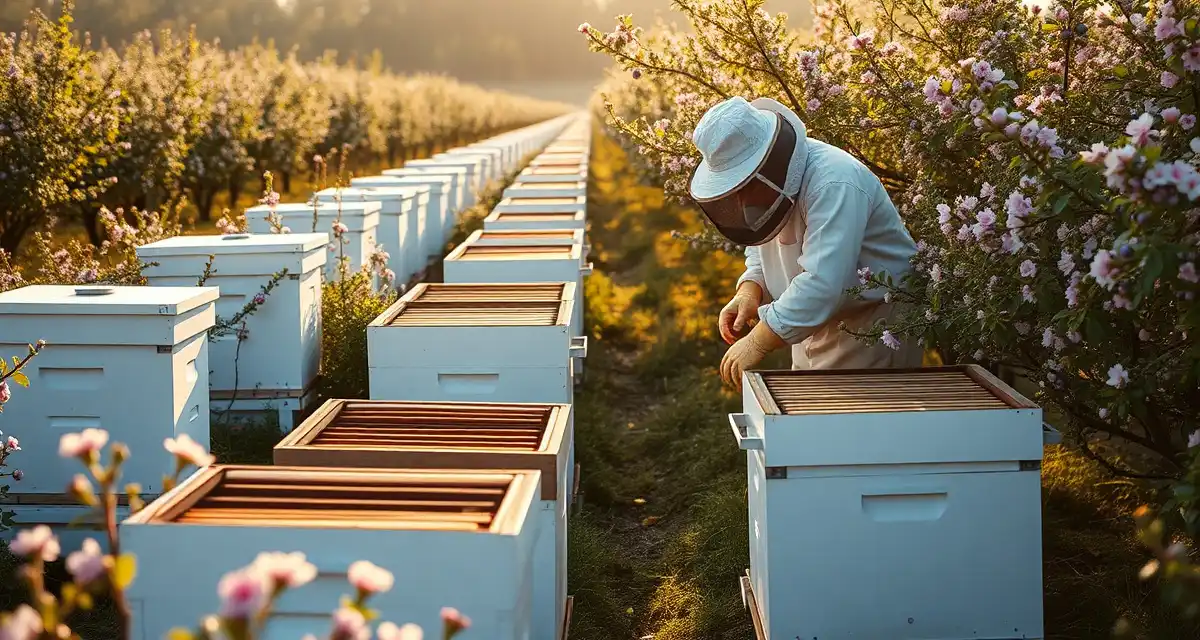
Pollination Service Management Software in the Southeast
Georgia is the top rabbiteye blueberry state in the US and one of the largest overall blueberry markets in the Southeast, with commercial production centered in the Alma, Homerville, and Waycross areas of south Georgia. For beekeepers working the Southeast circuit, Georgia blueberry in March is typically the first significant commercial pollination opportunity of the year, followed by cucurbit and vegetable contracts in April and May, and North Carolina and Virginia blueberry in late April and May.
The Southeast's bloom calendar runs approximately 8 weeks from early Georgia blueberry in March through Virginia apples in May, with multiple crop types overlapping in the middle of that window. Managing contracts across Georgia, Florida, North Carolina, and Virginia simultaneously requires county-level bloom timing calibration rather than a regional average, because the same crop blooms 3 to 5 weeks earlier in south Georgia than it does in the Virginia Piedmont.
TL;DR
- Commercial beekeeping operations face two primary management challenges: operational logistics (hive health, transport, placement) and administrative coordination (contracts, payments, documentation).
- Most disputes and revenue losses in commercial beekeeping are preventable with better documentation and clearer contract terms.
- The operations that run most profitably are those with disciplined systems for tracking hive health, contract status, and fleet logistics in one place.
- PollenOps is built specifically for the operational complexity of commercial-scale pollination services, not adapted from a hobbyist tool.
- The most important management decisions (treatment timing, contract renewal, hive allocation) require accurate current data to make well.
Southeast Pollination Crop Calendar
The Southeast's commercial pollination season progresses northward through the spring:
Early March (south Georgia, north Florida): Rabbiteye and southern highbush blueberry bloom in the Georgia wiregrass region and north Florida. Georgia's Atkinson and Bacon counties are among the earliest commercial blueberry markets in the country. Florida blueberry in Alachua and Bradford counties follows closely. This is the first significant commercial pollination market of the calendar year for most operators positioned in the Deep South.
Late March to early April (central Georgia, South Carolina): Mid-season blueberry markets in central Georgia and the South Carolina coastal plain. Cucurbit contracts (cucumber, squash, watermelon) also begin in this window as growers in Georgia, Alabama, and Mississippi start field plantings.
April (North Carolina, Virginia): North Carolina rabbiteye and southern highbush blueberry bloom in the Onslow, Pender, and Bladen County production areas. Virginia blueberry follows in the southeastern tidewater counties.
Late April to May (Virginia, Tennessee, Kentucky apples): Apple bloom in the Shenandoah Valley and adjacent orchards. Tennessee and Kentucky apple production is limited but provides additional regional contracts for operators based in the mid-South.
Georgia Blueberry Market Details
Georgia's blueberry market has grown substantially in the past decade, with commercial acreage expanding from south Georgia into the coastal plain and middle Georgia regions. The wiregrass region centered around Alma and Homerville remains the production core.
Georgia rabbiteye blueberry growers typically require 2 to 4 hives per acre depending on native pollinator presence and orchard age. Younger plantings with less established native habitat tend toward higher density requirements. Rates in Georgia run $65 to $90 per hive for rabbiteye contracts, with southern highbush contracts sometimes reaching $90 to $110 per hive due to the higher crop value.
Georgia requires a certificate of inspection from your home state before entering with hives. Georgia's Department of Agriculture has specific entry requirements that have changed in recent years; confirm current requirements each season with the Georgia Department of Agriculture before moving hives into the state.
North Carolina Blueberry and Transition
North Carolina's commercial blueberry production is concentrated in the southeastern coastal plain counties, particularly Bladen, Columbus, Pender, and Onslow. The University of North Carolina has been a significant driver of southern highbush variety development, and North Carolina growers have been among the early adopters of high-density planting systems that require more hives per acre for maximum yield.
North Carolina blueberry rates run $75 to $100 per hive. Colony strength requirements are typically 5 to 7 frames of bees, consistent with the broader Southeast commercial market standard.
After North Carolina blueberry, operators positioned in the region have several summer options: continue north to Mid-Atlantic blueberry in New Jersey (late May to June), transition to cucurbit contracts in the Carolina Piedmont and Virginia, or move toward the mid-Atlantic berry markets.
Managing Cucurbit Contracts in the Southeast
Southeast cucurbit pollination (cucumber, squash, watermelon, and cantaloupe) starts in south Georgia and Florida in March and moves north through Georgia, Alabama, Mississippi, and into the Carolinas through May. The season is longer geographically than the blueberry season because field plantings are staggered by grower and because the same operator can serve successive regional markets as planting dates progress northward.
Cucurbit contracts in the Southeast run $45 to $75 per hive, lower than blueberry rates but with shorter placement periods and less demanding strength requirements. At 0.5 to 1 hive per acre, a 100-acre watermelon contract requires 50 to 100 hives and generates $2,250 to $7,500 in contract revenue. Multiple simultaneous cucurbit contracts in a regional cluster can be efficient to service if yard distances are manageable.
PollenOps bloom timing alerts for Southeast cucurbit contracts fire on planting date plus growing degree day accumulation rather than on phenological bloom cues, since planted cucurbits don't have visible bloom prior to field placement. The alert triggers when field planting data indicates bloom onset is approaching based on the crop's development curve.
The bloom timing alerts documentation covers how PollenOps handles crop-specific trigger logic. For contract management across the full Southeast circuit, see the pollination contract software overview.
Frequently Asked Questions
When does blueberry bloom start in Georgia?
Georgia rabbiteye and southern highbush blueberry bloom starts in early March in the southernmost production areas around Alma, Homerville, and Waycross. In warm years, the earliest south Georgia orchards can reach bloom in late February. The bloom progresses northward, with middle Georgia orchards blooming in mid-March and northeastern Georgia reaching bloom in late March. North Carolina's coastal plain blueberry follows Georgia by 3 to 5 weeks, with peak bloom typically in mid to late April. PollenOps Southeast bloom alerts fire on local county weather station data for each contracted location rather than a regional average, so south Georgia alerts fire before north Georgia alerts, and North Carolina alerts fire when North Carolina conditions specifically are approaching the bloom trigger.
How do I manage contracts for both cucurbits and blueberries in the Southeast?
Treat blueberry and cucurbit contracts as overlapping rather than strictly sequential in the Southeast. Early Georgia blueberry runs in March; cucurbit contracts begin in earnest in late March and April. An operator with both can serve blueberry contracts first, then transition hives to cucurbit placements as blueberry bloom completes and cucurbit fields reach the placement trigger. The transition logistics work well geographically: south Georgia blueberry growers and south Georgia cucurbit growers are often in similar counties. The key is tracking removal dates for blueberry contracts so you know exactly when those hives are available for cucurbit placement. PollenOps shows both contract types on the same dashboard so you can see removal status and upcoming placement alerts together.
What permits are needed for moving hives into Georgia from Florida?
Georgia requires a certificate of inspection issued by a certified apiary inspector in your home state before entering Georgia with bees. The certificate must be current (typically dated within 30 days of the move) and must attest to the absence of American Foulbrood and other regulated diseases. Florida-based operators must obtain the certificate from a Florida Department of Agriculture certified inspector before crossing into Georgia. Georgia's Department of Agriculture entry requirements can change year to year; contact the Georgia Department of Agriculture's Plant Protection Division before your first seasonal move to confirm current documentation requirements and any recent changes to inspection standards.
What is the difference between commercial and hobby beekeeping?
Commercial beekeeping is distinguished by scale (typically 100+ hives, often 500-5,000+), revenue source (pollination contracts and bulk honey sales rather than local honey retail), and management approach (systematic protocols applied across yards rather than individual colony attention). Commercial operators manage bees as an agricultural enterprise, with the administrative, regulatory, and logistical complexity that entails. Most commercial operators derive the majority of their income from pollination services; honey production is a supplementary revenue stream.
How many hives are needed to make commercial beekeeping a full-time income?
Most beekeeping economists put the full-time commercial threshold at 500-800 hives, assuming efficient operations management and a combination of pollination and honey revenue. At 500 hives and $200/hive for almond pollination, almond season alone generates $100,000 in gross revenue before expenses. Net margins depend on operational efficiency, but well-run operations can achieve 30-50% net margins on pollination revenue. Additional crops and honey production improve per-hive economics but require additional management capacity.
What is the annual revenue potential for a 1,000-hive commercial operation?
A 1,000-hive operation running an almond season ($200/hive) plus blueberry or apple contracts ($80-100/hive) plus summer honey production ($25-40/hive after extraction costs) can generate $300,000-360,000 in annual gross revenue. Net margins after transport, crew, equipment, and hive replacement costs typically run 25-40% for well-managed operations, putting net income at $75,000-145,000 annually. The specific number depends heavily on circuit efficiency, loss rates, and contract quality.
Try These Free Tools
Sources
- USDA Agricultural Research Service
- Bee Informed Partnership
- American Beekeeping Federation (ABF)
- American Honey Producers Association
- Project Apis m.
Get Started with PollenOps
Managing a commercial beekeeping operation involves more data, more deadlines, and more moving parts than any general-purpose tool was designed to handle. PollenOps brings contracts, yard records, health documentation, and fleet logistics together in one platform built for the realities of commercial-scale beekeeping.