Foraging Range Mapping to Prevent Hive Overlap
Here's something that doesn't make it into many beekeeping conversations: your neighbors can hurt your contracts without either of you doing anything wrong.
When two operations place hives close enough that their foraging zones overlap, you're both splitting the available forage. Less forage per colony means weaker colonies. Weaker colonies means underperforming contracts. And underperforming contracts mean unhappy growers, disputed invoices, and a harder renewal conversation next season.
Foraging overlap between operations reduces per-hive honey yield by an estimated 15-25%. For pollination performance, the effect on colony strength and foraging intensity is real enough that some growers have started specifying minimum separation distances in their contracts.
TL;DR
- Commercial beekeeping operations face two primary management challenges: operational logistics (hive health, transport, placement) and administrative coordination (contracts, payments, documentation).
- Most disputes and revenue losses in commercial beekeeping are preventable with better documentation and clearer contract terms.
- The operations that run most profitably are those with disciplined systems for tracking hive health, contract status, and fleet logistics in one place.
- PollenOps is built specifically for the operational complexity of commercial-scale pollination services, not adapted from a hobbyist tool.
- The most important management decisions (treatment timing, contract renewal, hive allocation) require accurate current data to make well.
How Far Do Honeybees Forage?
Honeybees typically forage within a 1 to 2 mile radius of the hive under normal conditions. When forage is abundant, most foraging stays within a half mile or so. When forage is sparse, bees will travel up to 5 miles, but at significant energy cost to the colony.
For practical planning purposes, use a 2-mile radius as your baseline. That's the zone where meaningful competition for forage begins. For placement sites in areas with dense beekeeper activity, like the Central Valley during almond season, the calculation gets more complex because dozens of operations are concentrated in a small geographic area.
The key point is that foraging range is not a theoretical concern. It's a measurable, plannable factor that affects your hive performance and your contract outcomes.
Why Foraging Overlap Is a Bigger Problem in Some Markets
In almond season, the density of hive placements across the Central Valley means some degree of overlap is unavoidable. Growers space orchards, beekeepers concentrate bees at orchard edges, and the landscape determines what happens next. The industry has adapted to this through placement timing and hive density standards.
But in berry and fruit tree markets, where placements are more spread out and the landscape has more diverse forage options, unexpected overlap can have a more direct negative effect. A beekeeper who parks 200 hives a mile upwind of your 300-hive yard during cherry season is pulling foragers in both directions.
This is especially relevant if you're new to an area. Established operators often have informal territorial understandings that aren't obvious until you accidentally park in someone else's zone.
Mapping Your Foraging Footprint
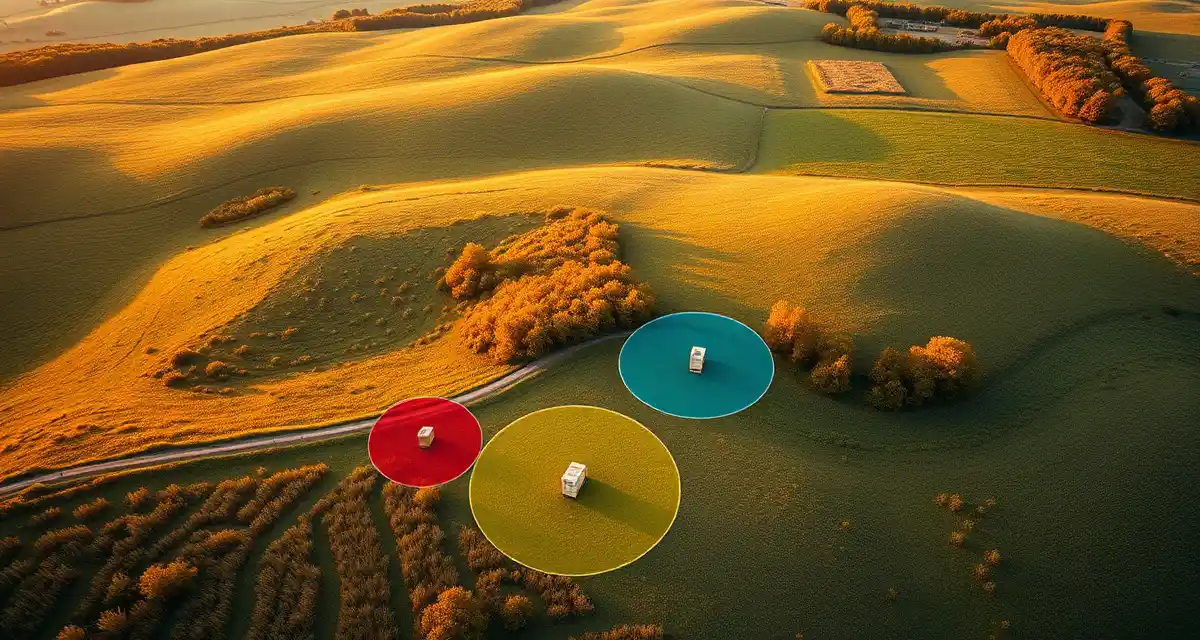
The first step is knowing where your yards are and visualizing their foraging radius. PollenOps GPS yard tracking pins every yard to a map and can display a foraging radius overlay around each location. When you're looking at a map with 20 yards and their associated foraging zones, overlap becomes immediately visible.
The overlap alert in PollenOps fires when two registered yards, including yards registered to other users in the same operation, fall within a shared foraging radius. This matters for operations with multiple employees or multiple trucks, where yard placement decisions might be made independently without a full view of where every other yard sits.
Preventing Overlap with Neighboring Operations
You can't always control what other beekeepers do, but you can protect yourself in a few ways:
Choose yard sites with natural separation. Mountains, rivers, highways, and large urban areas all create natural foraging boundaries. A yard on one side of a ridge is effectively isolated from a yard on the other side.
Communicate with neighboring operators. Many experienced migratory beekeepers have informal networks. Knowing who else is working a region and roughly where they're placing bees helps you avoid conflicts before they happen.
Check public apiary registrations. Most states maintain a registry of registered apiaries with approximate locations. It's not always current, but it's a starting point for understanding what operations are already active in an area.
Build foraging radius mapping into your yard planning process. Before you commit to a new yard location, map it against your existing placements and any known neighboring operations. Finding a conflict on a map is much cheaper than discovering it after your bees are already on site.
Does Foraging Overlap Affect Pollination Contract Performance?
Yes, and here's how it shows up in practice. When foraging competition is high, colonies reduce foraging intensity. Bees that would otherwise be working the contracted orchard may be competing for whatever other forage is available nearby. Growers notice when hive activity looks lower than expected during peak bloom.
The grower's concern is pollination effectiveness, not whose fault the competition is. If your bees aren't visibly working the trees at the density the contract calls for, you'll hear about it. And if you can't point to a foraging radius map that shows your yard was correctly sited, the conversation is harder to win.
Documenting your foraging radius planning before placement, and keeping that documentation in your contract record, gives you a defensible position if a grower raises performance questions later.
Using Foraging Range Mapping for New Yard Selection
The best use of foraging range mapping is proactive: before you agree to a new yard location, run the analysis. Check:
- Distance from your other active yards (avoid self-competition)
- Proximity to any known operations in the area
- Availability of diverse forage within the foraging zone
- Distance from the contracted crop (closer is generally better for pollination intensity)
This doesn't have to be complex. A quick radius check on your yard map, combined with a conversation with local beekeepers or a look at state registration records, is usually enough to identify obvious conflicts before you commit.
Frequently Asked Questions
How far do honeybees forage from a hive?
Honeybees typically forage within a 1 to 2 mile radius under normal conditions, though they can travel up to 5 miles when forage is scarce. For yard planning and overlap prevention, a 2-mile radius is the standard working assumption. In dense forage environments, most activity stays within half a mile of the hive.
How do I prevent my bees from overlapping with a neighboring beekeeper's foraging zone?
Map your yard locations with foraging radius overlays before committing to new placements. Choose sites with natural separation barriers when possible. Build communication with other operators in areas you work regularly. Use public apiary registration records to identify established operations in your target areas. PollenOps overlap alerts flag when any two yards in your account fall within a shared foraging radius.
Does foraging overlap affect pollination contracts performance?
Yes. When foraging competition is elevated, bees reduce foraging intensity and may work less actively in the contracted crop. Growers see this as reduced hive activity during bloom. Documenting your foraging radius planning before placement gives you a defensible record if contract performance is questioned. Selecting yard sites that minimize overlap is one of the more reliable ways to protect your contract outcomes.
What is the difference between commercial and hobby beekeeping?
Commercial beekeeping is distinguished by scale (typically 100+ hives, often 500-5,000+), revenue source (pollination contracts and bulk honey sales rather than local honey retail), and management approach (systematic protocols applied across yards rather than individual colony attention). Commercial operators manage bees as an agricultural enterprise, with the administrative, regulatory, and logistical complexity that entails. Most commercial operators derive the majority of their income from pollination services; honey production is a supplementary revenue stream.
How many hives are needed to make commercial beekeeping a full-time income?
Most beekeeping economists put the full-time commercial threshold at 500-800 hives, assuming efficient operations management and a combination of pollination and honey revenue. At 500 hives and $200/hive for almond pollination, almond season alone generates $100,000 in gross revenue before expenses. Net margins depend on operational efficiency, but well-run operations can achieve 30-50% net margins on pollination revenue. Additional crops and honey production improve per-hive economics but require additional management capacity.
What is the annual revenue potential for a 1,000-hive commercial operation?
A 1,000-hive operation running an almond season ($200/hive) plus blueberry or apple contracts ($80-100/hive) plus summer honey production ($25-40/hive after extraction costs) can generate $300,000-360,000 in annual gross revenue. Net margins after transport, crew, equipment, and hive replacement costs typically run 25-40% for well-managed operations, putting net income at $75,000-145,000 annually. The specific number depends heavily on circuit efficiency, loss rates, and contract quality.
Try These Free Tools
Sources
- USDA Agricultural Research Service
- Bee Informed Partnership
- American Beekeeping Federation (ABF)
- American Honey Producers Association
- Project Apis m.
Get Started with PollenOps
Managing a commercial beekeeping operation involves more data, more deadlines, and more moving parts than any general-purpose tool was designed to handle. PollenOps brings contracts, yard records, health documentation, and fleet logistics together in one platform built for the realities of commercial-scale beekeeping.